
We read your photo as:
Suggest a strategy to obtain the anti-Markovnikov alcohol selectively from an alkene, name reagents conditions and outline the key mechanistic idea. Recommend one synthetic route to convert an alkene
ScanSolve AI Answer
Step-by-step solution
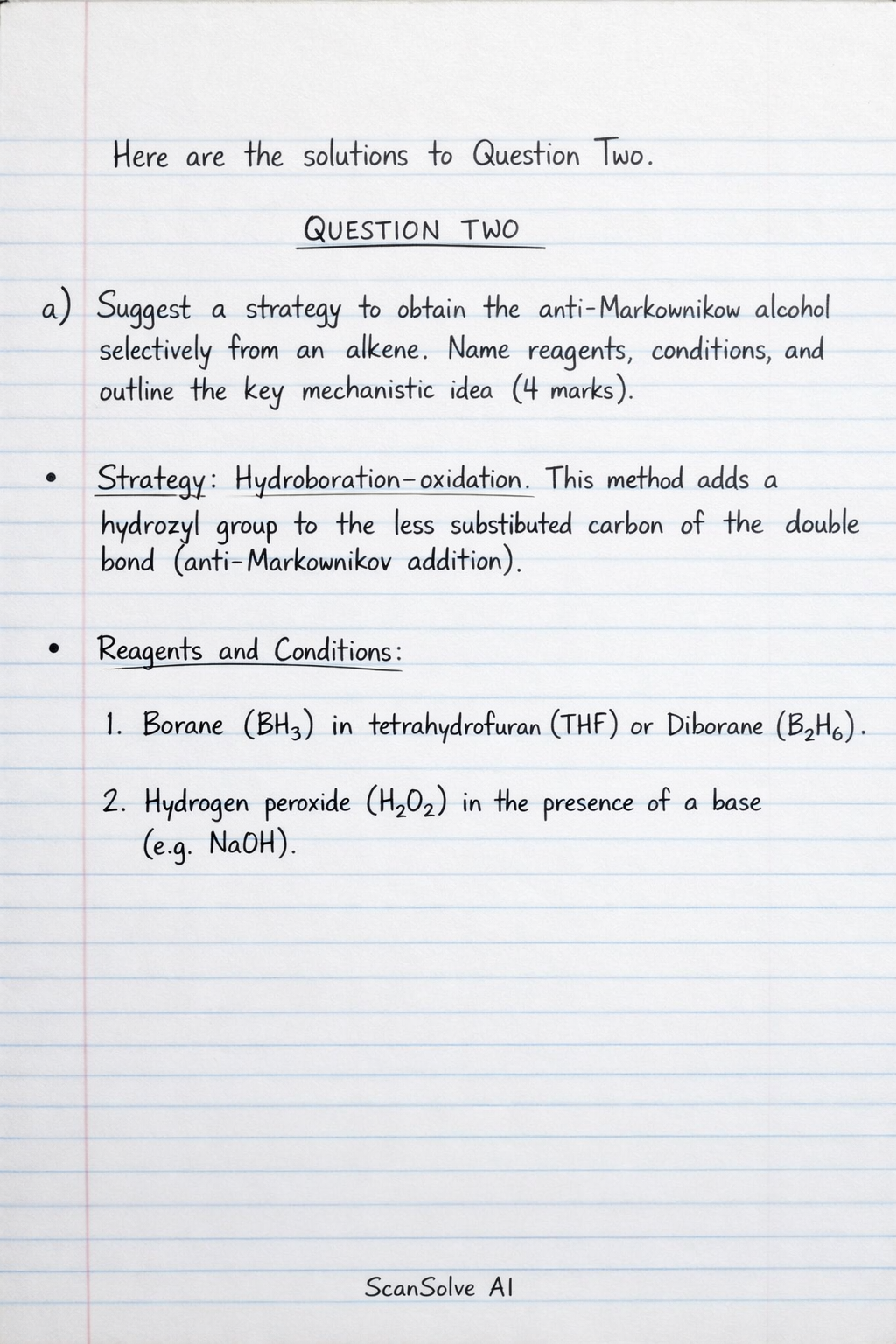
2 stepsHere are the solutions to Question Two.
QUESTION TWO
Part a
Suggest a strategy to obtain the anti-Markovnikov alcohol selectively from an alkene. Name reagents conditions and outline the key mechanistic idea (4 marks)
-
Strategy: Hydroboration-oxidation. This method adds a hydroxyl group to the less substituted carbon of the double bond (anti-Markovnikov addition).
-
Reagents and Conditions:
- Borane () in tetrahydrofuran () or diborane ().
- Hydrogen peroxide () in the presence of a base (e.g., ).
-
Key Mechanistic Idea:
- In the first step, borane adds to the alkene in a syn fashion, with the boron atom attaching to the less sterically hindered (less substituted) carbon of the double bond and a hydrogen atom attaching to the more substituted carbon. This is a concerted, four-membered transition state.
- In the second step, the alkylborane intermediate undergoes oxidation and hydrolysis, replacing the boron atom with a hydroxyl group, also with retention of stereochemistry. This results in the overall anti-Markovnikov addition of water across the double bond.
Part b· 2 steps
The R&D team wants a diol instead of an alcohol. Recommend one synthetic route to convert an alkene into a diol and outline the mechanism (4 marks)
-
Synthetic Route: Syn-dihydroxylation using osmium tetroxide () followed by a reducing agent.
-
Reagents and Conditions:
- (catalytic amount) and (N-methylmorpholine N-oxide) as a co-oxidant, or (stoichiometric amount).
- or (for workup if stoichiometric is used).
-
Mechanism:
The alkene reacts with to form a cyclic osmate ester intermediate.
This is a concerted syn addition, meaning both oxygen atoms from add to the same face of the double bond.
The osmate ester is then hydrolyzed (e.g., by ) to yield the syn-diol, where both hydroxyl groups are added to the same face of the original double bond.
The osmium catalyst is regenerated.
Part c
Design a quick lab test to confirm whether the feedstock contains an alkene. State the expected observations and the conclusions that can be drawn (4 marks)
-
Lab Test: Bromine water test.
-
Procedure: Add a few drops of reddish-brown bromine water ( in water or ) to a small sample of the feedstock in a test tube. Shake gently.
-
Expected Observations:
- If an alkene is present, the reddish-brown color of the bromine water will rapidly disappear (decolorize).
- If no alkene is present (e.g., an alkane), the reddish-brown color will persist.
-
Conclusions:
- Decolorization of bromine water: This indicates the presence of a carbon-carbon double bond (alkene) in the feedstock. The bromine undergoes an addition reaction across the double bond, consuming the colored and forming a colorless dibromoalkane.
- No change in color: This indicates the absence of a carbon-carbon double bond, suggesting the feedstock is saturated (e.g., an alkane) or contains functional groups that do not react with bromine under these conditions.
Still stuck on this one?
Ask a follow-up, and the answer starts from this question.
More Chemistry Questions
Handwritten Step-by-Step Solution
Get this as a handwritten image on WhatsApp — like a tutor wrote it for you.
Try on WhatsApp