
We read your photo as:
Identify the products of fermentation and dehydration of ethanol, and describe the conditions for fermentation and the reagents for reduction and decarboxylation.
ScanSolve AI Answer
Answer
Step-by-step solution
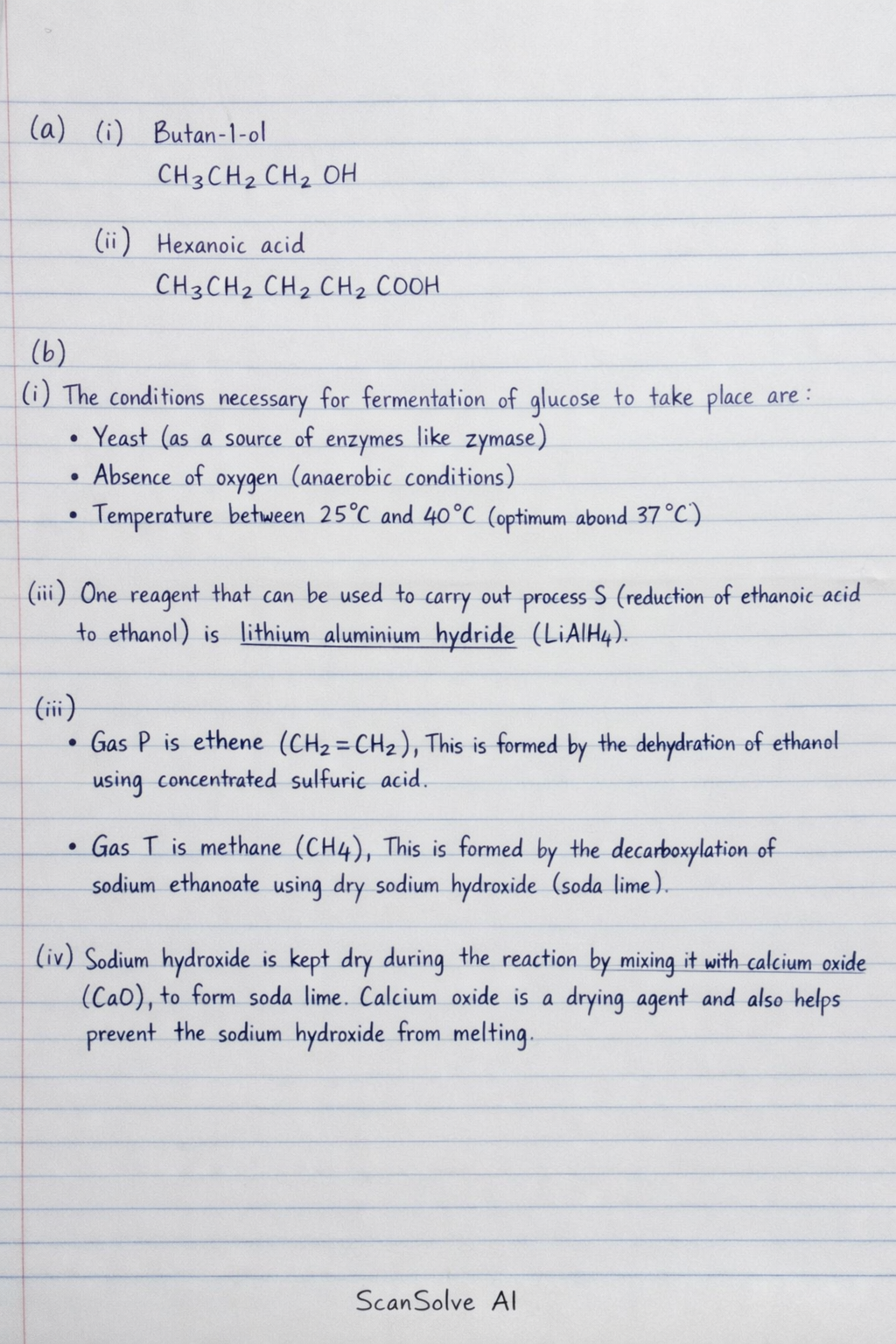
3 stepsPart a(i)
Butan-1-ol
Part a(ii)
Hexanoic acid
Part b(i)
The conditions necessary for fermentation of glucose to take place are
- Yeast (as a source of enzymes like zymase)
- Absence of oxygen (anaerobic conditions)
- Temperature between and (optimum around )
Part b(ii)
One reagent that can be used to carry out process S (reduction of ethanoic acid to ethanol) is lithium aluminium hydride ().
Part b(iii)
- Gas P is ethene (). This is formed by the dehydration of ethanol using concentrated sulfuric acid.
- Gas T is methane (). This is formed by the decarboxylation of sodium ethanoate using dry sodium hydroxide (soda lime).
(iv) Sodium hydroxide is kept dry during the reaction by mixing it with calcium oxide () to form soda lime. Calcium oxide is a drying agent and also helps prevent the sodium hydroxide from melting.
Part c
Calculate the molar mass of ethanol ().
Molar mass of .
Using approximate atomic masses (C=12, H=1, O=16):
Molar mass of .Calculate the number of moles of ethanol in 1 litre.
Given that 1 litre of ethanol has a mass of 780 g.
Calculate the total heat energy released.
Given that 1 mole of ethanol releases 1370 kJ of heat energy.
Rounding to three significant figures:
Try one yourself
A new problem that tests the same skill.
Still stuck on this one?
Ask a follow-up, and the answer starts from this question.
More Chemistry Questions
Handwritten Step-by-Step Solution
Get this as a handwritten image on WhatsApp — like a tutor wrote it for you.
Try on WhatsApp