
We read your photo as:
Identify the reactant and reaction conditions.
ScanSolve AI Answer
Answer
Step-by-step solution
5 stepsIdentify the reactant and reaction conditions.
The reactant is phenyl benzoate, which consists of two benzene rings connected by an ester linkage. The reaction conditions are , which indicates nitration, an electrophilic aromatic substitution reaction.
Analyze the directing effects of the substituents on each benzene ring.
Phenyl benzoate has the structure .
Let's label the two benzene rings:- Ring 1 (Benzoyl part): This ring is directly attached to the carbonyl carbon (). The -COOR group is an electron-withdrawing group by resonance and induction. It deactivates the benzene ring towards electrophilic substitution and is a meta-director.
- Ring 2 (Phenolic part): This ring is directly attached to the oxygen atom of the ester linkage. The -OR group (where R is the acyl group) is an electron-donating group by resonance (due to the lone pairs on oxygen). It activates the benzene ring towards electrophilic substitution and is an ortho-para director.
Determine which ring will undergo nitration.
Electrophilic aromatic substitution reactions preferentially occur on the more activated benzene ring. Since Ring 2 (phenolic part) is activated and Ring 1 (benzoyl part) is deactivated, the nitration will occur on Ring 2.
Determine the position of nitration on the activated ring.
The -OR group is an ortho-para director. Between the ortho and para positions, the para position is generally the major product due to less steric hindrance.
Select the correct product from the given options.
Based on the analysis, the nitro group () should be introduced at the para position of the phenolic ring (the ring attached to the oxygen atom).
- (a) Shows nitration on the meta position of the benzoyl ring (incorrect).
- (b) Shows nitration on the para position of the benzoyl ring (incorrect).
- (c) Shows nitration on the para position of the phenolic ring (correct).
- (d) Shows nitration on the meta position of the phenolic ring (incorrect).
Therefore, option (c) represents the major product.
The final answer is
Try one yourself
A new problem that tests the same skill.
Still stuck on this one?
Ask a follow-up, and the answer starts from this question.
More Chemistry Questions
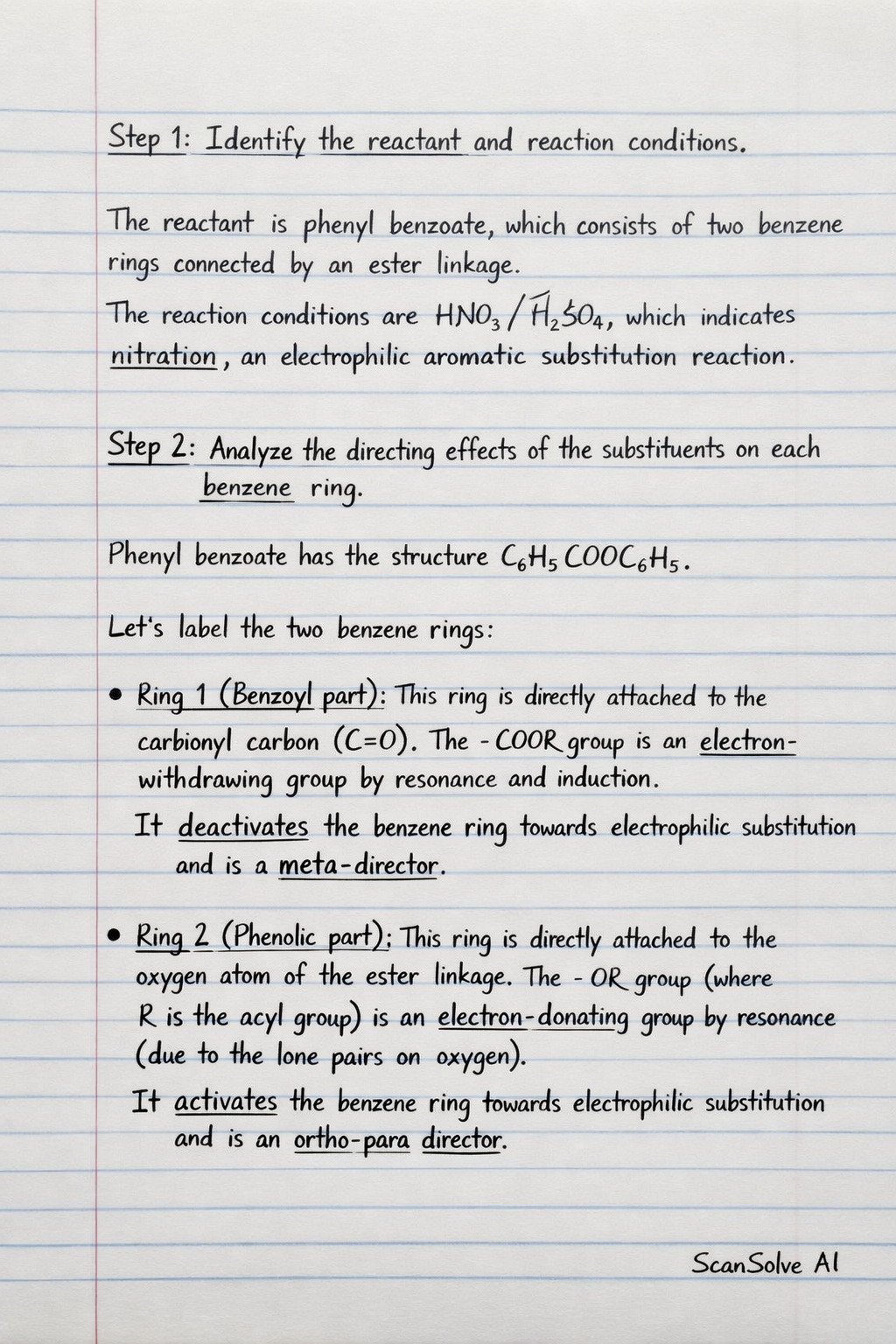
Handwritten Step-by-Step Solution
Get this as a handwritten image on WhatsApp — like a tutor wrote it for you.
Try on WhatsApp