

This chemistry question involves key chemical concepts and calculations. The detailed solution below walks through each step, from identifying the reaction type to computing the final answer.
ScanSolve AI Answer
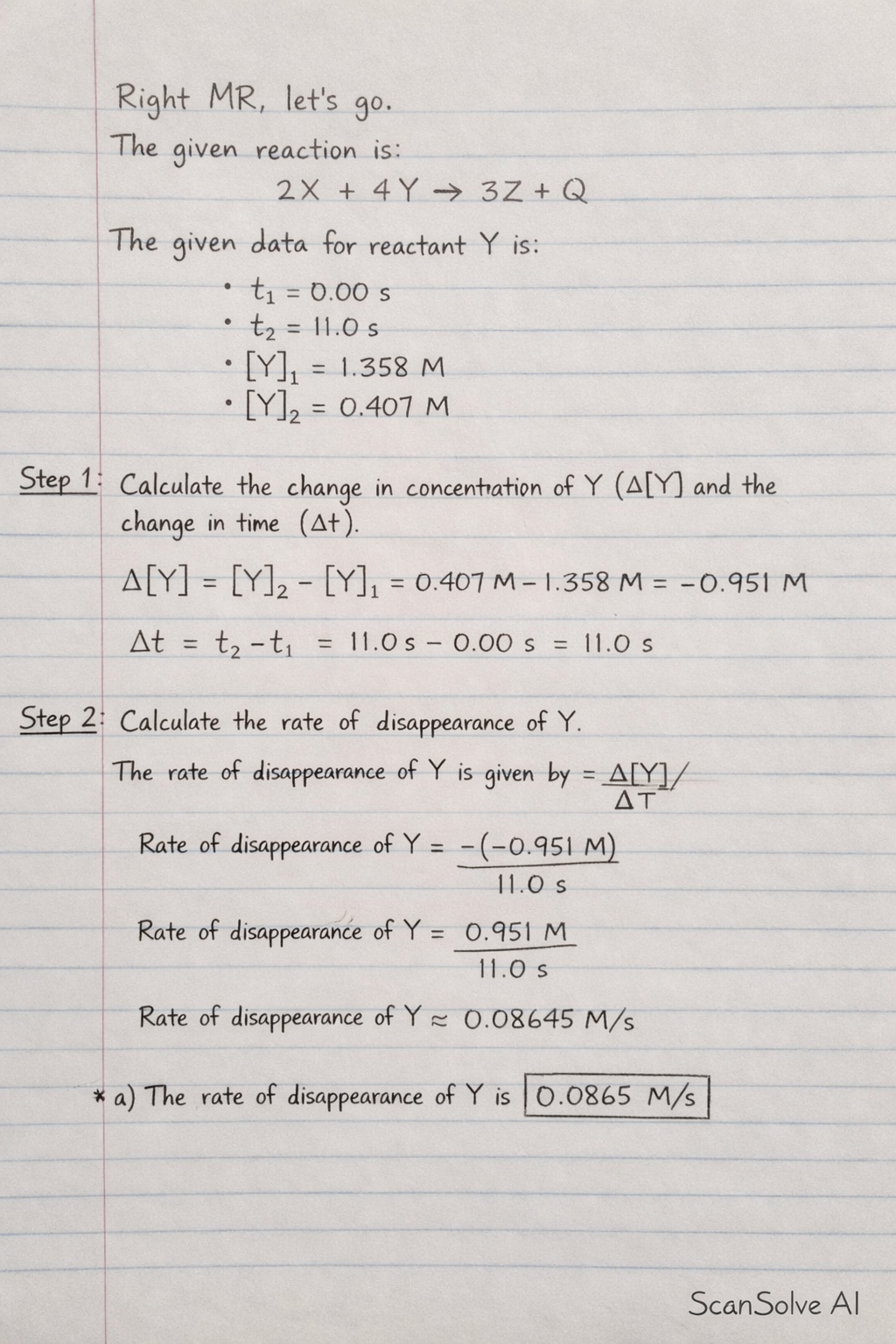
The given reaction is: 2X + 4Y → 3Z + Q The given data for reactant Y is: Initial time (t_1) = 0.00 s Final time (t_2) = 11.0 s Initial concentration of Y ([Y]_1) = 1.358 M Final concentration of Y ([Y]_2) = 0.407 M Step 1: Calculate the change in concentration of Y ([Y]) and the change in time ( t). [Y] = [Y]_2 - [Y]_1 = 0.407 M - 1.358 M = -0.951 M t = t_2 - t_1 = 11.0 s - 0.00 s = 11.0 s Step 2: Calculate the rate of disappearance of Y. The rate of disappearance of Y is given by -([Y])/( t). Rate of disappearance of Y = --0.951 M11.0 s = 0.951 M11.0 s Rate of disappearance of Y ≈ 0.08645 M/s a) The rate of disappearance of Y is 0.0865 M/s Step 3: Calculate the rate of disappearance of X. From the stoichiometry of the reaction (2X and 4Y), the relationship between their rates is: -(1)/(2)([X])/( t) = -(1)/(4)([Y])/( t) Rate of disappearance of X = -([X])/( t) = (2)/(4) (-([Y])/( t)) = (1)/(2) × (Rate of disappearance of Y) Rate of disappearance of X = (1)/(2) × 0.08645 M/s ≈ 0.043225 M/s b) The rate of disappearance of X is 0.0432 M/s Step 4: Calculate the rate of appearance of Z. From the stoichiometry of the reaction (4Y and 3Z), the relationship between their rates is: (1)/(3)([Z])/( t) = -(1)/(4)([Y])/( t) Rate of appearance of Z = ([Z])/( t) = (3)/(4) (-([Y])/( t)) = (3)/(4) × (Rate of disappearance of Y) Rate of appearance of Z = (3)/(4) × 0.08645 M/s ≈ 0.0648375 M/s c) The rate of appearance of Z is 0.0648 M/s Step 5: Calculate the rate of appearance of Q. From the stoichiometry of the reaction (4Y and 1Q), the relationship between their rates is: (1)/(1)([Q])/( t) = -(1)/(4)([Y])/( t) Rate of appearance of Q = ([Q])/( t) = (1)/(4) (-([Y])/( t)) = (1)/(4) × (Rate of disappearance of Y) Rate of appearance of Q = (1)/(4) × 0.08645 M/s ≈ 0.0216125 M/s d) The rate of appearance of Q is 0.0216 M/s Step 6: Calculate the overall rate of reaction. The overall rate of reaction is defined as: Overall Rate = -(1)/(2)([X])/( t) = -(1)/(4)([Y])/( t) = (1)/(3)([Z])/( t) = (1)/(1)([Q])/( t) Using the rate of disappearance of Y: Overall Rate = -(1)/(4)([Y])/( t) = (1)/(4) × (Rate of disappearance of Y) Overall Rate = (1)/(4) × 0.08645 M/s ≈ 0.0216125 M/s e) The overall rate of reaction is 0.0216 M/s Send me the next one 📸