

This chemistry question involves key chemical concepts and calculations. The detailed solution below walks through each step, from identifying the reaction type to computing the final answer.
ScanSolve AI Answer
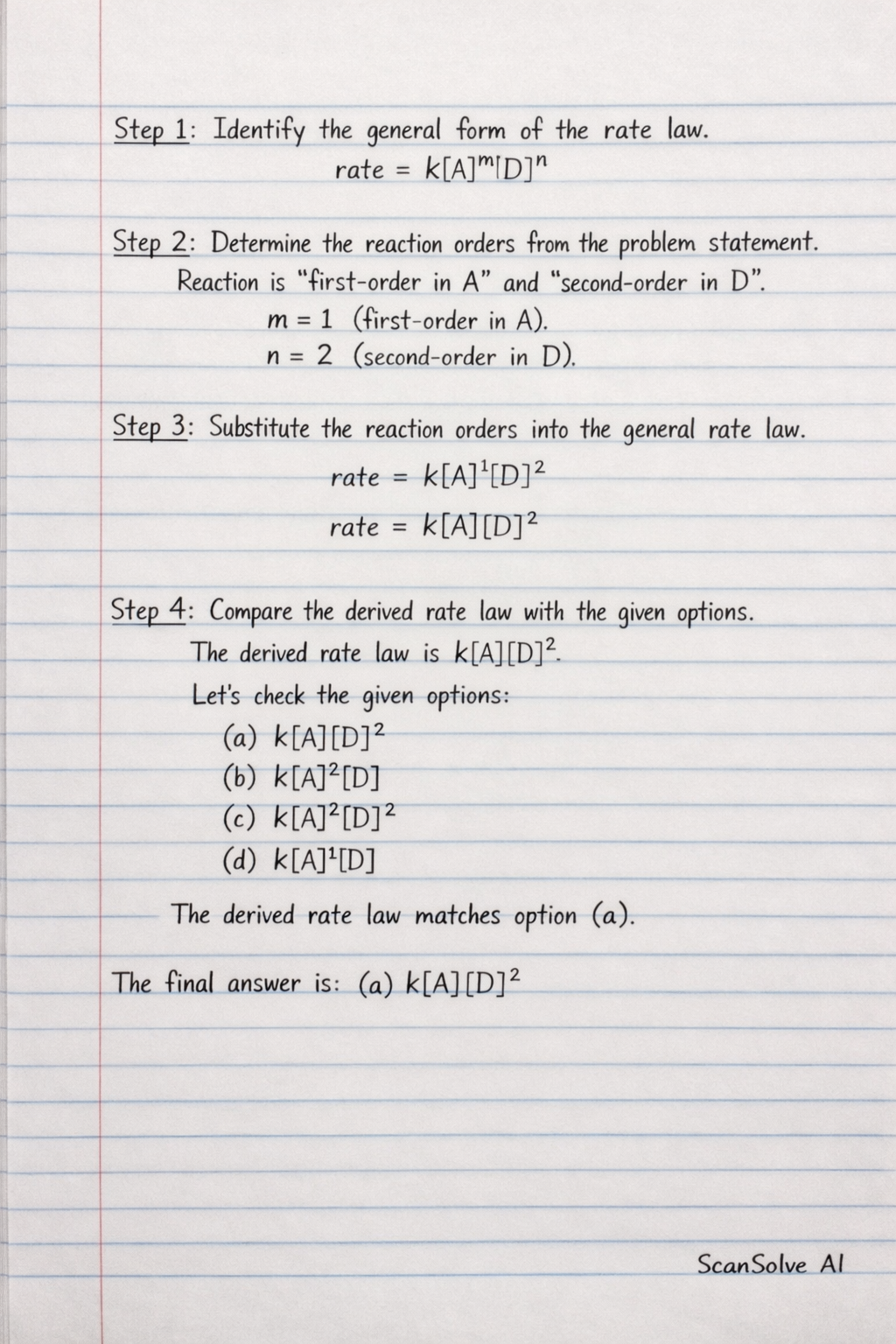
Step 1: Identify the general form of the rate law. The general rate law for a reaction involving reactants A and D is given by: rate = k[A]^m[D]^n where k is the rate constant, [A] and [D] are the concentrations of reactants A and D, and m and n are the reaction orders with respect to A and D, respectively. Step 2: Determine the reaction orders from the problem statement. The problem states that the reaction is "first-order in A" and "second-order in D". This means: • The order with respect to A, m, is 1. • The order with respect to D, n, is 2. Step 3: Substitute the reaction orders into the general rate law. Substitute m=1 and n=2 into the rate law equation: rate = k[A]^1[D]^2 This simplifies to: rate = k[A][D]^2 Step 4: Compare the derived rate law with the given options. The derived rate law is k[A][D]^2. Let's check the given options: (a) k[A][D]^2 (b) k[A]^2[D] (c) k[A]^2[D]^2 (d) k[A][D] The derived rate law matches option (a). The final answer is (a) k[A][D]^2. Send me the next one 📸