
We read your photo as:
In a science experiment, you are asked to dissolve 1 teaspoon of different substances into 50 mL of water. List the factors or variables that could lead to an inaccurate result. Is this a fair test?
Chemistry
ScanSolve AI Answer
Step-by-step solution
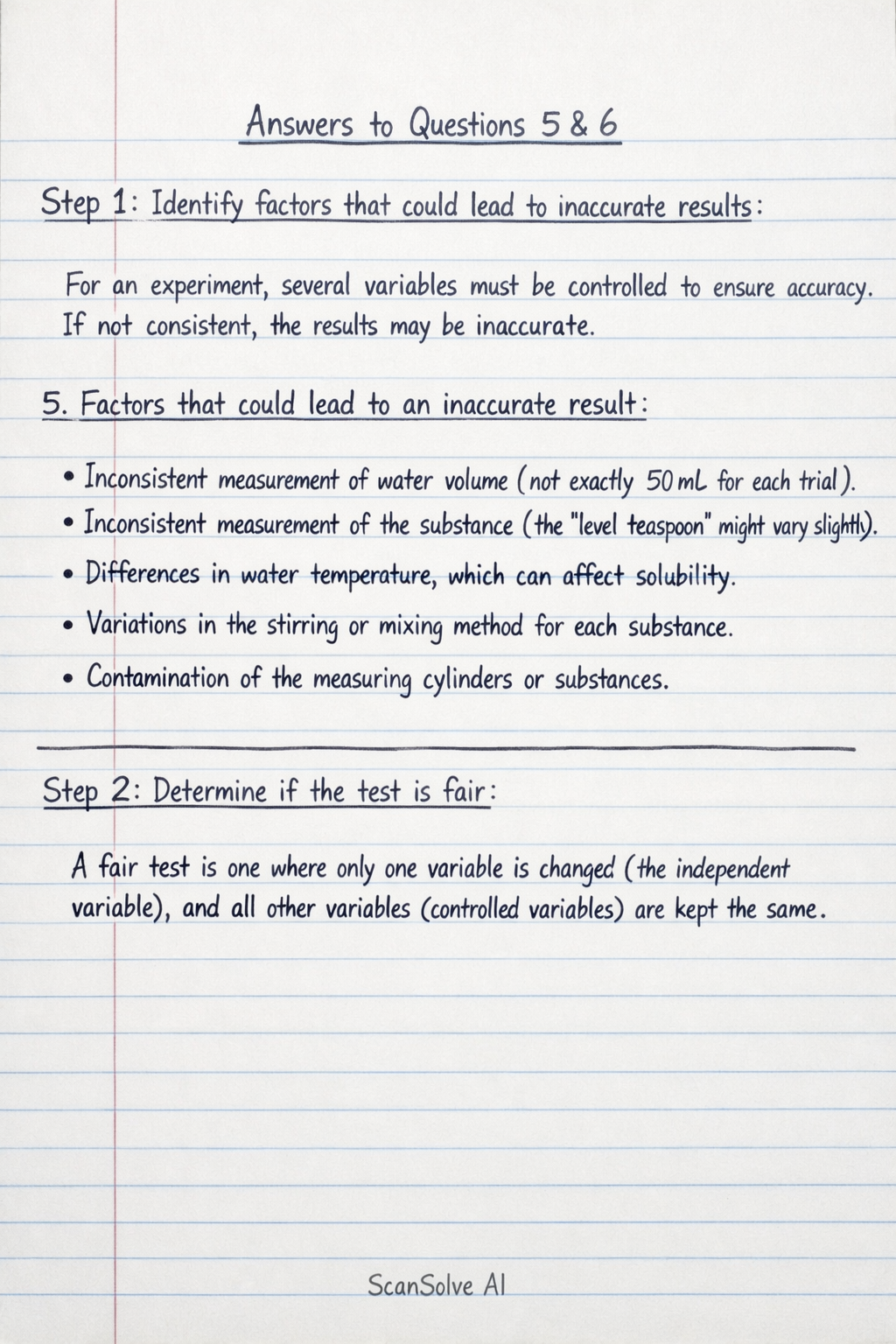
2 stepsHere are the answers to questions 5 and 6 based on the provided instructions:
Identify factors that could lead to inaccurate results.
For an experiment involving mixing substances with water, several variables need to be controlled to ensure accuracy. If these are not consistent, the results may be inaccurate.
- 5. List the factors or variables that could lead to an inaccurate result.
- Inconsistent measurement of water volume (not exactly 50 mL for each trial).
- Inconsistent measurement of the substance (the "level teaspoon" might vary slightly).
- Differences in water temperature, which can affect solubility.
- Variations in the stirring or mixing method for each substance.
- Contamination of the measuring cylinders or substances.
- 5. List the factors or variables that could lead to an inaccurate result.
Determine if the test is fair.
A fair test is one where only one variable is changed (the independent variable), and all other variables (controlled variables) are kept the same.
- 6. Is this a fair test?
Yes, this is designed to be a fair test because the instructions specify controlling two key variables:
- The volume of water (50 mL) is kept constant.
- The amount of each substance (one level teaspoon) is kept constant. This allows for a direct comparison of how different substances interact with water under similar conditions.
- 6. Is this a fair test?
Yes, this is designed to be a fair test because the instructions specify controlling two key variables:
Was this helpful?
Still stuck on this one?
Ask a follow-up, and the answer starts from this question.
Got a different question?Ask your own question
More Chemistry Questions
QPerform the following tests on sample R and record your observations. (a) Dissolve half of sample R…QDescribe laboratory apparatus and explain the concept of solubility, including factors affecting it…QA student is diluting concentrated sulfuric acid and preparing to test its properties. The…QIdentify laboratory apparatus and define solubility, explaining factors affecting it and how to…QIdentify laboratory apparatus and explain the concept of solubility and factors affecting it.
Handwritten Step-by-Step Solution
Get this as a handwritten image on WhatsApp — like a tutor wrote it for you.
Try on WhatsApp