
We read your photo as:
In an electrolysis, a current of 200 A was passed through molten oxide of metal Q for 58 minutes and 64.8 g of the metal deposited. Determine: i) Charge on metal Q ii) The volume of oxygen gas produce
ScanSolve AI Answer
Step-by-step solution
8 stepsHere's the solution to question 4:
4. In an electrolysis, a current of was passed through molten oxide of metal Q for 58 minutes and of the metal deposited. Determine:
i) Charge on metal Q
ii) The volume of oxygen gas produced at standard temperature and pressure (STP). (Q = 27, , molar gas volume at STP = )
Calculate the total charge passed.
The current and time .
Convert time to seconds:The total charge is given by .
Calculate the moles of metal Q deposited.
The molar mass of metal Q is given as .
The mass of metal Q deposited is .Determine the charge on metal Q.
According to Faraday's laws of electrolysis, the charge required to deposit one mole of a metal is , where is the charge on the metal ion and is Faraday's constant ().
The total charge passed is and of metal Q was deposited.
So, .The charge on metal Q is approximately 3.
Therefore, the metal ion is .i) Charge on metal Q:
The charge on metal Q isWrite the half-reaction for the deposition of metal Q.
Write the half-reaction for the production of oxygen gas.
In molten oxide electrolysis, the oxide ions () are oxidized at the anode to produce oxygen gas.
Calculate the moles of electrons transferred.
From Step 3, we know that of ions required 3 moles of electrons per mole of Q.
Alternatively, using the total charge:
We will use for consistency with the calculated charge on Q.
Calculate the moles of oxygen gas produced.
From the half-reaction for oxygen production, of electrons produce of .
Calculate the volume of oxygen gas produced at STP.
At STP, of any gas occupies .
ii) The volume of oxygen gas produced at standard temperature and pressure (STP):
The volume of oxygen gas produced is
Still stuck on this one?
Ask a follow-up, and the answer starts from this question.
More Chemistry Questions
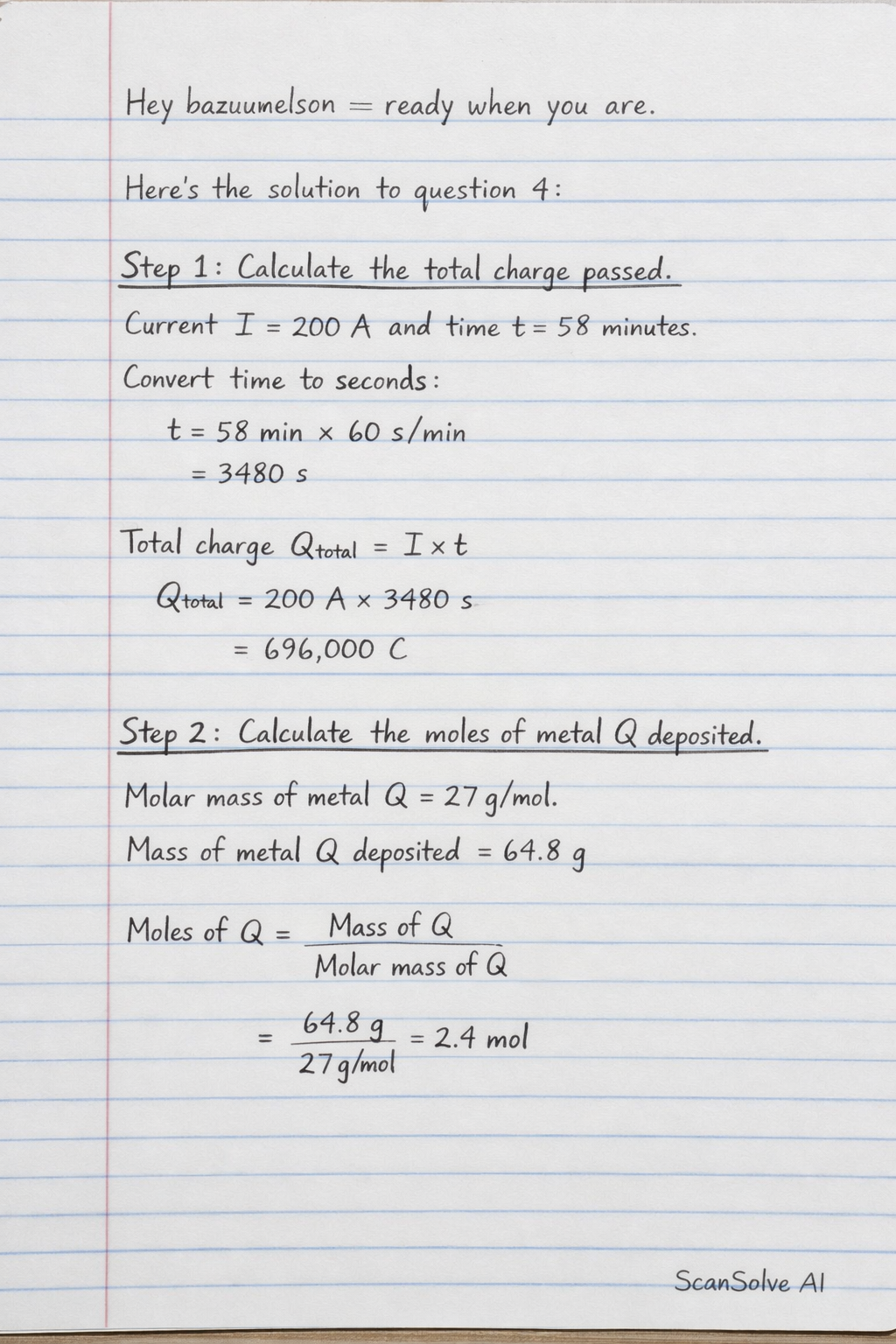
Handwritten Step-by-Step Solution
Get this as a handwritten image on WhatsApp — like a tutor wrote it for you.
Try on WhatsApp