

This chemistry question involves key chemical concepts and calculations. The detailed solution below walks through each step, from identifying the reaction type to computing the final answer.
ScanSolve AI Answer
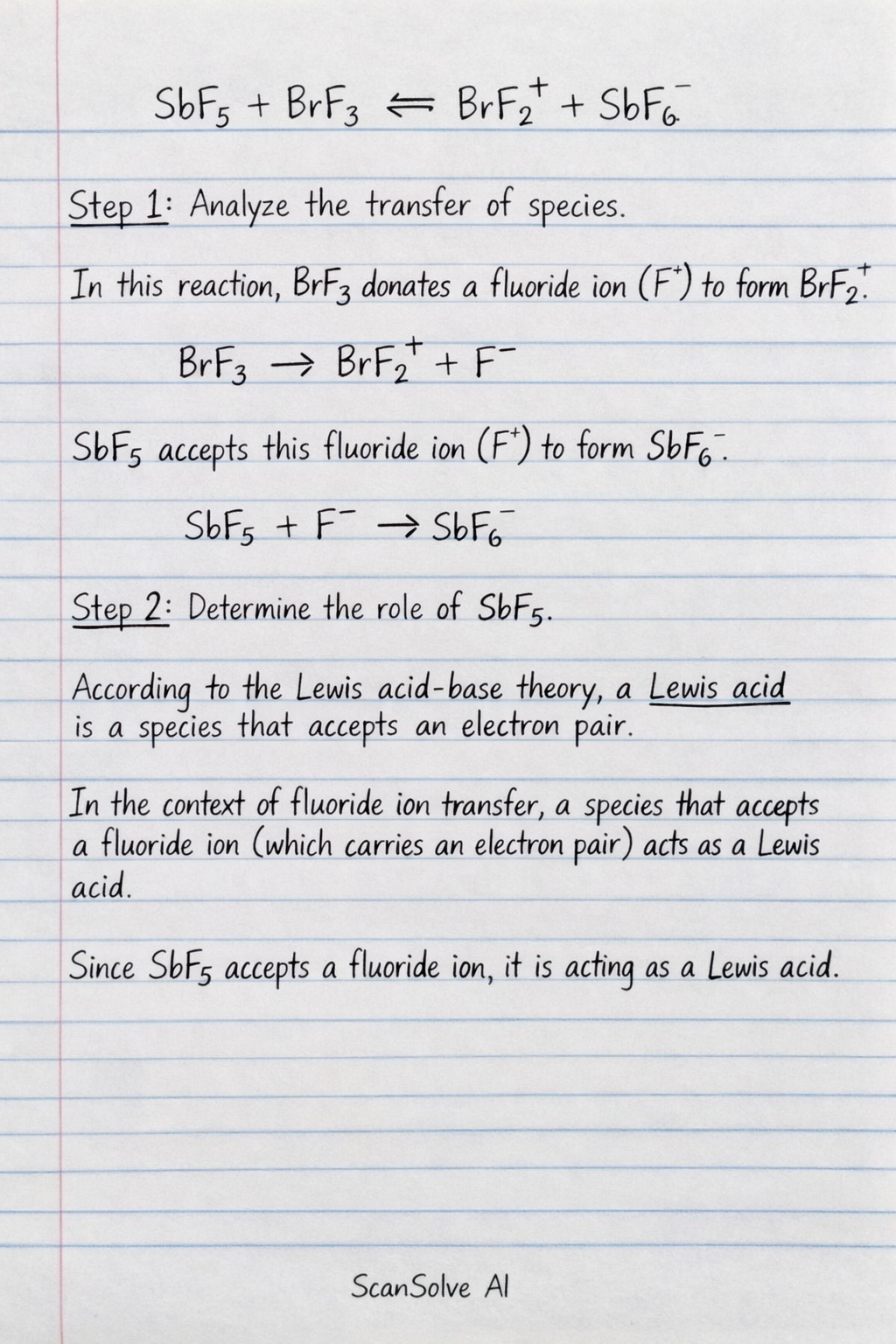
In the given reaction: SbF_5 + BrF_3 BrF_2^+ + SbF_6^- Step 1: Analyze the transfer of species. In this reaction, BrF₃ donates a fluoride ion (F⁻) to form BrF₂⁺. BrF_3 → BrF_2^+ + F^- SbF₅ accepts this fluoride ion (F⁻) to form SbF₆⁻. SbF_5 + F^- → SbF_6^- Step 2: Determine the role of SbF₅. According to the Lewis acid-base theory, a Lewis acid is a species that accepts an electron pair. In the context of fluoride ion transfer, a species that accepts a fluoride ion (which carries an electron pair) acts as a Lewis acid. Since SbF₅ accepts a fluoride ion, it is acting as a Lewis acid. Step 3: Compare with the given options. A: buffer - A buffer resists changes in pH. This is not the primary role here. B: indicator - An indicator signals the presence of a substance or a change in conditions. This is not the role here. C: base - A base is an electron pair donor or a proton acceptor. SbF₅ is an acceptor, not a donor. D: acid - An acid is an electron pair acceptor or a proton donor. SbF₅ acts as an electron pair acceptor (specifically, a fluoride ion acceptor), which classifies it as an acid (Lewis acid). The correct option is D. The final answer is D:acid. What's next? 📸