
We read your photo as:
Describe the industrial extraction of aluminium by electrolysis, including the role of cryolite and the reactions at the electrodes.
ScanSolve AI Answer
Answer
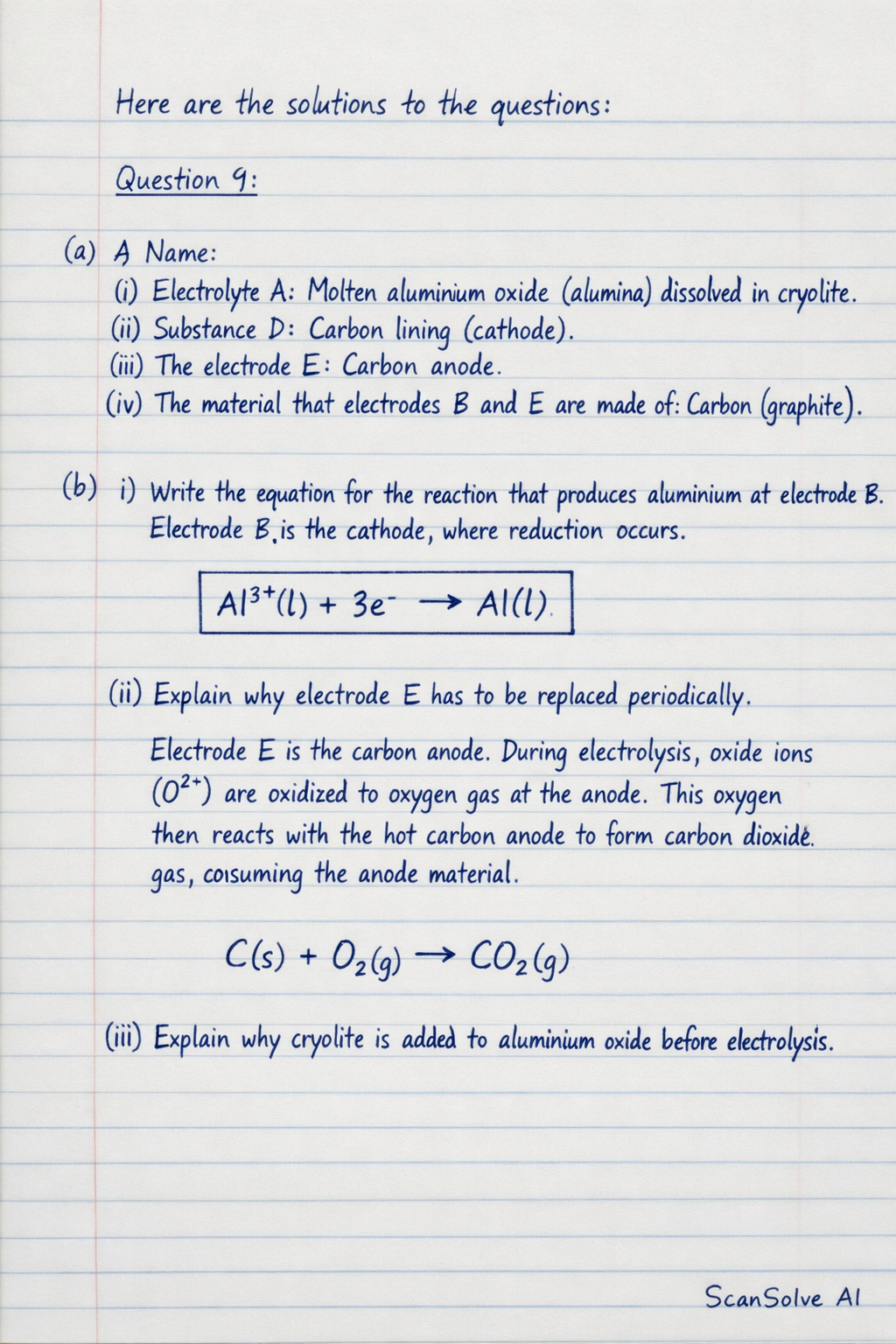
Here are the solutions to the questions:
Question 9:
a) Name:
i) Electrolyte A: Molten aluminium oxide (alumina) dissolved in cryolite.
ii) Substance D: Carbon lining (cathode).
iii) The electrode E: Carbon anode.
iv) The material that electrodes B and E are made of: Carbon (graphite).
b)
i) Write the equation for the reaction that produces aluminium at electrode B.
Electrode B is the cathode, where reduction occurs.
ii) Explain why electrode E has to be replaced periodically.
Electrode E is the carbon anode. During electrolysis, oxide ions () are oxidized to oxygen gas at the anode. This oxygen then reacts with the hot carbon anode to form carbon dioxide gas, consuming the anode material.
iii) Explain why cryolite is added to aluminium oxide before electrolysis.
Cryolite () is added to lower the melting point of aluminium oxide from over to approximately
Try one yourself
A new problem that tests the same skill.
Still stuck on this one?
Ask a follow-up, and the answer starts from this question.
More Chemistry Questions
Handwritten Step-by-Step Solution
Get this as a handwritten image on WhatsApp — like a tutor wrote it for you.
Try on WhatsApp