
We read your photo as:
How many coulombs of electricity would be needed to deposit 3.6 g of aluminium by the electrolysis of aluminium oxide dissolved in molten cryolite?
ScanSolve AI Answer
Answer
Step-by-step solution
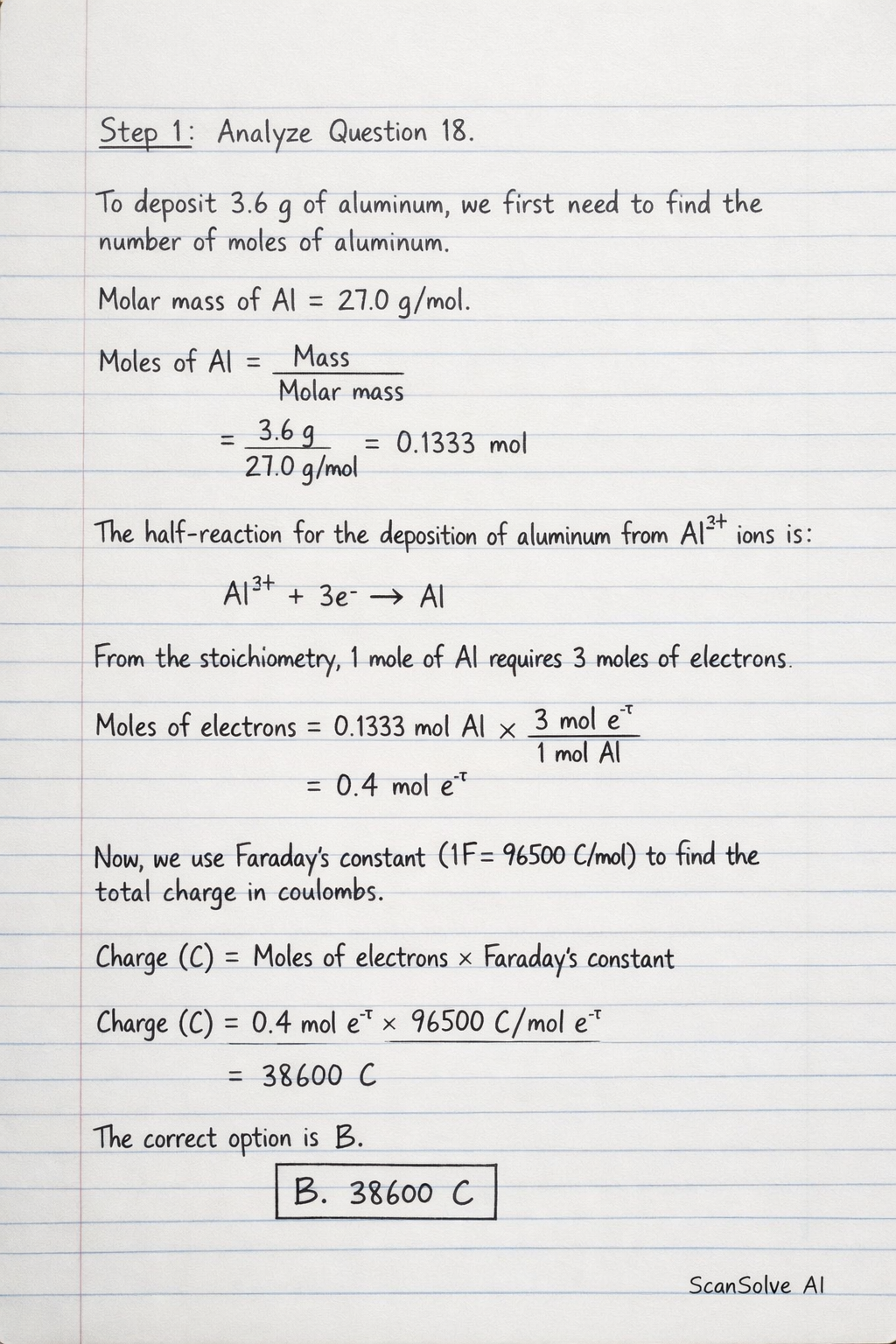
10 stepsAnalyze Question 18.
To deposit 3.6 g of aluminum, we first need to find the number of moles of aluminum.
Molar mass of Al = 27.0 g/mol.The half-reaction for the deposition of aluminum from ions is:
From the stoichiometry, 1 mole of Al requires 3 moles of electrons.
Now, we use Faraday's constant (1F = 96500 C/mol) to find the total charge in coulombs.
The correct option is B.
Analyze Question 19.
Carbon black is an allotrope of carbon widely used as a reinforcing filler in rubber products, such as tires, to improve their strength, durability, and wear resistance.
The correct option is D.
Analyze Question 20.
The two rows of elements placed below the main body of the periodic table are the lanthanides (I) and actinides (II). Both of these series are also collectively known as f-block elements (III) because their distinguishing electrons occupy f-orbitals. Therefore, all three statements are correct.
The correct option is D.
Analyze Question 21.
The process of converting glucose to ethanol by the use of yeast is a biochemical process called fermentation. Yeast contains enzymes that catalyze this conversion.
The correct option is D.
Analyze Question 22.
The loss of some or all of the water of crystallization when a hydrated compound is exposed to air is known as efflorescence.
- Hygroscopy is the ability of a substance to attract and hold water molecules from the surrounding environment.
- Dissociation is the process by which a compound breaks into smaller particles, typically ions, when dissolved in a solvent.
- Deliquescence is the process where a substance absorbs so much moisture from the air that it dissolves in the absorbed water to form a solution.
The correct option is D.
Analyze Question 23.
Electronegativity is a measure of the tendency of an atom in a molecule to attract shared electrons towards itself.
The correct option is A.
Analyze Question 24.
To find the molecular mass of , we sum the atomic masses of all atoms present.
Given atomic masses: Cu = 63.5, S = 32.0, O = 16.0, H = 1.0.The correct option is A.
Analyze Question 25.
Pure substances are classified into two categories: elements and compounds. If a pure substance is not an element, it must be a compound. Mixtures are not pure substances.
The correct option is A.
Analyze Question 26.
When a neutron strikes an unstable nucleus and causes it to split into two or more smaller nuclei, along with the release of energy and more neutrons, this process is known as nuclear fission.
The correct option is A.
Analyze Question 27.
Magnesium (Mg) has an atomic number of 12. Its electron configuration is .
The valence electrons are the electrons in the outermost principal energy level. For magnesium, the outermost principal energy level is , and the electrons are in the orbital.The correct option is D.
Try one yourself
A new problem that tests the same skill.
Still stuck on this one?
Ask a follow-up, and the answer starts from this question.
More Chemistry Questions
Handwritten Step-by-Step Solution
Get this as a handwritten image on WhatsApp — like a tutor wrote it for you.
Try on WhatsApp