
Calculate the current that must be passed into a solution of aluminum salt for 2hrs in order to deposit 2.5g of aluminum? An example of insoluble chloride im water is: SO₂ can be used as: If the mass number of X is 24 and X²+ contains 10 electrons, the nucleus will consist of
ScanSolve AI Answer
Step-by-step solution
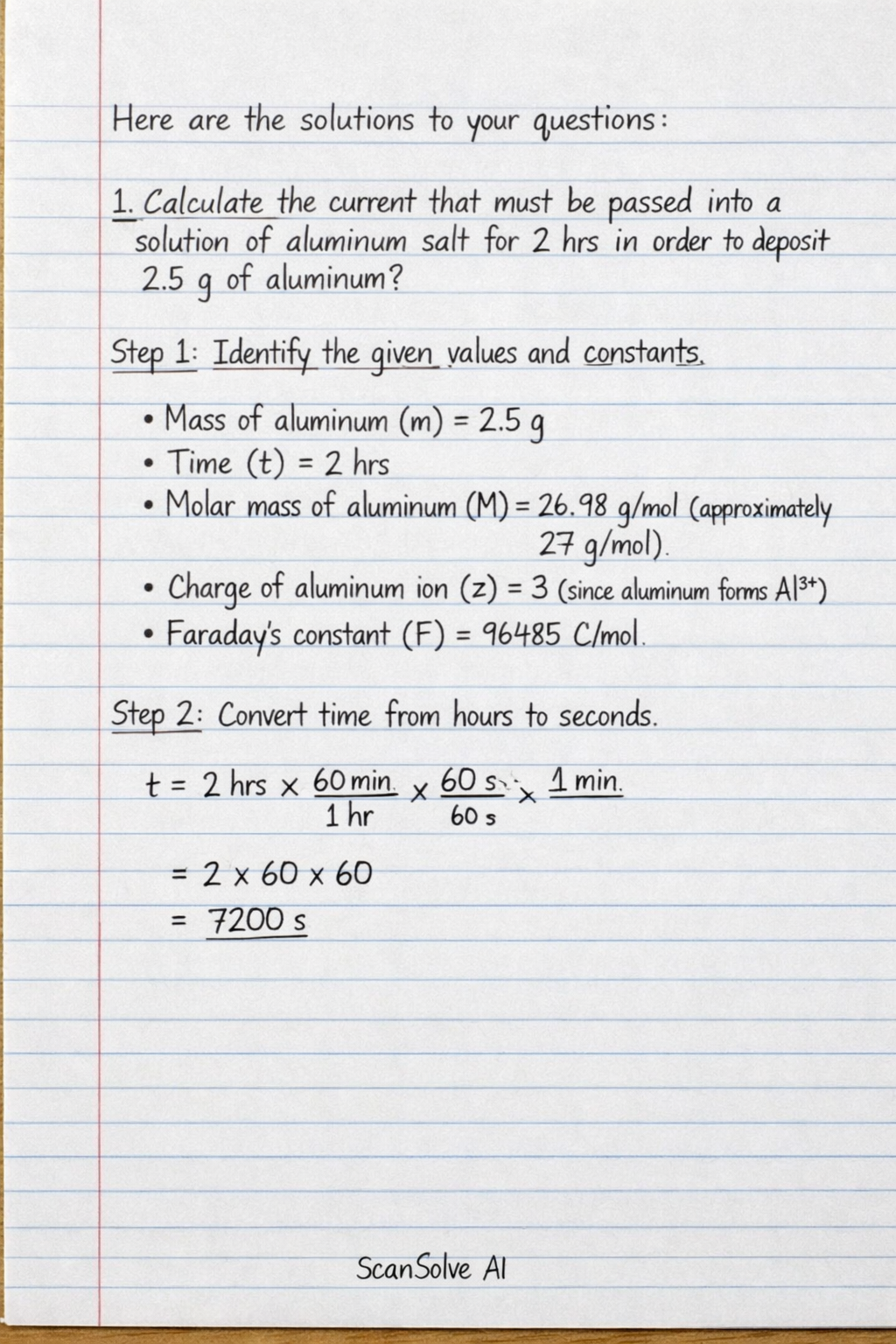
5 stepsHere are the solutions to your questions:
1. Calculate the current that must be passed into a solution of aluminum salt for 2hrs in order to deposit 2.5g of aluminum?
Identify the given values and constants.
- Mass of aluminum () =
- Time () =
- Molar mass of aluminum () = (approximately )
- Charge of aluminum ion () = 3 (since aluminum forms )
- Faraday's constant () =
Convert time from hours to seconds.
Use Faraday's first law of electrolysis to calculate the current ().
The formula is . Rearrange to solve for :
Substitute the values:
The current required is .
2. An example of insoluble chloride in water is:
An example of an insoluble chloride in water is silver chloride (). Other examples include lead(II) chloride () and mercury(I) chloride ().
3. SO₂ can be used as:
(sulfur dioxide) can be used as a preservative (e.g., in wines and dried fruits) and as a bleaching agent (e.g., for wool and silk).
4. If the mass number of X is 24 and X²⁺ contains 10 electrons, the nucleus will consist of:
Determine the number of protons.
- The ion has 10 electrons.
- Since it has a charge, it has lost 2 electrons.
- Therefore, the neutral atom X must have had electrons.
- In a neutral atom, the number of electrons equals the number of protons. So, the number of protons in X is 12.
Determine the number of neutrons.
- The mass number (A) is given as 24.
- The mass number is the sum of protons (Z) and neutrons (N): .
- We found the number of protons (Z) to be 12.
The nucleus of X will consist of .
Still stuck on this one?
Ask a follow-up, and the answer starts from this question.
More Physics Questions
Handwritten Step-by-Step Solution
Get this as a handwritten image on WhatsApp — like a tutor wrote it for you.
Try on WhatsApp