
We read your photo as:
Iv) Using dots (.) and Cross (X) Show the bonding in B and Q. v) Explain Why E is a better Conductor of both heat and electricity than B.
ScanSolve AI Answer
Here are the answers to your questions:
iv) Using dots (.) and Cross (X) Show the bonding in B and Q.
- Element B: Element B is in Group I (Alkali Metal), meaning it has 1 valence electron.
- Element Q: Element Q is in Group VIII (Noble Gas), meaning it has 8 valence electrons (a stable octet).
Dot-and-cross diagrams are typically used to show electron sharing in covalent bonds or electron transfer in ionic bonds. For individual elements, they can represent valence electrons.
For Element B:
(Element B has one valence electron, which it tends to lose to form a positive ion in chemical reactions, or contributes to a 'sea' of delocalized electrons in metallic bonding.)
For Element Q:
(Element Q has eight valence electrons, forming a stable electron configuration. Noble gases like Q are generally unreactive and do not readily form chemical bonds with other elements, nor do they form bonds between their own atoms, existing as discrete atoms.)
v) Explain Why E is a better Conductor of both heat and electricity than B.
Both E (Group III) and B (Group I) are metals, and metals conduct heat and electricity due to the presence of delocalized electrons in their metallic lattice structure.
- Element E is in Group III, meaning each atom of E contributes three valence electrons to the 'sea' of delocalized electrons.
- Element B is in Group I, meaning each atom of B contributes only one valence electron to the 'sea' of delocalized electrons.
Since Element E contributes more delocalized electrons per atom than Element B, it has a higher concentration of mobile charge carriers. This greater number of delocalized electrons allows for more efficient transfer of electrical charge and thermal energy, making E a better conductor of both heat and electricity than B.
Still stuck on this one?
Ask a follow-up, and the answer starts from this question.
More Chemistry Questions
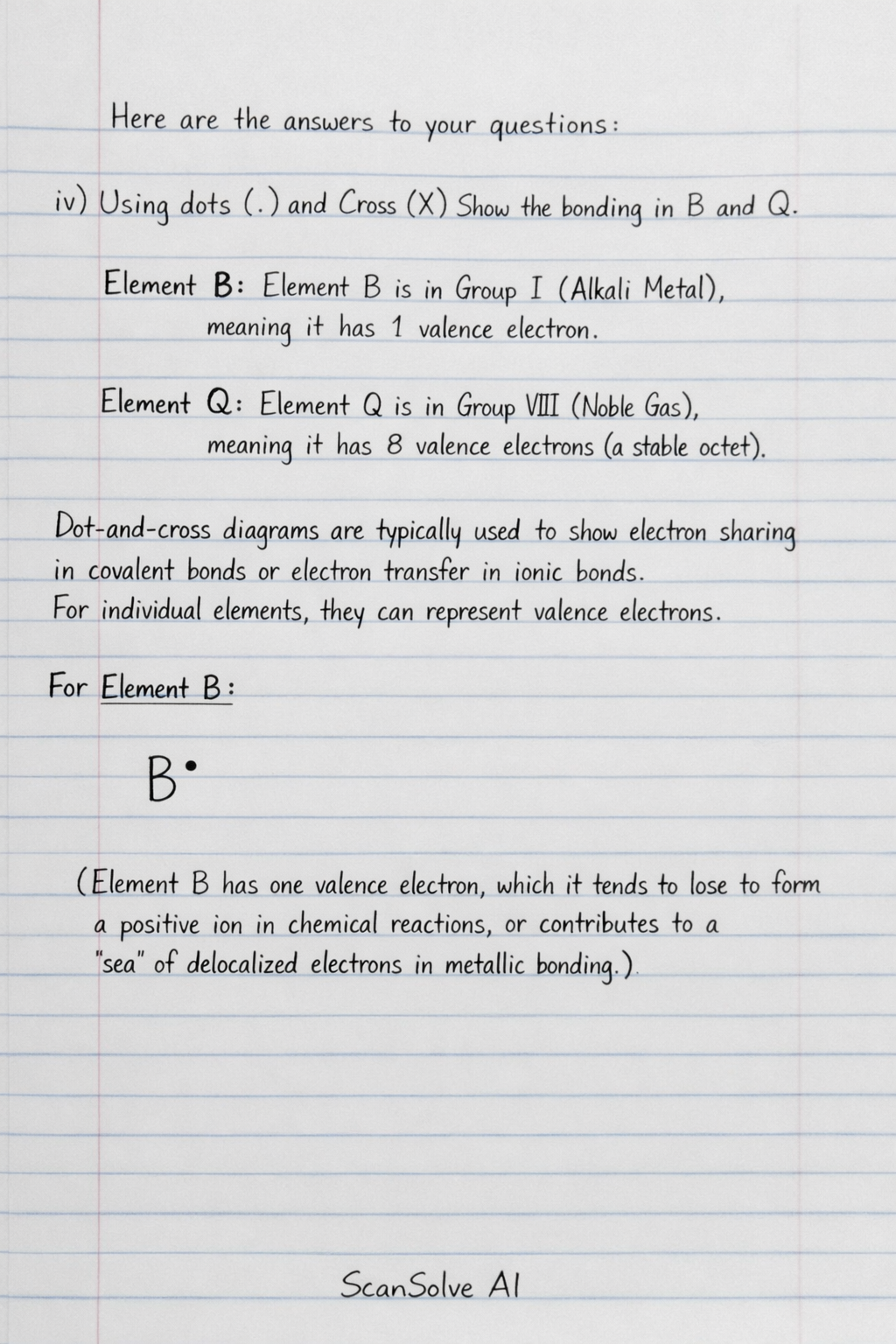
Handwritten Step-by-Step Solution
Get this as a handwritten image on WhatsApp — like a tutor wrote it for you.
Try on WhatsApp