
This chemistry question involves key chemical concepts and calculations. The detailed solution below walks through each step, from identifying the reaction type to computing the final answer.
ScanSolve AI Answer
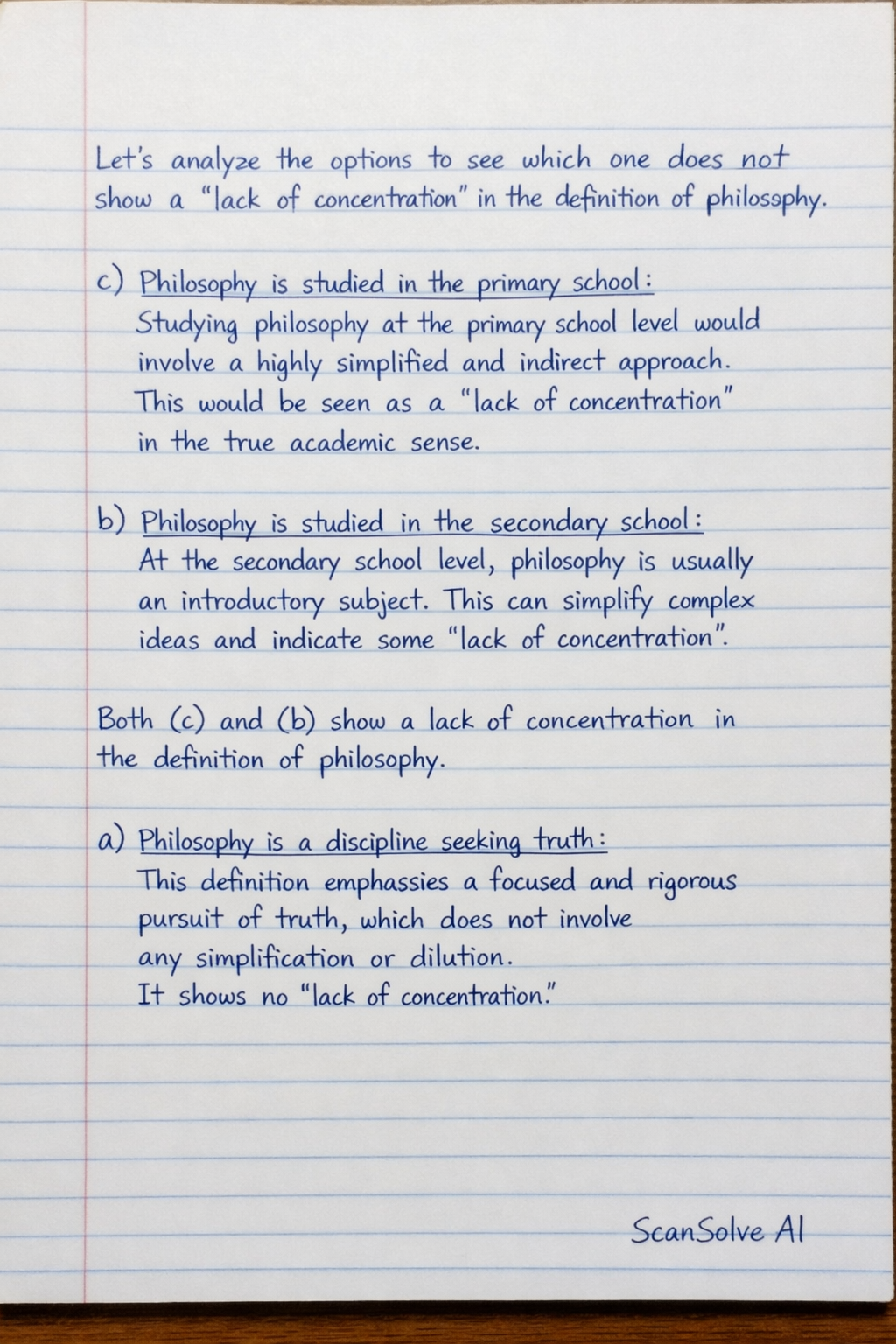
The question asks to identify the option that does not indicate a "lack of concentration" in the definition of philosophy. A "lack of concentration" in the definition implies that the definition is being stretched, simplified, or diluted. c) The fact that philosophy is a subject that is studied in the primary school: Studying philosophy at the primary school level would necessarily involve a highly simplified and often indirect approach to philosophical concepts, which could be seen as a dilution or "lack of concentration" in its rigorous academic definition. b) The fact that philosophy is a subject that is studied in the secondary school: While more advanced than primary school, philosophy in secondary school is often still an introduction or survey, potentially simplifying complex ideas and thus showing some "lack of concentration" compared to its full academic scope. a) The fact that philosophy is a subject that is studied in the university and d) The fact that philosophy is a subject that is studied in the tertiary institution: Both university and tertiary institutions represent higher education where philosophy is studied as a specialized, rigorous academic discipline. At this level, philosophy is explored in its full complexity and depth, meaning its definition is concentrated and not diluted. Therefore, the fact that philosophy is studied at these levels does not* indicate a lack of concentration in its definition; rather, it indicates its proper and focused academic study. Given that both (a) and (d) point to the same idea of higher education where philosophy is studied rigorously, and assuming the question expects a single best answer, the fact that philosophy is studied at the university or tertiary level is the exception to the "lack of concentration." a) The fact that philosophy is a subject that is studied in the university