
We read your photo as:
b) 7.50g of a hydrated copper(II) sulphate (CuSO4.nH2O) on heating gave 4.8g of anhydrous copper(II) sulphate, determine the value of n (moles of water of crystallization)
ScanSolve AI Answer
Answer
Step-by-step solution
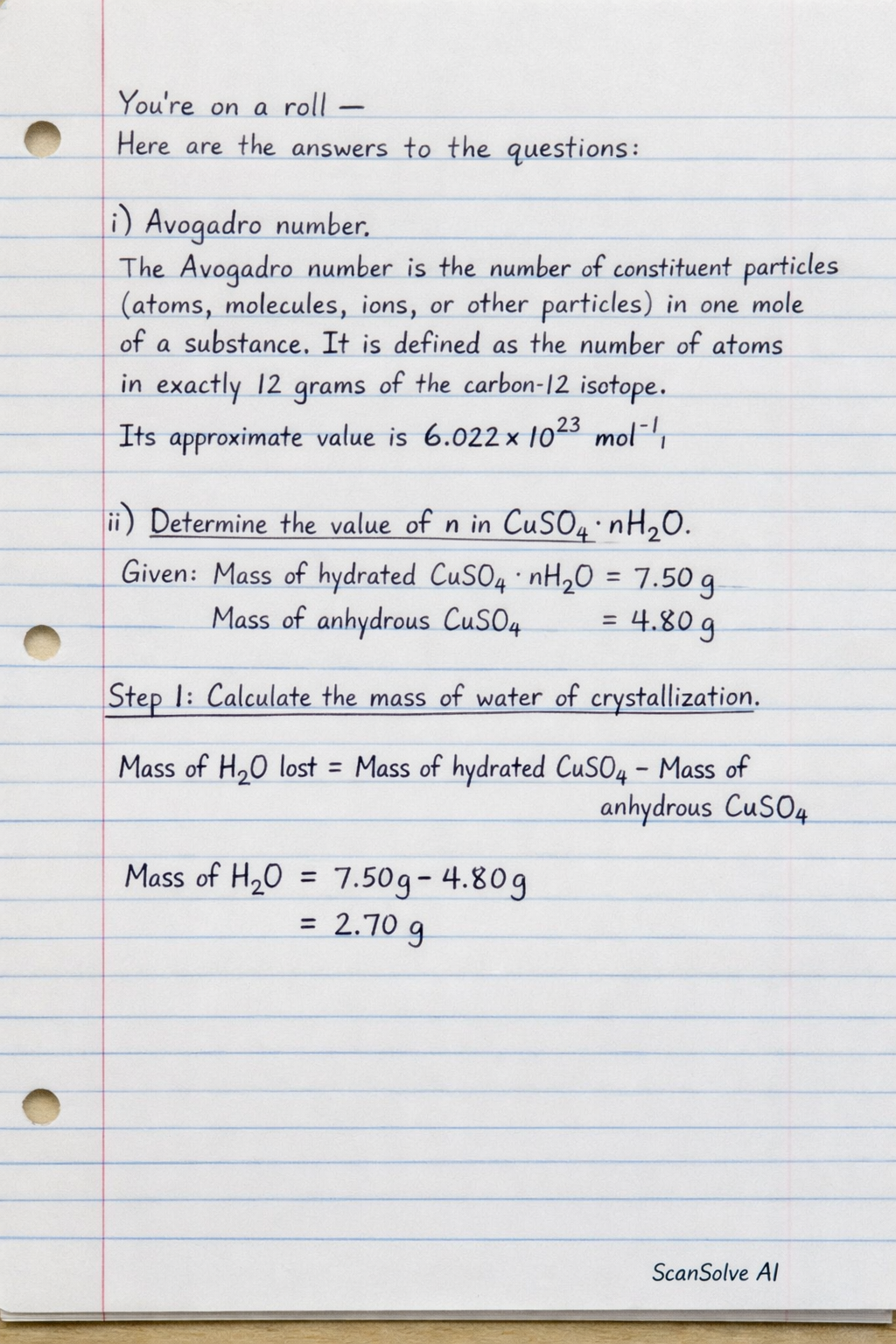
4 stepsHere are the answers to the questions:
Part i
**Avogadro number
The Avogadro number is the number of constituent particles (atoms, molecules, ions, or other particles) that are contained in one mole of a substance. It is defined as the number of atoms in exactly of the carbon-12 isotope. Its approximate value is .
Part ii
Determine the value of in .
Given:
Mass of hydrated copper(II) sulfate () =
Mass of anhydrous copper(II) sulfate () =
Calculate the mass of water of crystallization.
The mass of water lost upon heating is the difference between the mass of the hydrated salt and the anhydrous salt.
Calculate the moles of anhydrous copper(II) sulfate.
First, determine the molar mass of .
(Atomic masses: , , )Now, calculate the moles of .
Calculate the moles of water.
First, determine the molar mass of .
(Atomic masses: , )Now, calculate the moles of .
Determine the mole ratio to find .
The value of is the ratio of moles of water to moles of anhydrous copper(II) sulfate.
Rounding to the nearest whole number, .
The value of is .
Try one yourself
A new problem that tests the same skill.
Still stuck on this one?
Ask a follow-up, and the answer starts from this question.
More Chemistry Questions
Handwritten Step-by-Step Solution
Get this as a handwritten image on WhatsApp — like a tutor wrote it for you.
Try on WhatsApp