
We read your photo as:
Calculate the percentage yield of copper (II) sulphate crystals. Actual yield = 4.2 g.
ScanSolve AI Answer
Step-by-step solution
4 stepsIdentify the given information.
The actual yield of copper (II) sulphate crystals obtained by the student is given.
Understand the formula for percentage yield.
To calculate the percentage yield, we use the formula:
Identify missing information.
The theoretical yield of copper (II) sulphate is required to complete this calculation. The theoretical yield is the maximum amount of product that can be formed from the given amounts of reactants, based on stoichiometry. This value is typically calculated from previous parts of the question (e.g., parts a or b) which would provide information about the initial reactants. Since this information is not provided in the current question part (c), the theoretical yield cannot be determined.
Explain how to complete the calculation once the theoretical yield is known.
Once the theoretical yield is known, substitute both the actual yield and the theoretical yield into the formula to find the percentage yield.
For example, if the theoretical yield were, say, 5.0 g, the calculation would be:
Since the theoretical yield is not provided, a numerical answer for the percentage yield cannot be given.
Still stuck on this one?
Ask a follow-up, and the answer starts from this question.
More Chemistry Questions
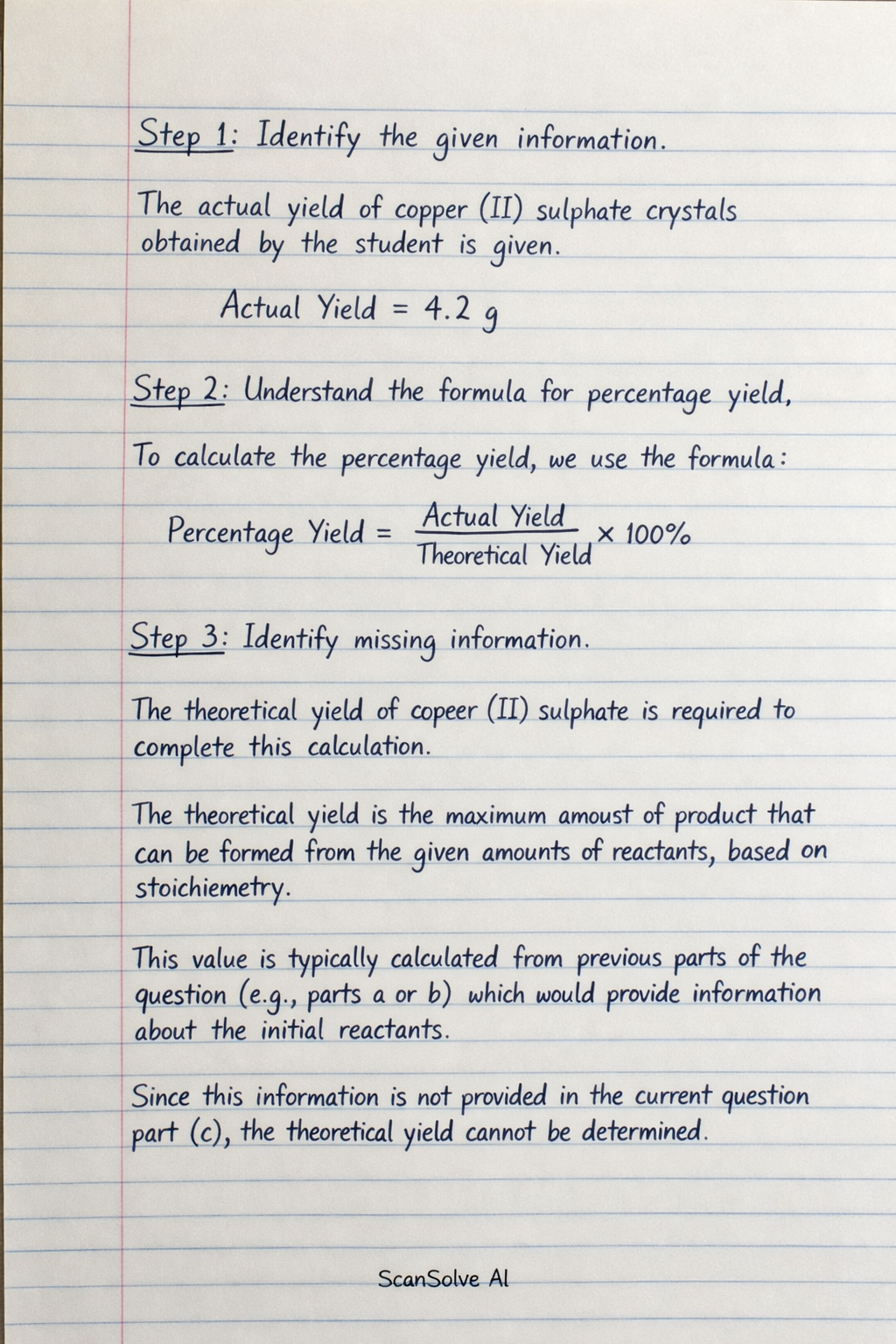
Handwritten Step-by-Step Solution
Get this as a handwritten image on WhatsApp — like a tutor wrote it for you.
Try on WhatsApp