

This chemistry question involves key chemical concepts and calculations. The detailed solution below walks through each step, from identifying the reaction type to computing the final answer.
ScanSolve AI Answer
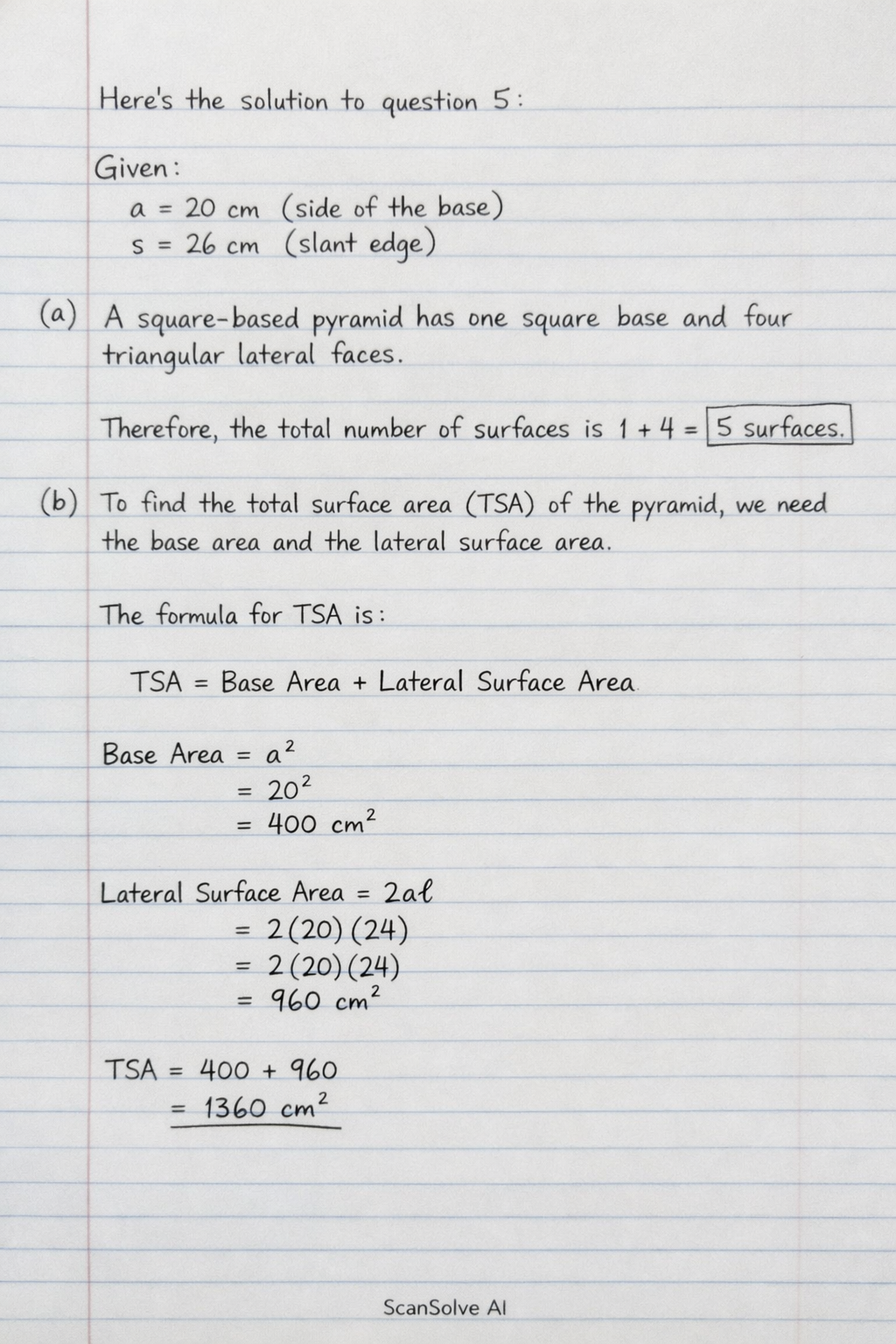
Here's the solution to question 5: Given: Length of a side of the base of the square-based pyramid, a = 20 cm. Length of the slant edge, s = 26 cm. a) A square-based pyramid has one square base and four triangular lateral faces. Therefore, the total number of surfaces is 1 + 4 = 5 surfaces. b) To find the total surface area (TSA) of the pyramid, we need the base area and the lateral surface area. The formula for TSA is TSA = Base Area + Lateral Surface Area. Base Area = a^2. Lateral Surface Area = 2al, where l is the slant height. Step 1: Calculate the vertical height (h) of the pyramid. We use the relationship between the slant edge (s), vertical height (h), and half of the base diagonal. The length of half the base diagonal is asqrt(2)2. Using the Pythagorean theorem: s^2 = h^2 + (asqrt(2)2)^2 Substitute the given values: 26^2 = h^2 + (20^2 × 2)/(4) 676 = h^2 + (400 × 2)/(4) 676 = h^2 + (800)/(4) 676 = h^2 + 200 h^2 = 676 - 200 h^2 = 476 h = sqrt(476) cm Step 2: Calculate the slant height (l) of the pyramid. We use the relationship between the slant height (l), vertical height (h), and half of the base side length ((a)/(2)). l^2 = h^2 + ((a)/(2))^2 Substitute the values for h^2 and a: l^2 = 476 + ((20)/(2))^2 l^2 = 476 + 10^2 l^2 = 476 + 100 l^2 = 576 l = sqrt(576) l = 24 cm Step 3: Calculate the total surface area (TSA). TSA = a^2 + 2al TSA = 20^2 + 2 × 20 × 24 TSA = 400 + 960 TSA = 1360 cm^2 The total surface area of the pyramid is 1360 cm^2. c) To compare the vertical height (h) and slant height (l): Step 1: State the values of h and l. Vertical height h = sqrt(476) cm. Slant height l = 24 cm. Step 2: Compare the values. We know that 21^2 = 441 and 22^2 = 484. So, sqrt(476) is between 21 and 22. h ≈ 21.82 cm. Since 24 > 21.82, the slant height is greater than the vertical height. Comparison: The slant height (l = 24 cm) is greater than the vertical height (h = sqrt(476) ≈ 21.82 cm). That's 2 down. 3 left today — send the next one.