
We read your photo as:
List three natural carbonates and give examples of soluble and insoluble ones. Write the reaction equation for CO2 gas and baryta water over 5 mins.
Chemistry
ScanSolve AI Answer
Step-by-step solution
2 stepshere are the answers to your tutorial questions:
1. a) List three natural carbonates you have studied.
- Calcium carbonate () - found as limestone, marble, chalk.
- Magnesium carbonate () - found as magnesite.
- Iron(II) carbonate () - found as siderite.
Part b
Give three examples of carbonates that are soluble in water and three that are not.
- Soluble carbonates:
- Sodium carbonate ()
- Potassium carbonate ()
- Ammonium carbonate ()
- Insoluble carbonates:
- Calcium carbonate ()
- Magnesium carbonate ()
- Copper(II) carbonate ()
Part c· 2 steps
Write the equation for the reaction between gas and baryta water taken place for over 5mins.
Carbon dioxide reacts with barium hydroxide (baryta water) to form a white precipitate of barium carbonate.
If excess carbon dioxide is passed for an extended period (over 5 minutes), the insoluble barium carbonate reacts further with carbon dioxide and water to form soluble barium hydrogen carbonate, causing the precipitate to redissolve.
2. Distinguish between and using the available reagents.
Here are three simple tests:
-
Test 1: Using Phenolphthalein indicator
- Procedure: Add a few drops of phenolphthalein indicator to separate solutions of and .
- Observation: The solution will turn pink/red (strongly alkaline), while the solution will show a faint pink color or remain colorless (less alkaline).
- Explanation: Sodium carbonate is a salt of a strong base and a weak acid, leading to significant hydrolysis and a higher pH. Potassium hydrogen carbonate is less alkaline.
-
Test 2: Using Magnesium Sulfate () solution
- Procedure: Add magnesium sulfate solution to separate solutions of and at room temperature.
- Observation: With , an immediate white precipitate of magnesium carbonate forms. With , no precipitate forms in the cold solution. A precipitate would only form upon heating the mixture.
- Equations: (Magnesium bicarbonate is soluble)
-
Test 3: Using Barium Chloride () solution
- Procedure: Add barium chloride solution to separate solutions of $\text{Na
-
Was this helpful?
Still stuck on this one?
Ask a follow-up, and the answer starts from this question.
Got a different question?Ask your own question
More Chemistry Questions
QWrite an equation in each case to represent the change that occurs when the following carbonates are…QI. CaCO3(s) CaO(s) + CO2(g)QA) Name a possible metal carbonate M, give a reason for your choice. b) Write a balanced chemical…QHere are some chemistry questions: 1. Briefly describe the method of preparing soluble salt. 2…QName a possible metal carbonate M and write a balanced chemical equation for its reaction with an…
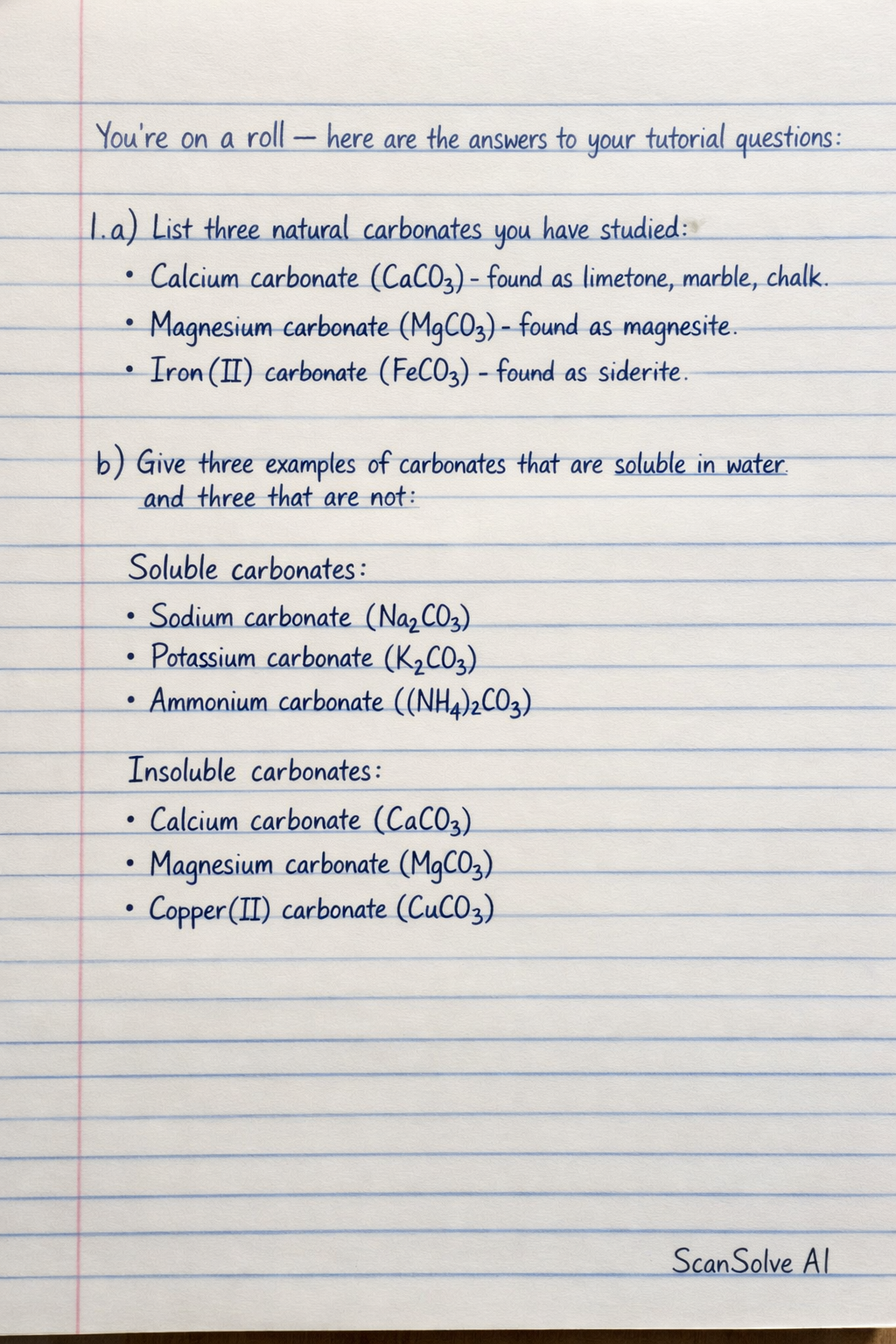
Handwritten Step-by-Step Solution
Get this as a handwritten image on WhatsApp — like a tutor wrote it for you.
Try on WhatsApp