
How to look for the molarity of a solution for example aqueous potassium dichromate
Chemistry
ScanSolve AI Answer
Answer
Step-by-step solution
3 stepsTo find the molarity of a solution, such as aqueous potassium dichromate (), you need to know the mass of the solute dissolved and the total volume of the solution.
Molarity (M) is defined as the number of moles of solute per liter of solution.
Here's how to calculate it:
Determine the moles of the solute.
- First, find the molar mass of the solute. For potassium dichromate ():
- Molar mass of K =
- Molar mass of Cr =
- Molar mass of O =
- Molar mass of
- Next, measure the mass of the solute (e.g., in grams) that was dissolved.
- Calculate the moles of solute using the formula: For example, if you dissolved of :
- First, find the molar mass of the solute. For potassium dichromate ():
Determine the volume of the solution in liters.
- Measure the total volume of the solution (not just the solvent) in milliliters (mL) or cubic centimeters ().
- Convert the volume to liters (L) by dividing by 1000: For example, if the solution was made up to a total volume of :
Calculate the molarity.
- Divide the moles of solute (from Step 1) by the volume of the solution in liters (from Step 2): Using the example values: So, the molarity of the potassium dichromate solution is .
Was this helpful?
Try one yourself
A new problem that tests the same skill.
Still stuck on this one?
Ask a follow-up, and the answer starts from this question.
Got a different question?Ask your own question
More Chemistry Questions
QCalculate the moles of dichromate(VI) used in the reaction, given the concentration and volume of…QCalculate the amount, in moles, of dichromate (VI) ions used in the titration.QHow do you calculate molarity of a solution?QA solution of 25.0 cm³ of iron(II) ammonium sulphate needed exactly 20.0 cm³ of a solution of…QA) i-iv. Calculate the amount in moles of dichromate (VI) used and Fe2+ present in 25 cm³ of…
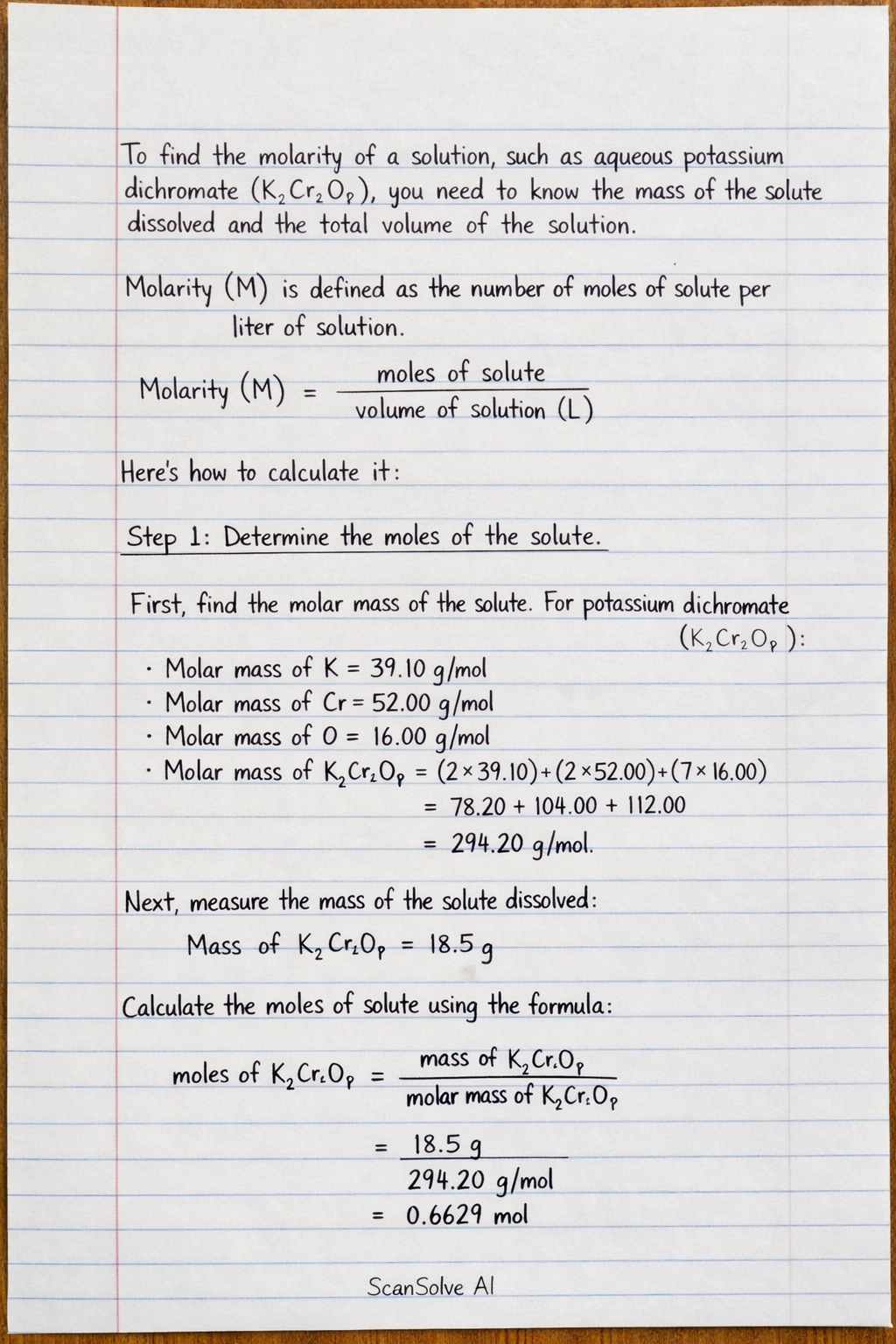
Handwritten Step-by-Step Solution
Get this as a handwritten image on WhatsApp — like a tutor wrote it for you.
Try on WhatsApp