
We read your photo as:
How many geometrical isomers are possible in the following two alkenes? (I) CH3–CH=CH–CH=CH–CH3 (II) CH3–CH=CH–CH=CH–Cl
ScanSolve AI Answer
Step-by-step solution
3 stepsTo determine the number of geometrical isomers (cis-trans isomers), we need to identify the number of double bonds that can exhibit cis-trans isomerism. A double bond can show cis-trans isomerism if each carbon atom of the double bond is attached to two different groups.
For a molecule with different double bonds capable of cis-trans isomerism, the maximum number of geometrical isomers is . However, if the molecule is symmetrical, the number of isomers might be less than .
Analyze molecule (i) .
This molecule has two double bonds. Let's label them as and .
- For : The is attached to and . The is attached to and . Both carbons have two different groups, so this double bond can exhibit cis-trans isomerism.
- For : The is attached to and . The is attached to and . Both carbons have two different groups, so this double bond can exhibit cis-trans isomerism. This molecule is symmetrical. The general formula for the number of geometrical isomers for a symmetrical polyene with double bonds is if is even. Here, . Number of isomers . The three isomers are:
- cis, cis
- trans, trans
- cis, trans (which is identical to trans, cis due to symmetry)
Analyze molecule (ii) .
This molecule also has two double bonds. Let's label them as and .
- For : The is attached to and . The is attached to and . Both carbons have two different groups, so this double bond can exhibit cis-trans isomerism.
- For : The is attached to and . The is attached to and . Both carbons have two different groups, so this double bond can exhibit cis-trans isomerism. This molecule is unsymmetrical. For an unsymmetrical polyene with double bonds, the number of geometrical isomers is . Here, . Number of isomers . The four isomers are:
- cis, cis
- cis, trans
- trans, cis
- trans, trans
Compare with the given options.
Molecule (i) has 3 geometrical isomers.
Molecule (ii) has 4 geometrical isomers.
The correct option should be 3 and 4.The final answer is .
Still stuck on this one?
Ask a follow-up, and the answer starts from this question.
More Chemistry Questions
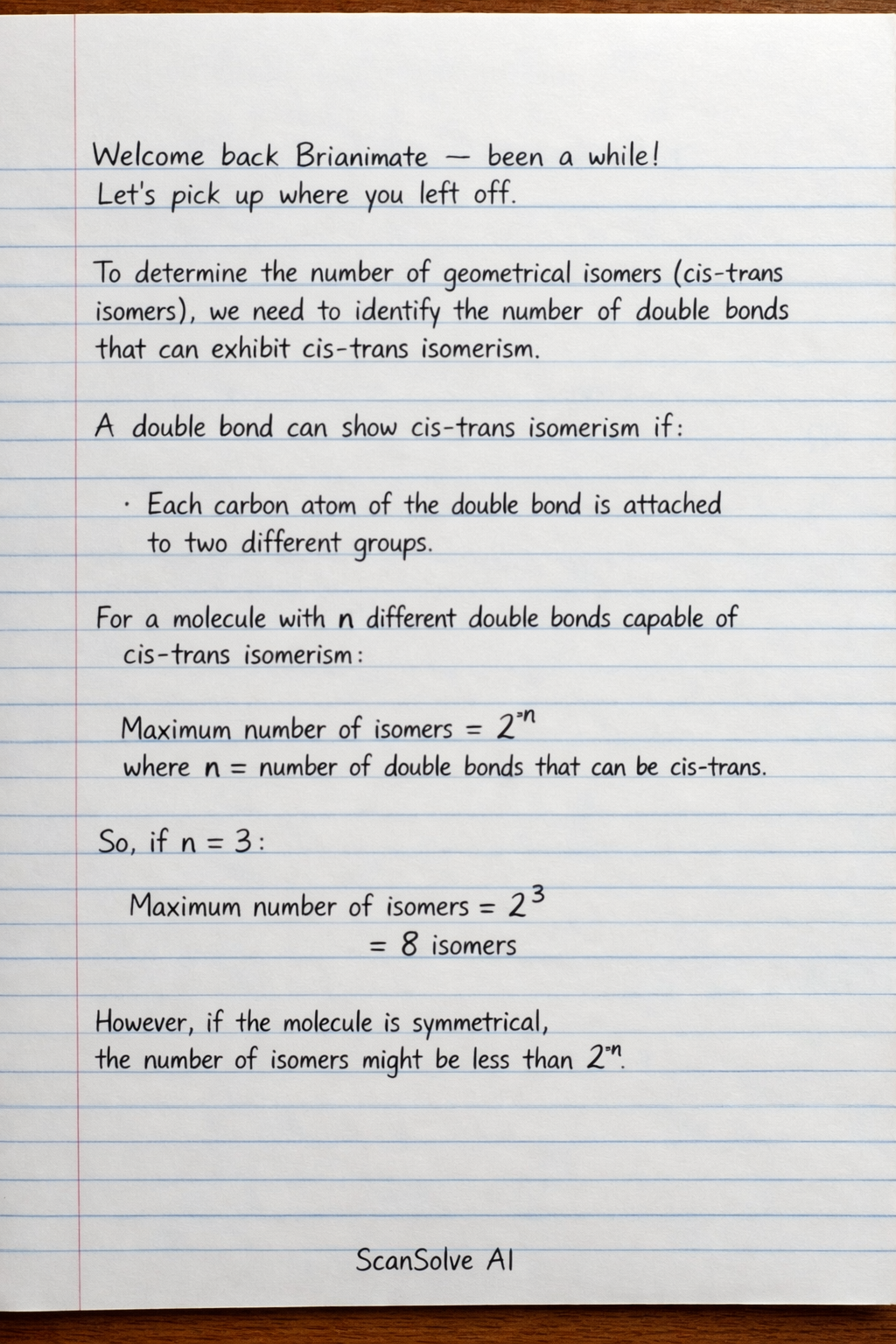
Handwritten Step-by-Step Solution
Get this as a handwritten image on WhatsApp — like a tutor wrote it for you.
Try on WhatsApp