

This chemistry question involves key chemical concepts and calculations. The detailed solution below walks through each step, from identifying the reaction type to computing the final answer.
ScanSolve AI Answer
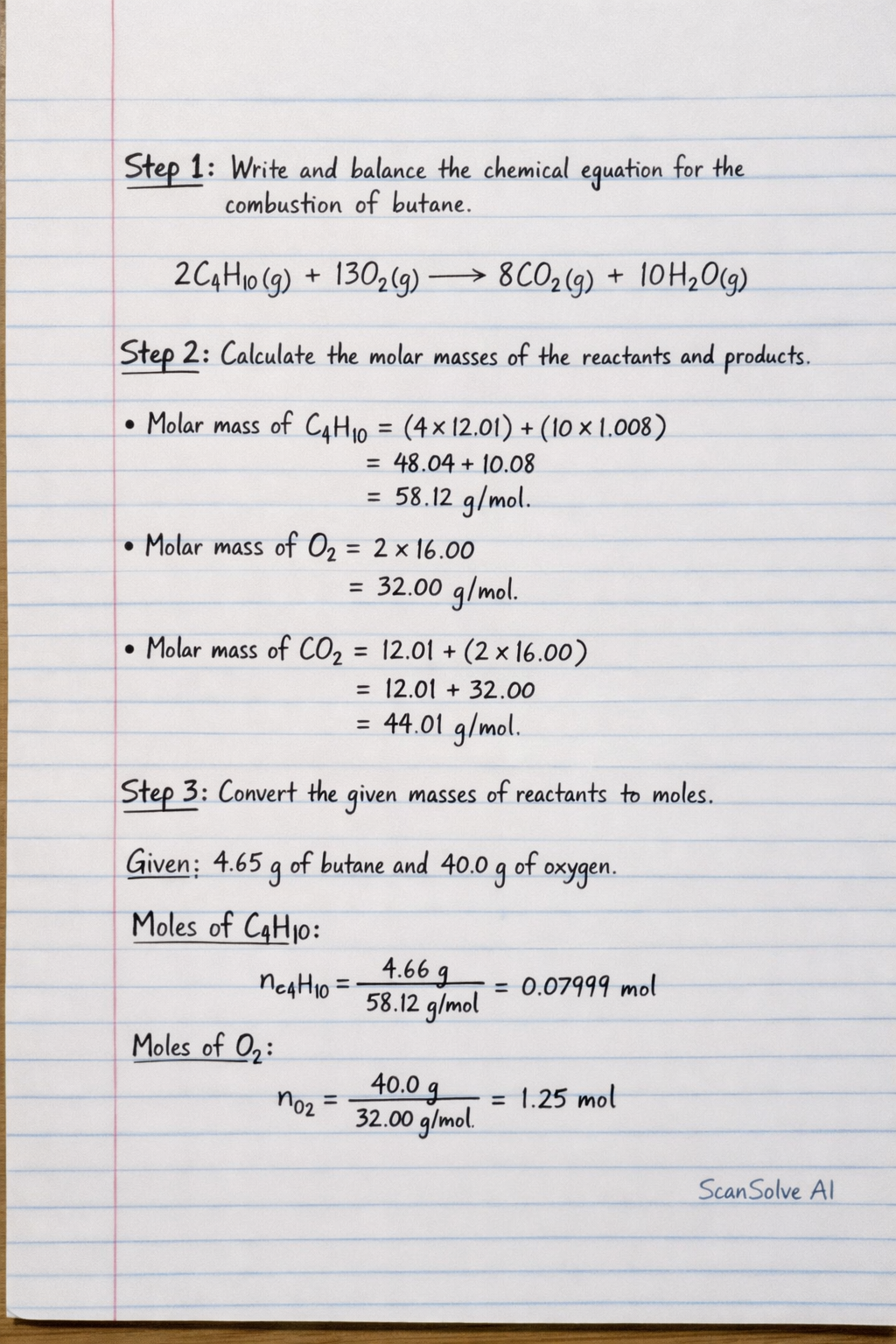
Step 1: Write and balance the chemical equation for the combustion of butane. Butane (C_4H_10) burns in oxygen (O_2) to produce carbon dioxide (CO_2) and water vapor (H_2O). 2C_4H_10(g) + 13O_2(g) 8CO_2(g) + 10H_2O(g) Step 2: Calculate the molar masses of the reactants and products. • Molar mass of C_4H_10 = (4 × 12.01) + (10 × 1.008) = 48.04 + 10.08 = 58.12 g/mol • Molar mass of O_2 = 2 × 16.00 = 32.00 g/mol • Molar mass of CO_2 = 12.01 + (2 × 16.00) = 12.01 + 32.00 = 44.01 g/mol Step 3: Convert the given masses of reactants to moles. Given: 4.65 g of butane and 40.0 g of oxygen. Moles of C_4H_10: n_C_4H_10 = 4.65 g58.12 g/mol = 0.07999 mol Moles of O_2: n_O_2 = 40.0 g32.00 g/mol = 1.25 mol Step 4: Determine the limiting reactant. Using the stoichiometric coefficients from the balanced equation: For C_4H_10: 0.07999 mol C_4H_10 × 13 mol O_22 mol C_4H_10 = 0.5199 mol O_2 needed. Since we have 1.25 mol O_2, which is more than 0.5199 mol O_2 needed, C_4H_10 is the limiting reactant. O_2 is the excess reactant. Step 5: Calculate the mass of carbon dioxide produced based on the limiting reactant. From the balanced equation, 2 mol C_4H_10 produces 8 mol CO_2. Moles of CO_2 produced: n_CO_2 = 0.07999 mol C_4H_10 × 8 mol CO_22 mol C_4H_10 = 0.31996 mol CO_2 Mass of CO_2 produced: Mass_CO_2 = 0.31996 mol × 44.01 g/mol = 14.08 g The mass of carbon dioxide produced is 14.08 g. Step 6: Calculate the mass of the excess reactant (O_2) remaining. Moles of O_2 consumed: n_O_2, consumed = 0.07999 mol C_4H_10 × 13 mol O_22 mol C_4H_10 = 0.5199 mol O_2 Moles of O_2 remaining: n_O_2, remaining = 1.25 mol (initial) - 0.5199 mol (consumed) = 0.7301 mol O_2 Mass of O_2 remaining: Mass_O_2, remaining = 0.7301 mol × 32.00 g/mol = 23.36 g The mass of excess reactant remaining is 23.36 g. Drop the next question.