
We read your photo as:
Calculate the mass of iron produced from 20 g of 50% pure Fe2O3 and 9 g of CO, given the reaction: Fe2O3 + 3CO → 2Fe + 3CO2.
ScanSolve AI Answer
This answer stops before the end.
It was cut off when it was first written. Ask ScanSolve this question again for the full working.
Step 1: Calculate the actual mass and moles of reactants.
The balanced chemical equation is:
Given: 20 g of 50% pure and 9 g of .
First, calculate the actual mass of pure :
Next, calculate the molar masses of the reactants:
Now, calculate the moles of each reactant:
Step 2: Determine the limiting reactant.
From the balanced equation, 1 mole of reacts with 3 moles of .
To react completely with of , the moles of required would be:
Since we have of (which is more than required), is the limiting reactant.
a) i) The limiting reactant is:
Step 3: Calculate the moles of unreacted reactant left over.
The excess reactant is .
Moles of consumed in the reaction:
Moles of left over:
a) ii) Moles of unreacted reactant left over:
Step 4: Calculate the number of moles of CO consumed in the reaction.
This was calculated in Step 3.
a) iii) Number of moles of CO consumed:
Step 5: Calculate the mass of NaOH required to absorb all produced.
First, calculate the moles of produced. Since is the limiting reactant:
The reaction between and is:
Still stuck on this one?
Ask a follow-up, and the answer starts from this question.
More Chemistry Questions
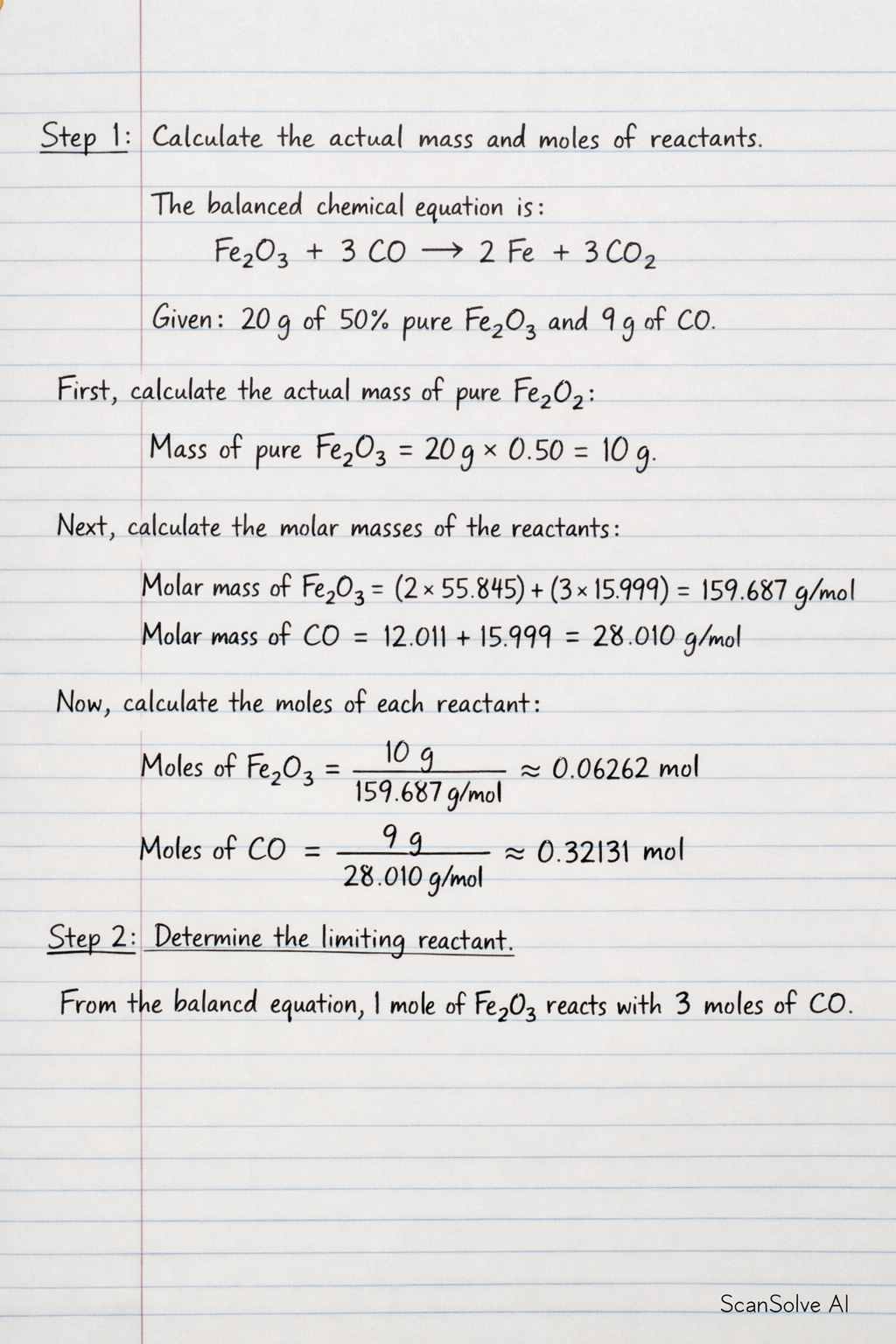
Handwritten Step-by-Step Solution
Get this as a handwritten image on WhatsApp — like a tutor wrote it for you.
Try on WhatsApp