
We read your photo as:
Calculate the moles of each element:
ScanSolve AI Answer
Step-by-step solution
3 stepsDetermine the empirical formula.
Assume a 100 g sample of the hydrocarbon.
Mass of Carbon (C) = 83.3 g
Mass of Hydrogen (H) = 16.7 gCalculate the moles of each element:
Moles of C
Moles of HDivide by the smallest number of moles to find the simplest mole ratio:
Ratio of C
Ratio of HTo obtain whole numbers, multiply the ratios by a suitable integer. Since , we multiply both ratios by 5:
C:
H:The empirical formula is .
Calculate the empirical formula mass.
Empirical formula mass
Empirical formula mass
Empirical formula massDetermine the molar mass from the vapor density.
The question states "the vapor density of the hydrocarbon is 36 gdm". In chemistry problems, "vapor density" is often used to refer to the relative vapor
Still stuck on this one?
Ask a follow-up, and the answer starts from this question.
More Chemistry Questions
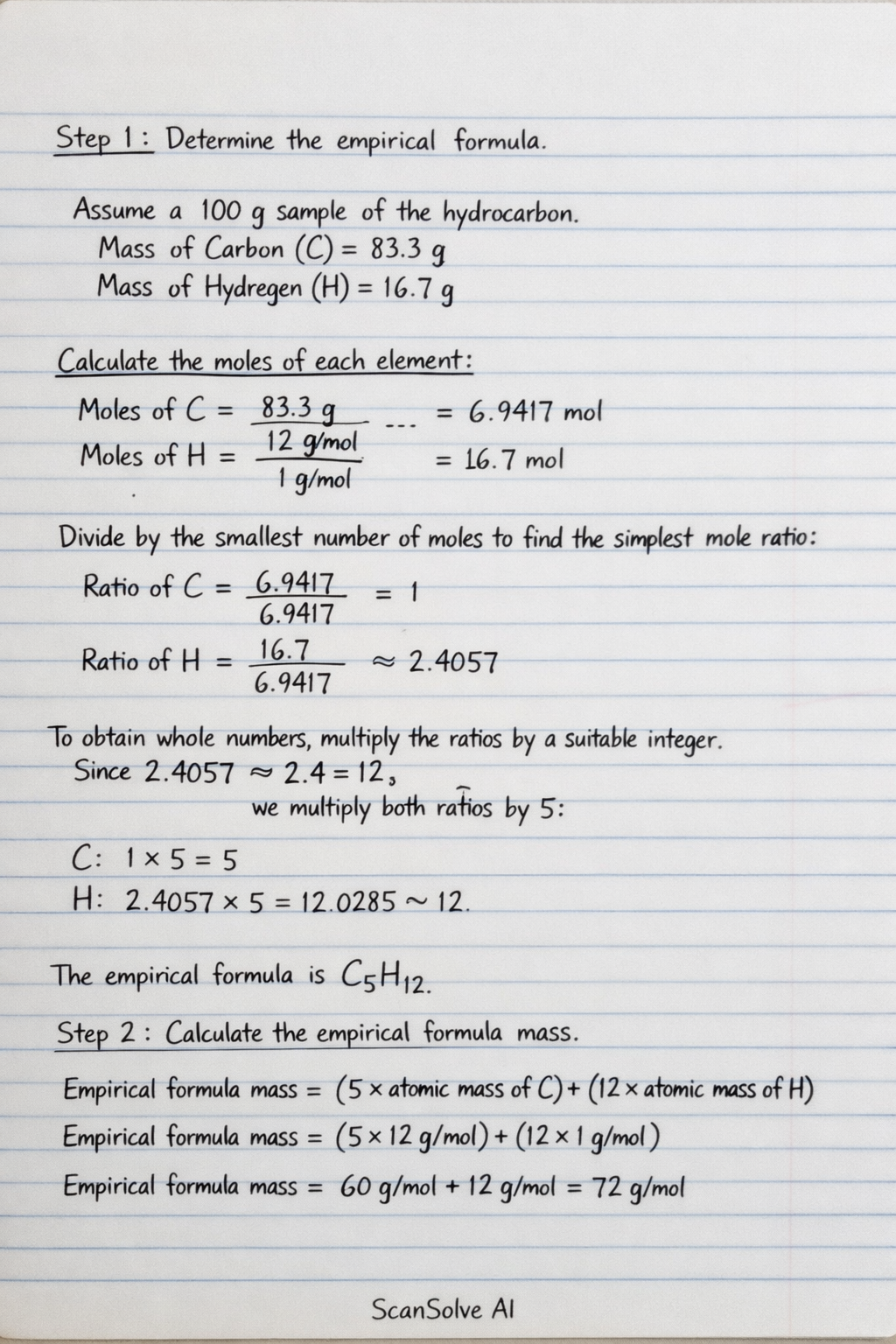
Handwritten Step-by-Step Solution
Get this as a handwritten image on WhatsApp — like a tutor wrote it for you.
Try on WhatsApp