
We read your photo as:
Calculate the moles of NaCl, Au, glucose, and N2 given their respective amounts in formula units, atoms, and molecules.
ScanSolve AI Answer
Step-by-step solution
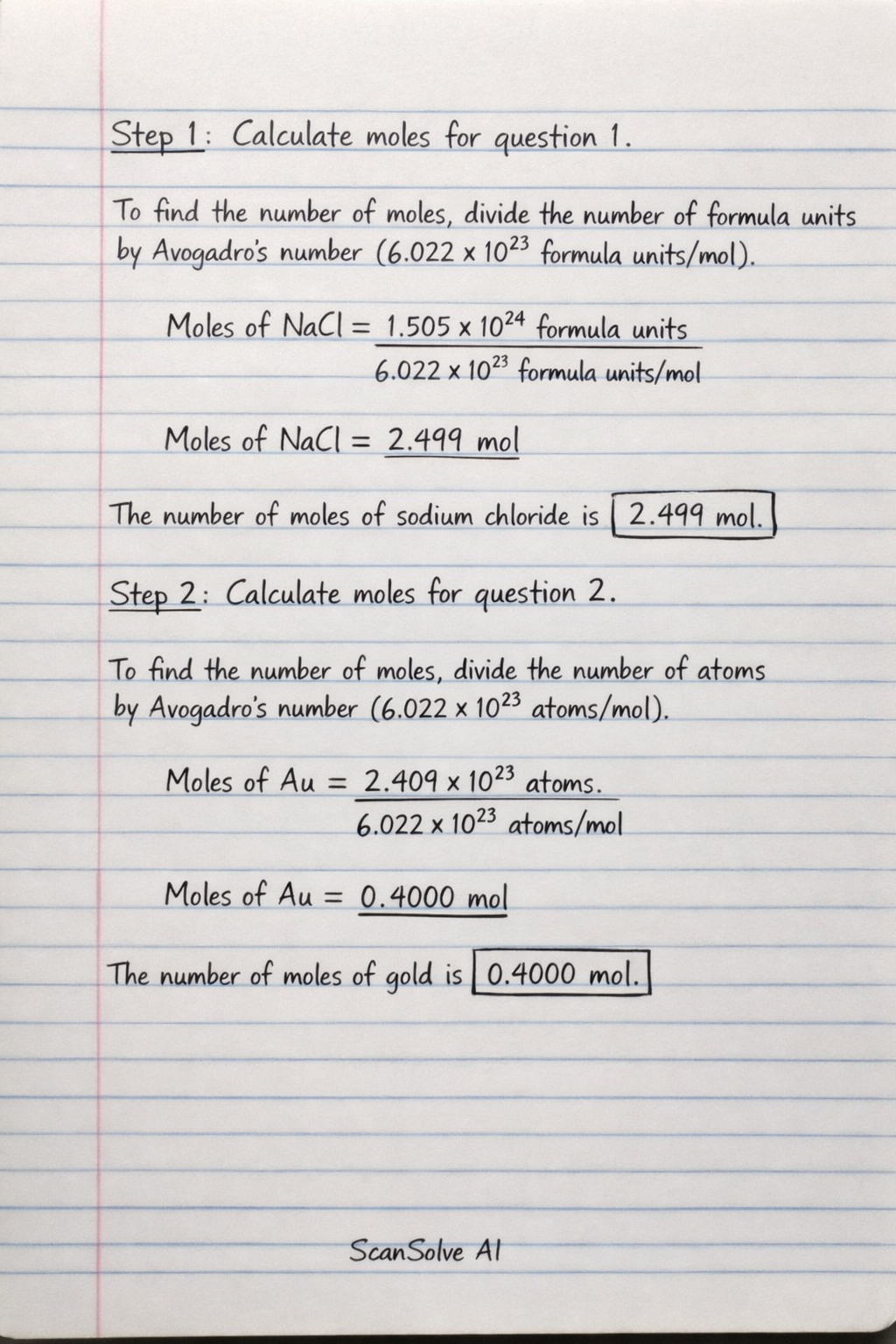
6 stepsCalculate moles for question 1.
To find the number of moles, divide the number of formula units by Avogadro's number ( formula units/mol).
The number of moles of sodium chloride is .
Calculate moles for question 2.
To find the number of moles, divide the number of atoms by Avogadro's number ( atoms/mol).
The number of moles of gold is .
Calculate moles for question 3.
To find the number of moles, divide the number of molecules by Avogadro's number ( molecules/mol).
The number of moles of glucose is .
Calculate moles for question 4.
To find the number of moles, divide the number of molecules by Avogadro's number ( molecules/mol).
The number of moles of nitrogen gas is .
Answer question 5.
A mole is the SI unit for the amount of substance. It is defined as the amount of substance that contains exactly elementary entities (atoms, molecules, ions, or formula units). It is important in chemistry because it provides a convenient way to count extremely large numbers of atoms or molecules and to relate macroscopic quantities (like mass) to microscopic quantities (like the number of particles) in chemical reactions.
Answer question 6.
The mole is directly related to Avogadro's number (). One mole of any substance contains exactly Avogadro's number of particles (atoms, molecules, ions, or formula units). This means that Avogadro's number is the conversion factor between the number of particles and the number of moles.
Still stuck on this one?
Ask a follow-up, and the answer starts from this question.
More Chemistry Questions
Handwritten Step-by-Step Solution
Get this as a handwritten image on WhatsApp — like a tutor wrote it for you.
Try on WhatsApp