

This chemistry question involves key chemical concepts and calculations. The detailed solution below walks through each step, from identifying the reaction type to computing the final answer.
ScanSolve AI Answer
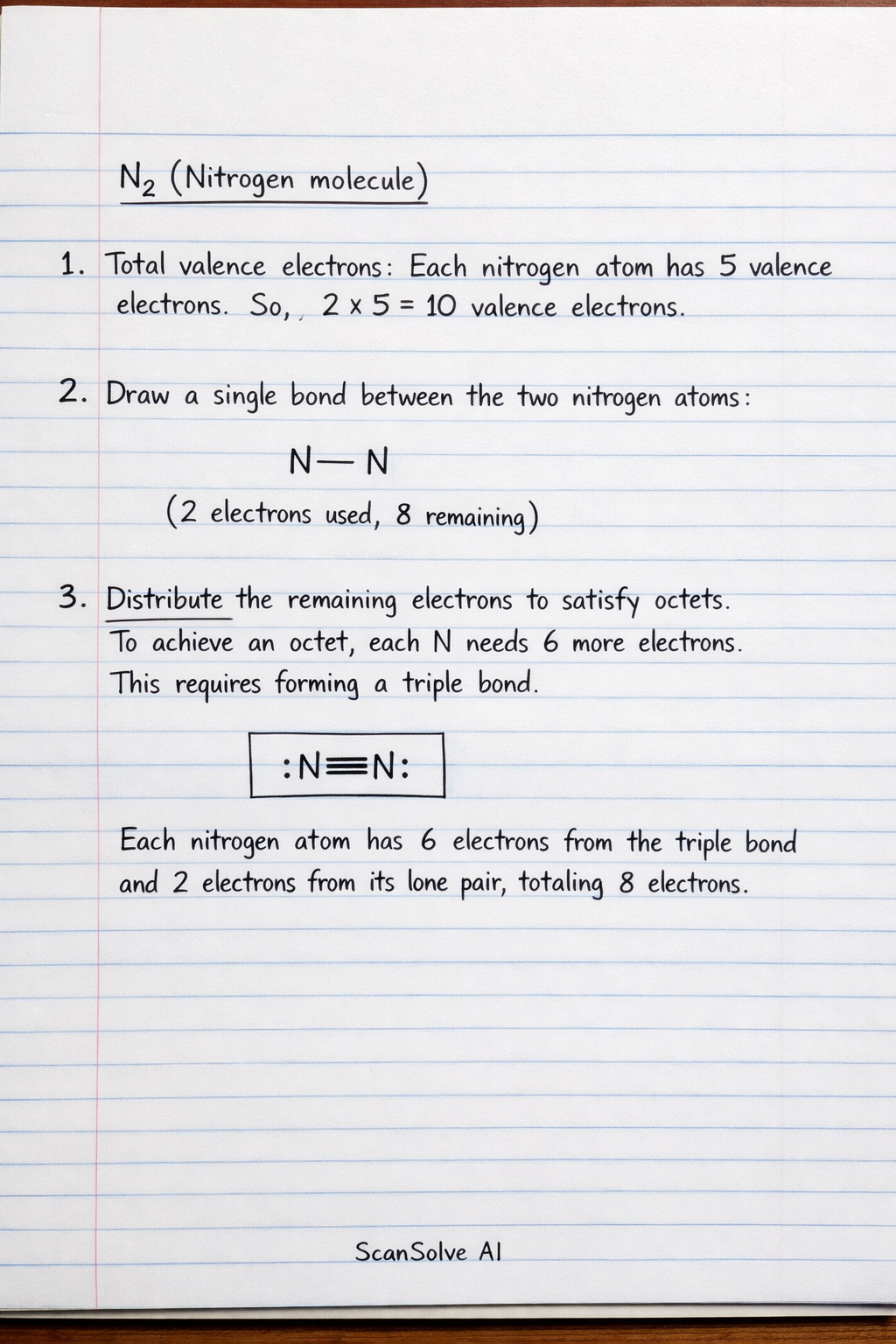
Here are the Lewis structures for N_2, O_2, Cl_2, and CO_2: N_2 (Nitrogen molecule) 1. Total valence electrons: Each nitrogen atom has 5 valence electrons. So, 2 × 5 = 10 valence electrons. 2. Draw a single bond between the two nitrogen atoms: N-N (2 electrons used, 8 remaining). 3. Distribute the remaining electrons to satisfy octets. To achieve an octet, each N needs 6 more electrons. This requires forming a triple bond. :N: Each nitrogen atom has 6 electrons from the triple bond and 2 electrons from its lone pair, totaling 8 electrons. O_2 (Oxygen molecule) 1. Total valence electrons: Each oxygen atom has 6 valence electrons. So, 2 × 6 = 12 valence electrons. 2. Draw a single bond between the two oxygen atoms: O-O (2 electrons used, 10 remaining). 3. Distribute the remaining 10 electrons as lone pairs. If 6 electrons are placed on each oxygen, that's 12 electrons, which is too many. Place 6 on one O and 4 on the other. 4. The oxygen with only 6 electrons (2 from bond + 4 from lone pairs) needs 2 more. Form a double bond by moving a lone pair from the other oxygen. :O=O: Each oxygen atom has 4 electrons from the double bond and 4 electrons from its two lone pairs, totaling 8 electrons. Cl_2 (Chlorine molecule) 1. Total valence electrons: Each chlorine atom has 7 valence electrons. So, 2 × 7 = 14 valence electrons. 2. Draw a single bond between the two chlorine atoms: Cl-Cl (2 electrons used, 12 remaining). 3. Distribute the remaining 12 electrons as lone pairs to satisfy octets. Each chlorine atom needs 6 more electrons. :Cl-Cl: Each chlorine atom has 2 electrons from the single bond and 6 electrons from its three lone pairs, totaling 8 electrons. CO_2 (Carbon dioxide) 1. Total valence electrons: Carbon has 4, and each oxygen has 6. So, 4 + (2 × 6) = 16 valence electrons. 2. Carbon is the central atom. Draw single bonds to the oxygen atoms: O-C-O (4 electrons used, 12 remaining). 3. Distribute the remaining 12 electrons as lone pairs to the outer oxygen atoms first. Each oxygen needs 6 more electrons. :O-C-O: (6 electrons on each oxygen, 12 used. Central carbon has 4 electrons). 4. The central carbon atom only has 4 electrons. To achieve an octet, it needs 4 more electrons. Move one lone pair from each oxygen atom to form double bonds with the carbon atom. :O=C=O: Each oxygen atom has 4 electrons from the double bond and 4 electrons from its two lone pairs, totaling 8 electrons. The central carbon atom has 4 electrons from each double bond, totaling 8 electrons. 3 done, 2 left today. You're making progress.