
We read your photo as:
State and explain whether the reaction is exothermic or endothermic. Calculate the enthalpy change when 10 grams of NaOH is dissolved in water, given that the molar mass of sodium hydroxide is 40 gram
ScanSolve AI Answer
Step-by-step solution
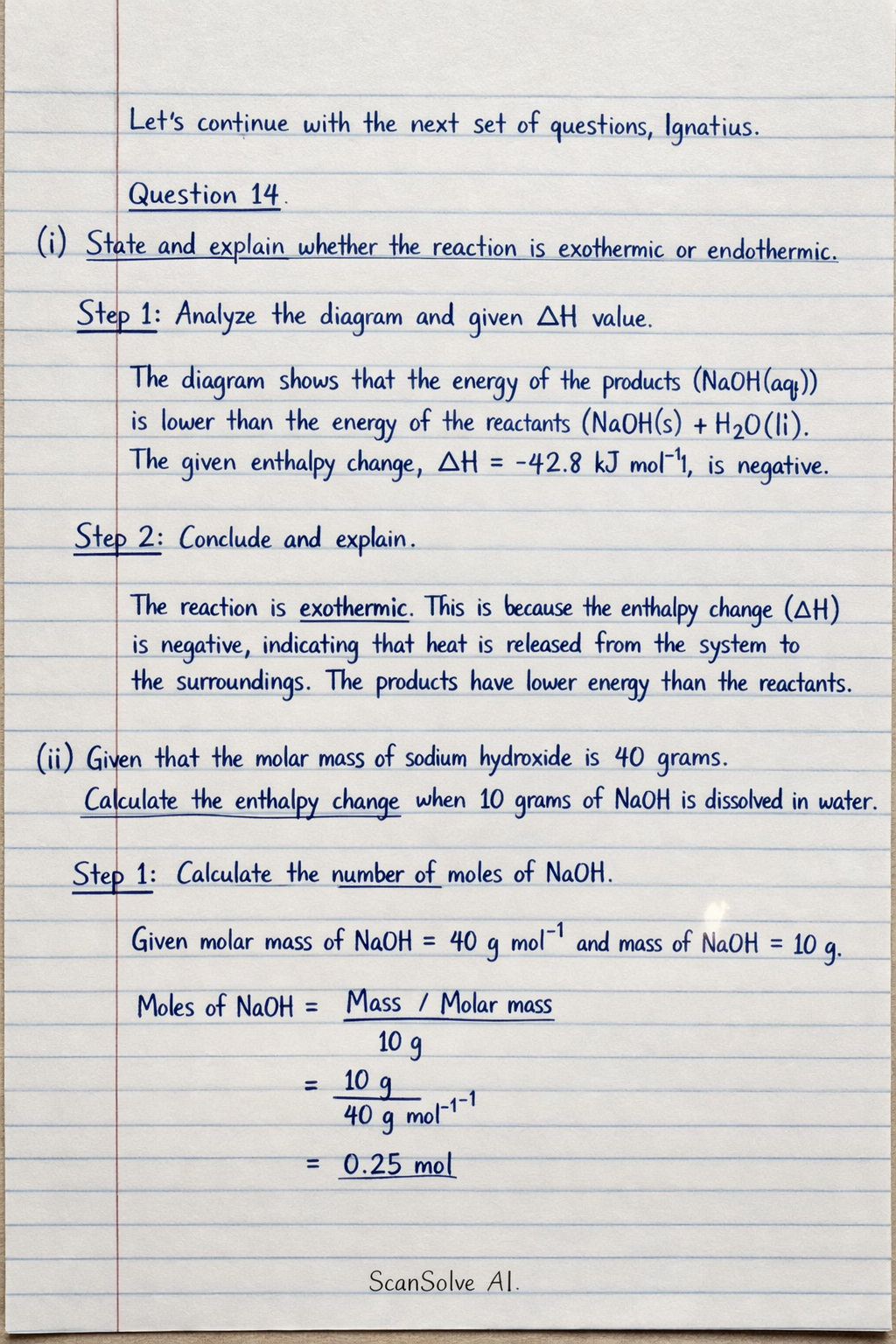
9 stepsLet's continue with the next set of questions, Ignatius.
Question 14
i) State and explain whether the reaction is exothermic or endothermic.
Analyze the diagram and given value.
The diagram shows that the energy of the products (NaOH(aq)) is lower than the energy of the reactants (NaOH(s) + HO(l)). The given enthalpy change, , is negative.
Conclude and explain.
The reaction is exothermic. This is because the enthalpy change () is negative, indicating that heat is released from the system to the surroundings. The products have lower energy than the reactants.
ii) Given that the molar mass of sodium hydroxide is 40 grams. Calculate the enthalpy change when 10 grams of NaOH is dissolved in water.
Calculate the number of moles of NaOH.
Given molar mass of NaOH = and mass of NaOH = .
Calculate the total enthalpy change.
The molar enthalpy change for dissolution is .
Question 15
i) Define molar heat of combustion of a substance.
The molar heat of combustion is the heat energy released when one mole of a substance undergoes complete combustion in excess oxygen under standard conditions.
ii) 1.26 grams of element Q was completely burned in air. The heat evolved was used to heat 250 cm³ of water, rising the temperature from 32 to 50°C. Calculate the relative atomic mass of element Q given that molar enthalpy of combustion is -360 kJ mol⁻¹ (density of water is 1 g cm⁻³ and specific heat capacity of water = 4.2 J g⁻¹ K⁻¹).
Calculate the mass of water.
Given volume of water = and density of water = .
Calculate the temperature change of water.
Initial temperature = , Final temperature = .
(Note: A change of is equivalent to a change of ).
Calculate the heat absorbed by water ().
Given specific heat capacity of water () = .
Convert Joules to kilojoules:
Calculate the number of moles of Q that reacted.
The heat evolved from the combustion of Q is equal to the heat absorbed by water.
Molar enthalpy of combustion of Q = .Calculate the relative atomic mass of Q.
Given mass of Q = .
Question 16
a) Explain why a plastic container is used instead of a metallic one.
A plastic container is used because plastic is a poor conductor of heat (an insulator). This minimizes heat loss to the surroundings, ensuring that the measured heat change for the reaction is as accurate as possible. A metallic container, being a good conductor of heat, would allow significant heat loss, leading to inaccurate results.
Still stuck on this one?
Ask a follow-up, and the answer starts from this question.
More Chemistry Questions
Handwritten Step-by-Step Solution
Get this as a handwritten image on WhatsApp — like a tutor wrote it for you.
Try on WhatsApp