
We read your photo as:
Please answer the following questions: 25) Why is magnesium ribbon cleaned before burning? 26) Identify compound X and the reaction type. Write the balanced equation. 27) Difference between arteries a
ScanSolve AI Answer
Step-by-step solution
3 stepsHere are the answers to your questions:
-
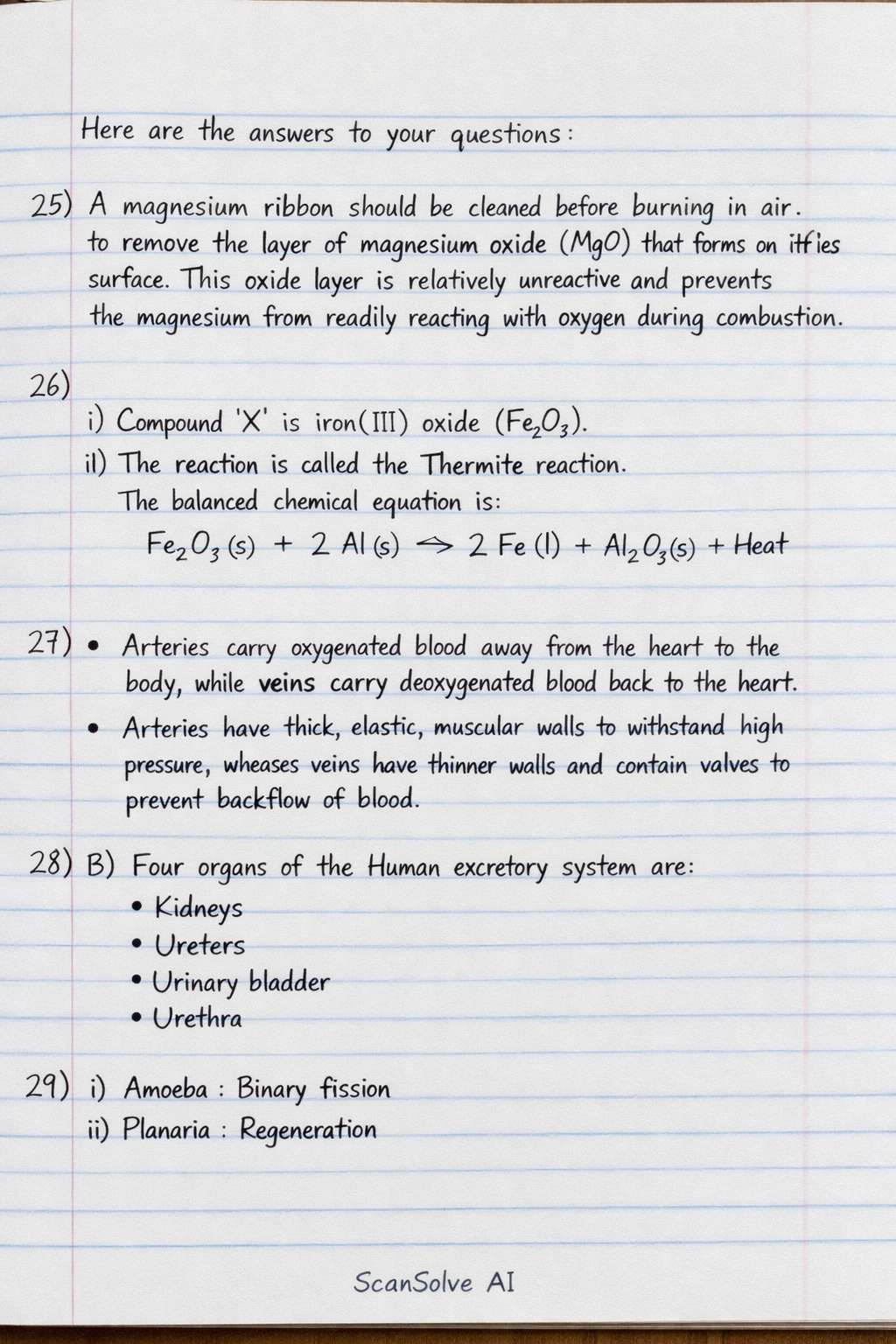
A magnesium ribbon should be cleaned before burning in air to remove the layer of magnesium oxide () that forms on its surface. This oxide layer is relatively unreactive and prevents the magnesium from readily reacting with oxygen during combustion.
i) Compound 'X' is iron(III) oxide ().
ii) The reaction is called the Thermite reaction.
The balanced chemical equation is:
- Arteries carry oxygenated blood away from the heart to the body, while veins carry deoxygenated blood back to the heart.
- Arteries have thick, elastic, muscular walls to withstand high pressure, whereas veins have thinner walls and contain valves to prevent backflow of blood.
- B) Four organs of the Human excretory system are:
- Kidneys
- Ureters
- Urinary bladder
- Urethra
i) Amoeba: Binary fission
ii) Planaria: Regeneration
-
Planets do not twinkle because they are much closer to Earth than stars and appear as extended sources of light. The light from a planet is considered a collection of many point sources. Any atmospheric turbulence that might cause one part of the planet's light to dim is compensated by another part brightening, resulting in a steady, non-twinkling appearance.
Identify the given values.
Voltage,
Current,Use the formula for power.
The power () of an electric bulb is given by the product of voltage () and current ():
Substitute the values and calculate the power.
The power of the bulb is .
- The resistance of a conductor depends on the following factors:
- Length of the conductor (Resistance is directly proportional to length).
- Area of cross-section of the conductor (Resistance is inversely proportional to the area of cross-section).
- Nature of the material of the conductor (Different materials have different resistivities).
- Temperature of the conductor (Resistance generally increases with temperature for metals).
Still stuck on this one?
Ask a follow-up, and the answer starts from this question.
More Chemistry Questions
Handwritten Step-by-Step Solution
Get this as a handwritten image on WhatsApp — like a tutor wrote it for you.
Try on WhatsApp