
We read your photo as:
State any two uses of sodium, magnesium, copper, zinc, aluminium, iron, gold, and silver. Distinguish between hard and soft water and state 3 advantages of each.
Chemistry
ScanSolve AI Answer
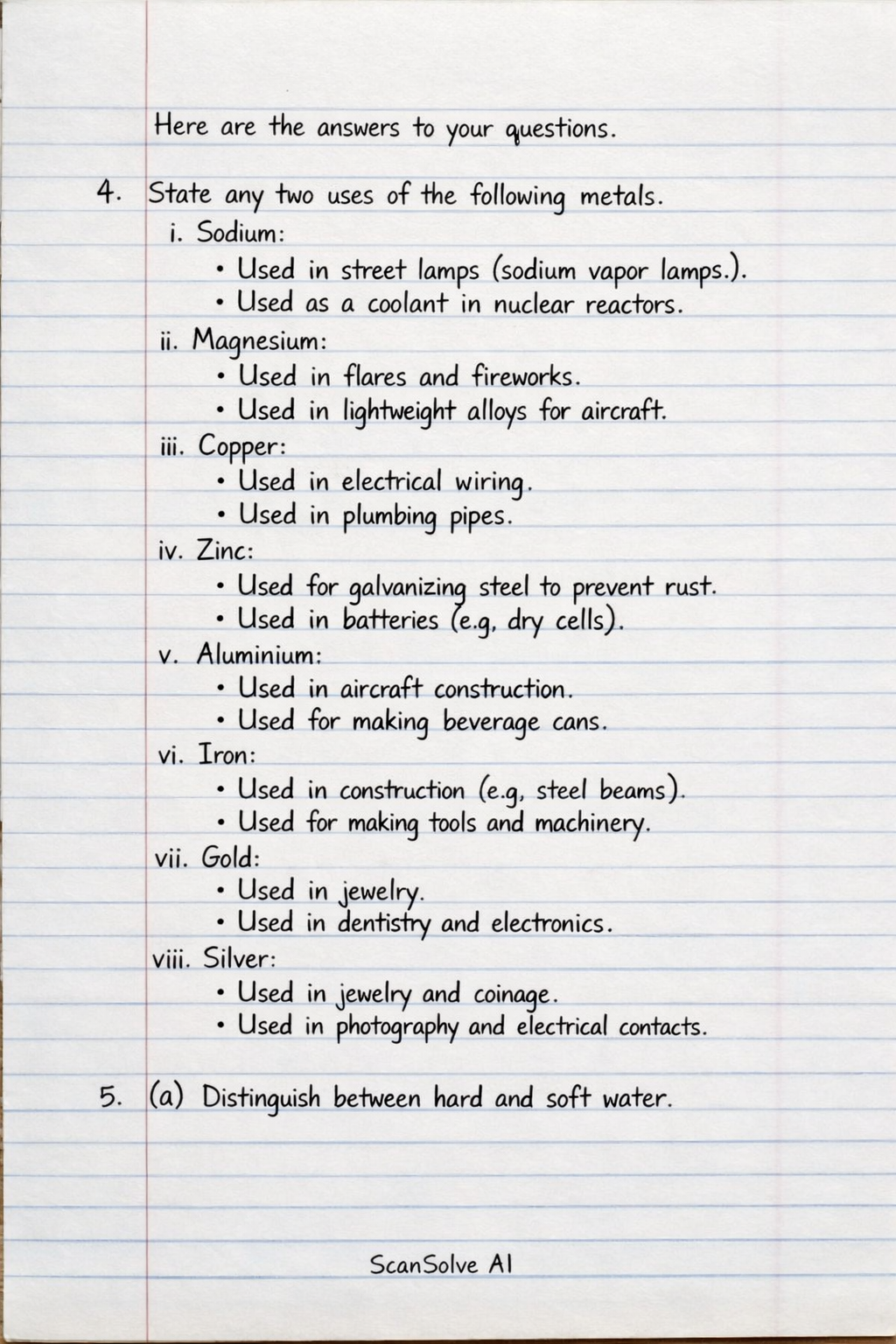
Here are the answers to your questions.
4. State any two uses of the following metals.
- i. Sodium:
- Used in street lamps (sodium vapor lamps).
- Used as a coolant in nuclear reactors.
- ii. Magnesium:
- Used in flares and fireworks.
- Used in lightweight alloys for aircraft.
- iii. Copper:
- Used in electrical wiring.
- Used in plumbing pipes.
- iv. Zinc:
- Used for galvanizing steel to prevent rust.
- Used in batteries (e.g., dry cells).
- v. Aluminium:
- Used in aircraft construction.
- Used for making beverage cans.
- vi. Iron:
- Used in construction (e.g., steel beams).
- Used for making tools and machinery.
- vii. Gold:
- Used in jewelry.
- Used in dentistry and electronics.
- viii. Silver:
- Used in jewelry and coinage.
- Used in photography and electrical contacts.
5. (a) Distinguish between hard and soft water.
- Hard water contains dissolved mineral ions, primarily calcium () and magnesium () ions, and does not readily form lather with soap.
- Soft water contains very few or no dissolved mineral ions and readily forms lather with soap.
5. (b) State 3 advantages of soft water and 3 advantages of hard water.
- Advantages of soft water:
- Forms lather easily with soap, reducing soap consumption.
- Does not form scale in pipes and boilers, preventing blockages.
- Better for washing clothes and dishes as it cleans more effectively.
- Advantages of hard water:
- Contains essential minerals like calcium and magnesium, beneficial for human health.
- Has a pleasant taste due to dissolved minerals.
- Suitable for brewing beer and tanning leather.
5. (c) State 2 disadvantages of soft water and 2 disadvantages of hard water.
- Disadvantages of soft water:
- Lacks beneficial minerals like calcium and magnesium.
- Can be corrosive to lead pipes, dissolving lead into the water.
- Disadvantages of hard water:
- Wastes soap as it does not readily form lather.
- Forms scale (limescale) in kettles, pipes, and boilers, reducing efficiency.
5. (d) Explain any 3 ways of removing water hardness.
- 1. Boiling: This method removes temporary hardness. Boiling causes the soluble bicarbonates of calcium and magnesium to decompose into insoluble carbonates, which then precipitate out.
- 2. Adding washing soda (sodium carbonate): Washing soda reacts with calcium and magnesium ions to form insoluble carbonates, which precipitate out of the water. This method removes both temporary and permanent hardness.
- 3. Ion exchange method: Hard water is passed through a column containing ion-exchange resins. These resins exchange their sodium ions for the calcium and magnesium ions present in the hard water, effectively softening it.
Was this helpful?
Still stuck on this one?
Ask a follow-up, and the answer starts from this question.
Got a different question?Ask your own question
More Chemistry Questions
QList the uses for the following metals: Silver, Copper, Zinc, Calcium, and Tungsten.QA) Write the ionic forms of the following elements: i) Sodium (Na), ii) Calcium (Ca), iii) Aluminium…QDescribe the physical and chemical properties of water, the difference between hard and soft water…QMetals and their compounds. Their general properties Alkali metals eg. Sodium. Sodium hydroxide…QExplain methods for water purification, water softening, air drying, and the properties and uses of…
Handwritten Step-by-Step Solution
Get this as a handwritten image on WhatsApp — like a tutor wrote it for you.
Try on WhatsApp