
We read your photo as:
Which of the following is the definition of Avogadro's constant? What is the empirical formula for C6H12O6? What technique is used to determine the atomic and molecular structure of a crystal?
ScanSolve AI Answer
Answer
Step-by-step solution
11 stepsAnalyze Question 1.
The number of particles in 1 mole of any substance is defined as Avogadro's constant, which is approximately particles/mol.
- A Molar mass is the mass of one mole of a substance.
- B Avogadro's constant is the number of particles in one mole.
- C Atomic mass unit is a unit of mass used to express atomic and molecular weights.
- D Relative atomic mass is the ratio of the average mass of atoms of an element to of the mass of an atom of carbon-12.
The correct option is B.
Analyze Question 2.
The empirical formula is the simplest whole-number ratio of atoms in a compound. For the molecular formula , we find the greatest common divisor (GCD) of the subscripts 6, 12, and 6, which is 6.
Divide each subscript by 6:
The empirical formula is .The correct option is A.
Analyze Question 3.
X-ray diffraction (XRD) is a technique used to determine the atomic and molecular structure of a crystal. It reveals the crystal structure, including lattice parameters, and the arrangement of atoms within the crystal.
- A Electronic configuration of atoms is determined by quantum mechanics and spectroscopic methods.
- B Crystal structure and lattice parameters are directly determined by XRD.
- C Molecular weight of compounds is determined by techniques like mass spectrometry.
- D Chemical composition is determined by elemental analysis.
The correct option is B.
Analyze Question 4.
Dehydration of ethanol () at in the presence of a strong acid (like concentrated sulfuric acid) leads to intramolecular dehydration, forming an alkene.
The product is ethene.The correct option is A.
Analyze Question 5.
Methane () has a central carbon atom bonded to four hydrogen atoms. The carbon atom forms four single bonds and has no lone pairs. According to VSEPR theory, this leads to a tetrahedral geometry. To accommodate four single bonds, the carbon atom undergoes hybridization.
The correct option is C.
Analyze Question 6.
The industrial preparation of ammonia is known as the Haber-Bosch process. The balanced chemical equation for this reaction is:
From the stoichiometry, 1 mole of nitrogen reacts with 3 moles of hydrogen. Therefore, the ratio of nitrogen to hydrogen is 1:3.The correct option is A.
Analyze Question 7.
This question involves Raoult's Law, which states that the vapor pressure of a solvent above a solution is equal to the mole fraction of the solvent multiplied by the vapor pressure of the pure solvent.
Given:
Vapor pressure of pure water () =
Moles of glucose () =
Moles of water () =First, calculate the total moles in the solution:
Next, calculate the mole fraction of water ():
Now, apply Raoult's Law to find the vapor pressure of the solution ():
Rounding to one decimal place, the vapor pressure of the solution is approximately .
The correct option is B.
Analyze Question 8.
Transition metals often form colored compounds due to the presence of partially filled d-orbitals. When ligands approach the central metal ion, the d-orbitals split into different energy levels. Electrons can absorb energy (from visible light) and transition from a lower energy d-orbital to a higher energy d-orbital. This process is called d-d transition. The color observed is the complementary color of the light absorbed.
The correct option is D.
Analyze Question 9.
The thermal stability of Group 2 carbonates increases down the group. This is because as you go down the group, the size of the Group 2 cation () increases.
A larger cation has a lower charge density and therefore a lower polarizing power. A cation with lower polarizing power is less effective at distorting the electron cloud of the large carbonate anion (). Less distortion means the carbonate ion is more stable and less likely to decompose into and a metal oxide upon heating.The correct option is D.
Analyze Question 10.
Halogenoalkanes (alkyl halides, R-X) undergo nucleophilic substitution reactions with aqueous sodium hydroxide (). The hydroxide ion () acts as a nucleophile, replacing the halogen atom (X).
The product formed is an alcohol.The correct option is D.
Analyze Question 11.
In mass spectrometry, the molecular ion peak (often denoted as or ) corresponds to the intact molecule that has lost one electron. The mass-to-charge ratio () of this peak directly gives the molecular mass of the compound.
- A Fragment mass refers to the mass of smaller ions formed by the fragmentation of the molecular ion.
- B Isotope abundance can be determined from the relative intensities of peaks around the molecular ion peak (e.g., M+1, M+2 peaks).
- C Molecular mass is directly given by the molecular ion peak.
- D Bond energy is a thermodynamic property and is not directly measured by mass spectrometry.
The correct option is C.
Try one yourself
A new problem that tests the same skill.
Still stuck on this one?
Ask a follow-up, and the answer starts from this question.
More Chemistry Questions
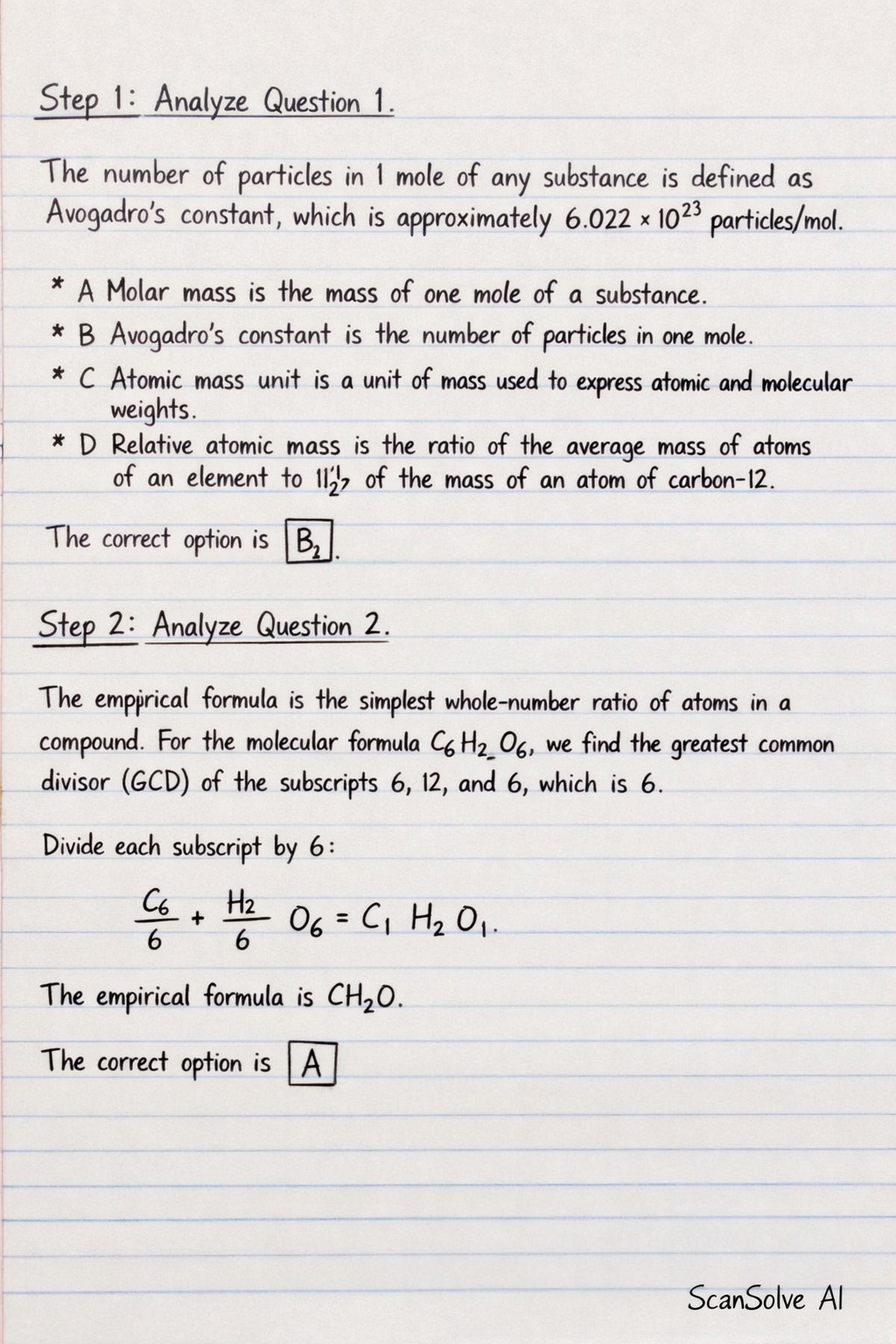
Handwritten Step-by-Step Solution
Get this as a handwritten image on WhatsApp — like a tutor wrote it for you.
Try on WhatsApp