
We read your photo as:
What is the empirical formula of C4H8O2? What is a mole and what is Avogadro's constant? What are the applications of X-ray diffraction?
ScanSolve AI Answer
Answer
Step-by-step solution
14 stepsPart 1· 2 steps
Recall the definition of a mole.
A mole is defined as the amount of substance that contains Avogadro's constant number of particles.
Identify Avogadro's constant.
Avogadro's constant is approximately particles per mole.
The correct option is B.
Part 2· 3 steps
Write the given molecular formula.
The molecular formula is .
Find the greatest common divisor (GCD) of the subscripts.
The subscripts are 4, 8, and 2. The GCD of 4, 8, and 2 is 2.
Divide each subscript by the GCD to find the empirical formula.
.
The correct option is C.
Part 3· 2 steps
Recall the applications of X-ray diffraction (XRD).
XRD is a technique used to determine the atomic and molecular structure of a crystal. It reveals the crystal structure, including the arrangement of atoms, bond lengths, and bond angles.
Evaluate the given options.
- A: Electronic configuration of atoms is determined by quantum mechanics and spectroscopy, not directly by XRD.
- B: Crystal structure and lattice parameters are directly determined by XRD.
- C: Molecular weight of compounds is determined by mass spectrometry or colligative properties, not directly by XRD.
- D: Chemical composition is determined by elemental analysis, not directly by XRD.
The correct option is B.
Part 4· 2 steps
Identify the reactant and reaction conditions.
Reactant: Ethanol ().
Conditions: Dehydration at (typically with a strong acid catalyst like concentrated or ).Determine the product of dehydration.
Dehydration of an alcohol involves the removal of a water molecule () to form an alkene.
The product is ethene.The correct option is A.
Part 5· 3 steps
Determine the central atom and its bonding.
In methane (), carbon is the central atom, bonded to four hydrogen atoms via single bonds.
Count the number of electron domains around the central atom.
There are four single bonds and no lone pairs on the carbon atom. Thus, there are four electron domains.
Determine the hybridization based on the number of electron domains.
Four electron domains correspond to hybridization.
The correct option is D.
Part 6· 2 steps
Recall the Haber process for ammonia synthesis.
The Haber process is .
Identify factors that affect reaction rate.
- A: Temperature: Increasing temperature generally increases reaction rate.
- B: Pressure: For gaseous reactions, increasing pressure (by increasing concentration of reactants) increases reaction rate.
- C: Catalyst: A catalyst increases reaction rate by lowering activation energy.
- D: Chemical composition only: This is too vague and not a direct factor influencing the rate of a given reaction. The chemical composition defines the reaction, but not its rate under varying conditions.
The correct option is D. (Assuming "chemical composition only" refers to the inherent nature of the reactants, which determines the potential for reaction, but not the rate under specific conditions. The other options are direct factors affecting the rate.)
Self-correction: The question asks what the industrial preparation of ammonia involves in the rates. It's asking about factors affecting the rate. Temperature, pressure, and catalyst are all factors. "Chemical composition only" is not a factor that changes the rate for a given reaction. The question is poorly phrased, but among the choices, A, B, and C are known factors. D is not a factor that varies to change the rate. Let's re-read the options carefully.
A: A 13
B: B 11
C: C 1
D: D 23
These options are numbers, not factors. This indicates the question is likely asking about the order of the reaction or some numerical value related to the rate, which is not provided in the question stem.
Given the options are numbers, this question is unanswerable as stated. It seems to be a multiple-choice question where the options are numerical values, but the question asks about factors affecting the rate. There might be missing context or the question is flawed.
Assumption: If the question is asking about the order of the reaction with respect to one of the reactants, or the overall order, that information is not given.
Let's assume the question is asking about the number of factors that influence the rate of the industrial preparation of ammonia.
Factors influencing rate:- Concentration of (related to pressure)
- Concentration of (related to pressure)
- Temperature
- Presence of a catalyst So, there are at least 3-4 main factors. None of the options (13, 11, 1, 23) make sense in this context.
Let's re-examine the image for Question 6. The options are A, B, C, D with numbers 13, 11, 1, 23. This is highly unusual for a question about factors affecting rate.
If it's a typo and it's asking for the order of the reaction, that information is not provided.
Given the options are numbers, and the question is "The industrial preparation of ammonia involves reaction of nitrogen and hydrogen in the rates", it's possible it's asking for something like the rate constant or a specific rate value under certain conditions, which is not given.
However, if I have to choose the most plausible interpretation given the options are numbers, and assuming it's a multiple choice question, it's impossible to answer without more context.Let's assume there's a typo and the question
Try one yourself
A new problem that tests the same skill.
Still stuck on this one?
Ask a follow-up, and the answer starts from this question.
More Chemistry Questions
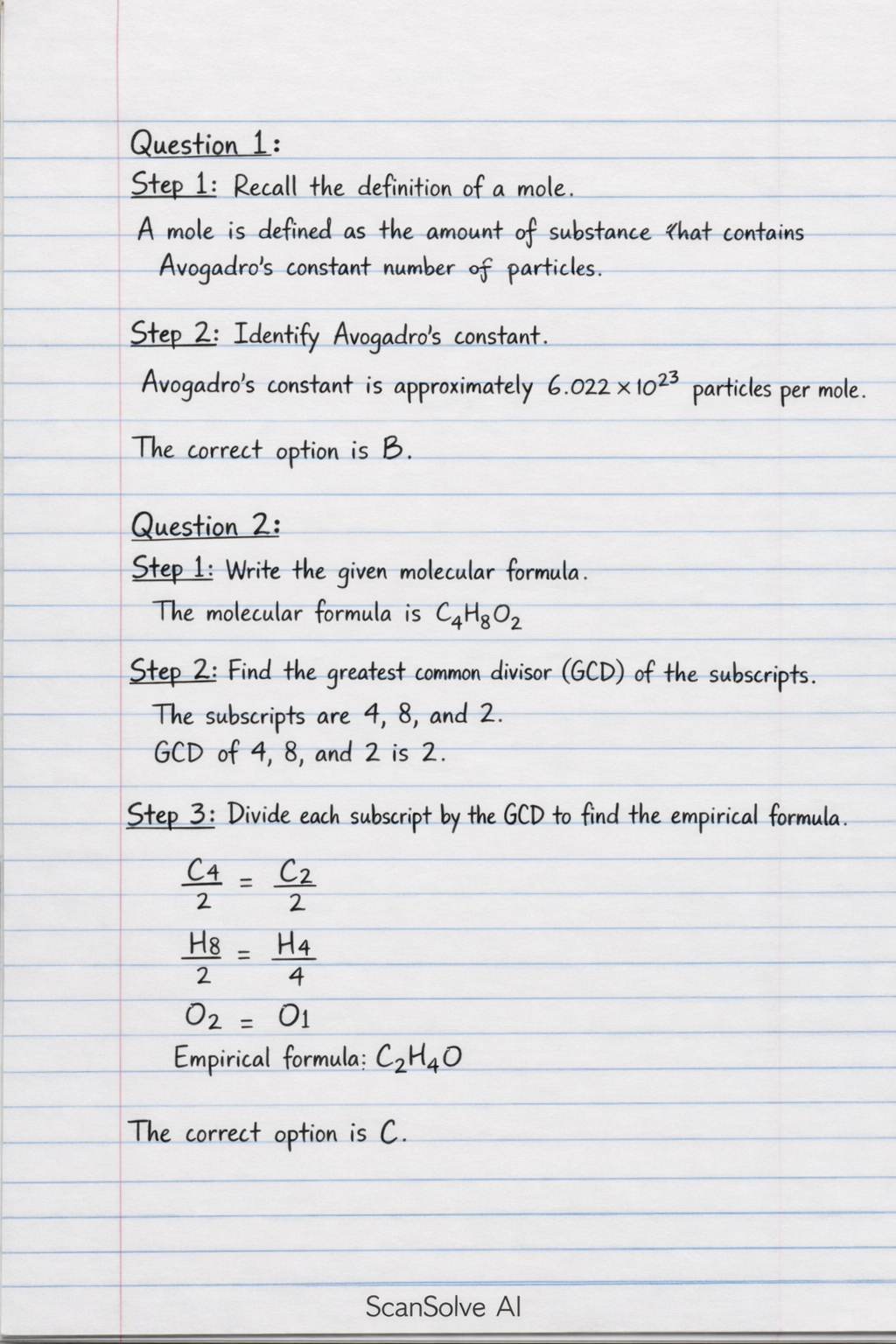
Handwritten Step-by-Step Solution
Get this as a handwritten image on WhatsApp — like a tutor wrote it for you.
Try on WhatsApp