
We read your photo as:
The empirical formula of a compound is given as C 2H 4O. Its relative molecular mass would be [C = 12; H = 1; 0 = 16]
ScanSolve AI Answer
Step-by-step solution
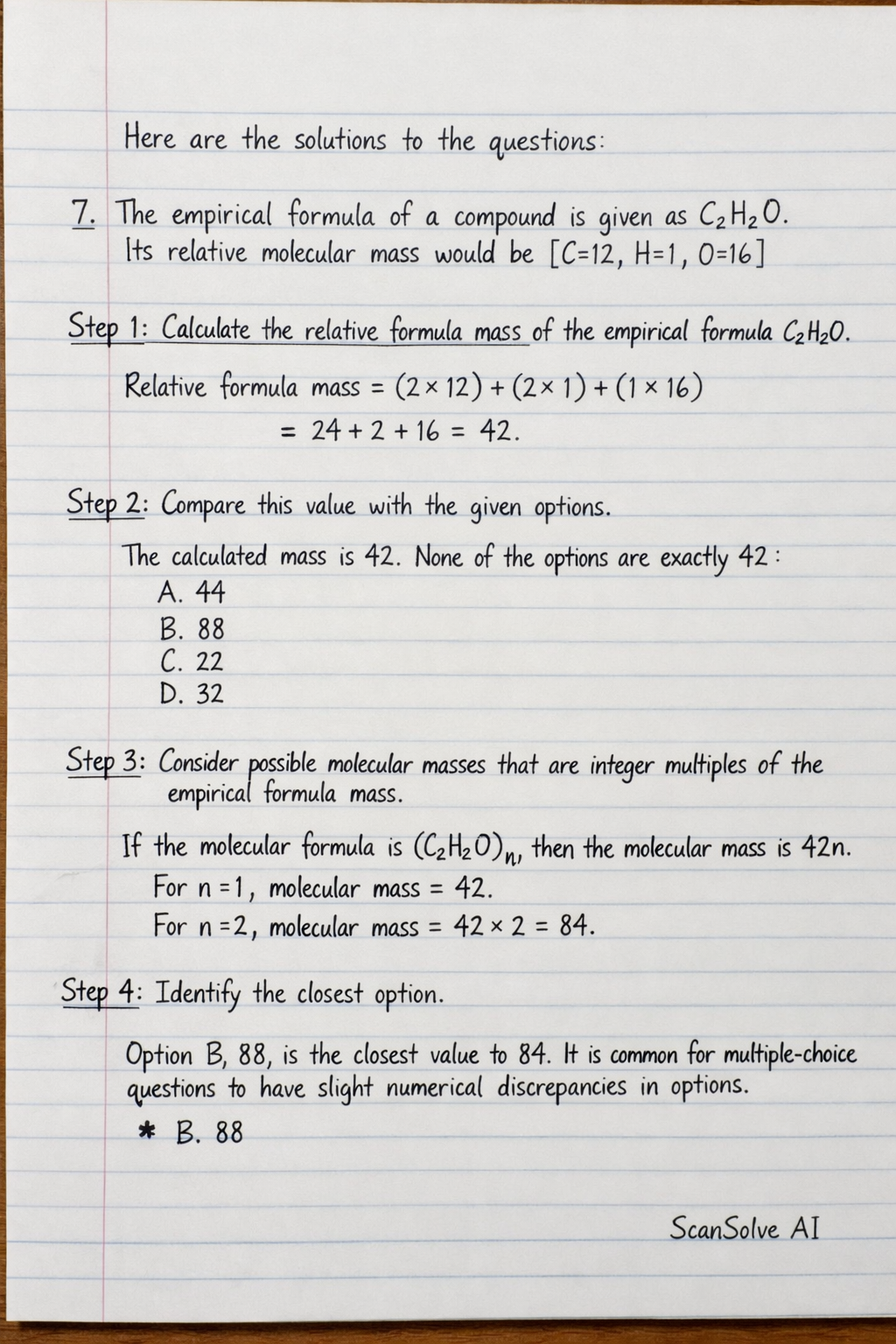
13 stepsHere are the solutions to the questions:
7. The empirical formula of a compound is given as . Its relative molecular mass would be [C=12, H=1, O=16]
Calculate the relative formula mass of the empirical formula .
Relative formula mass = .
Compare this value with the given options.
The calculated mass is 42. None of the options are exactly 42.
A. 44
B. 88
C. 22
D. 32Consider possible molecular masses that are integer multiples of the empirical formula mass.
If the molecular formula is , then the molecular mass is .
For , molecular mass = 42.
For , molecular mass = .Identify the closest option.
Option B, 88, is the closest value to 84. It is common for multiple-choice questions to have slight numerical discrepancies in options.
- B. 88
8. A balloon was filled with a mixture containing equal volumes of , He and . Which of the following statements about the gases is correct?
According to Avogadro's Law, equal volumes of gases at the same temperature and pressure contain an equal number of molecules (or moles).- A. The masses of , He and would not be equal because they have different molar masses.
- B. The number of molecules of would be equal to and He, not the greatest, due to equal volumes.
- C. According to Dalton's Law of Partial Pressures, the total pressure of a gas mixture is the sum of the partial pressures of its component gases. This statement is correct.
- D. Diffusion rate is inversely proportional to the square root of molar mass (Graham's Law). (molar mass 2 g/mol) would diffuse fastest, not He (molar mass 4 g/mol).
- C. The pressure in the balloon would be a sum of the partial pressures of , He and .
9. Which of the following molecules possesses polar bonds but is non-polar?
A molecule is non-polar if its bond dipoles cancel out due to symmetry, even if it contains polar bonds.- A. Sulphur(IV) oxide () has a bent shape and is polar.
- B. Water () has a bent shape and is polar.
- C. Ammonia () has a trigonal pyramidal shape and is polar.
- D. Carbon(IV) oxide () has polar C=O bonds, but its linear and symmetrical structure causes the bond dipoles to cancel out, making the molecule non-polar.
- D. Carbon(IV) oxide
10. Which of the following carbohydrates contains fructose?
- A. Lactose is a disaccharide of glucose and galactose.
- B. Galactose is a monosaccharide.
- C. Cellulose is a polysaccharide made of glucose units.
- D. Sucrose is a disaccharide composed of one glucose unit and one fructose unit.
- D. Sucrose
11. A suitable substance used to purify ethanol is
To purify ethanol, especially from water, a drying agent is used.- A. Tetraoxosulphate(VI) acid (concentrated ) is a strong dehydrating agent but can react with ethanol.
- B. Zinc dust is a reducing agent, not typically used for drying ethanol.
- C. Calcium chloride () is an effective and commonly used drying agent (desiccant) for organic solvents like ethanol, forming hydrates with water.
- D. Calcium oxide () is also a drying agent, but calcium chloride is generally preferred for drying organic solvents.
- C. calcium chloride
12. Consider the following reaction equation:
It can be deduced thatAssign oxidation states.
In , is +1, is -2.
In , is 0.
In , is +1, is -2.
In , is 0.Analyze changes in oxidation states.
- Copper changes from +1 to 0 (reduction).
- X changes from 0 to +1 (oxidation).
- Sulfur remains -2.
Evaluate the options.
- A. The oxidation number of X increases (from 0 to +1). This is correct.
- B. X is oxidized, not necessarily a precipitating agent.
- C. is reduced (Cu gains electrons), not lost electrons.
- D. X is oxidized, meaning it is a reducing agent, not an oxidizing agent.
- A. the oxidation number of X increases.
13. How many sub-atomic particles are contained in ?
Identify protons.
The atomic number (bottom number) is 13, so there are 13 protons.
Identify neutrons.
The mass number (top number) is 27. Neutrons = Mass number - Protons = neutrons.
Identify electrons.
The charge is +3, meaning 3 electrons have been lost from a neutral atom. A neutral atom would have 13 electrons. So, electrons = electrons.
Sum the sub-atomic particles.
Total particles = Protons + Neutrons + Electrons = .
- D. 37
14. Magnesium oxide is an example of
Magnesium oxide () is an ionic compound formed between a metal (magnesium) and oxygen. Metal oxides are generally basic.- A. a basic oxide: Correct. reacts with acids to form salt and water.
- B. an amphoteric oxide: Amphoteric oxides react with both acids and bases (e.g., ). is not amphoteric.
- C. a neutral oxide: Neutral oxides do not react with acids or bases (e.g., ). is not neutral.
- D. an acidic oxide: Acidic oxides are typically non-metal oxides (e.g., ). is not acidic.
- A. a basic oxide.
15. A particle that is made up of 10 electrons and 13 protons is
Determine the charge.
Charge = (number of protons) - (number of electrons) = .
Classify the particle.
A particle with a net positive charge is called a cation.
- D. a cation.
16. A molecule is the smallest independent particle of
A molecule is the smallest particle of a substance (element or compound) that retains the chemical properties of that substance and is capable of independent existence.- A. an ion: An ion is a charged atom or molecule.
- B. an atom: An atom is the smallest unit of an element. Molecules are made of atoms.
- C. an element: Some elements (like , ) exist as molecules, but not all (e.g., noble gases are monatomic, metals are giant structures). This option is partially correct but not universally true for all elements.
- D. a salt: Salts are ionic compounds that exist as crystal lattices, not discrete molecules. Given the options, "an element" is the most plausible answer, referring to elements that exist as diatomic or polyatomic molecules.
- C. an element.
Still stuck on this one?
Ask a follow-up, and the answer starts from this question.
More Chemistry Questions
Handwritten Step-by-Step Solution
Get this as a handwritten image on WhatsApp — like a tutor wrote it for you.
Try on WhatsApp