
We read your photo as:
Which of the following mixtures are homogeneous except
ScanSolve AI Answer
Answer
Step-by-step solution
20 stepsHere are the solutions to the questions:
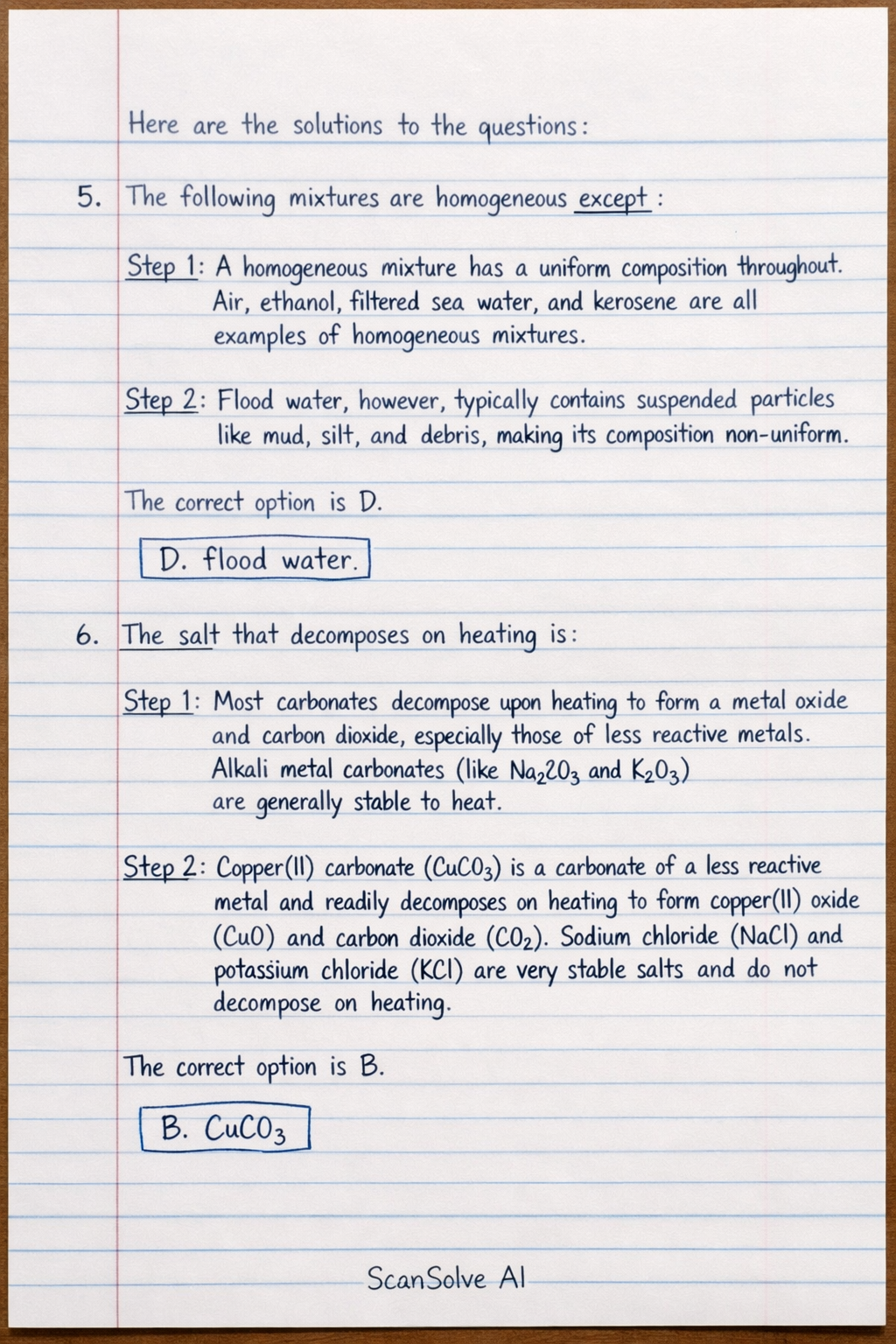
- The following mixtures are homogeneous except:
A homogeneous mixture has a uniform composition throughout.
Air, ethanol, filtered sea water, and kerosene are all examples of homogeneous mixtures.
Flood water, however, typically contains suspended particles like mud, silt, and debris, making its composition non-uniform.
The correct option is D. $$ \boxed{\text{D. flood water}} $$6. The salt that decomposes on heating is:
Most carbonates decompose upon heating to form a metal oxide and carbon dioxide, especially those of less reactive metals.
Alkali metal carbonates (like and ) are generally stable to heat.
Copper(II) carbonate () is a carbonate of a less reactive metal and readily decomposes on heating to form copper(II) oxide () and carbon dioxide ().
Sodium chloride () and potassium chloride () are very stable salts and do not decompose on heating.
The correct option is B.- The method that can be used to prevent rusting is:
Rusting is the corrosion of iron and its alloys, typically caused by the reaction of iron with oxygen and water.
Galvanising involves coating iron with a layer of zinc.
Zinc is more reactive than iron and acts as a sacrificial anode, corroding instead of the iron, thereby preventing rust.
The correct option is A.- Which of the following is a physical change?
A physical change alters the form of a substance but not its chemical composition.
A chemical change results in the formation of new substances.
Burning of firewood, dissolution of limestone in acid, fermentation of glucose, and rusting of iron all involve the formation of new chemical substances.
Dissolution of salt in water is a physical change because the salt can be recovered by evaporating the water, and no new chemical compounds are formed.
The correct option is C.- The following have linear molecular shapes except:
A linear molecular shape occurs when atoms are arranged in a straight line, typically in diatomic molecules or molecules where the central atom has no lone pairs and forms two bonds apart (e.g., ).
, , and are diatomic molecules and are inherently linear.
has a central carbon atom double-bonded to two oxygen atoms with no lone pairs, resulting in a linear shape. Water () has a central oxygen atom bonded to two hydrogen atoms and two lone pairs of electrons. These lone pairs repel the bonding pairs, giving a bent or angular molecular shape.
The correct option is E.- Which of the following elements has the highest ionisation energy?
Ionisation energy generally increases across a period from left to right and decreases down a group.
All the given elements (Li, Be, B, C, N) are in Period 2 of the periodic table.
Following the trend across Period 2, the ionisation energy generally increases from Lithium (Group 1) to Nitrogen (Group 15).
Nitrogen has a half-filled p-subshell, which contributes to its relatively high stability and thus higher ionisation energy compared to its neighbors.
The correct option is E.- Industrial wastes that are acidic can be treated with:
Acidic wastes need to be neutralized to prevent environmental damage.
Neutralization involves reacting an acid with a base.
Slaked lime, which is calcium hydroxide (), is a base.
It can react with acidic wastes to neutralize them. Brine, chlorine, ethanol, and water are not suitable for neutralizing acidic waste.
The correct option is D.- The alkaline hydrolysis of oil is:
Oils are triglycerides, which are esters.
Hydrolysis is the breaking down of a compound by reaction with water. Alkaline hydrolysis specifically refers to the reaction of an ester with a strong base (like NaOH or KOH).
The alkaline hydrolysis of fats and oils produces glycerol and fatty acid salts, which are commonly known as soap.
This process is called saponification.
The correct option is D.- Catalytic hydrogenation of vegetable oil produces:
Vegetable oils are typically unsaturated fats, meaning they contain carbon-carbon double bonds.
Hydrogenation is a chemical reaction that adds hydrogen atoms to these double bonds, converting them into single bonds. This process requires a catalyst (e.g., nickel).
This conversion changes the physical properties of the oil, making it more saturated and solid at room temperature.
Margarine is produced by the catalytic hydrogenation of vegetable oils.
The correct option is C.- Incomplete combustion of carbon produces:
Combustion is a chemical process where a substance reacts rapidly with oxygen, usually producing heat and light.
When carbon undergoes complete combustion in the presence of sufficient oxygen, it produces carbon dioxide ().
However, if there is insufficient oxygen, incomplete combustion occurs, leading to the formation of carbon monoxide () and/or soot (elemental carbon).
The correct option is D.
Try one yourself
A new problem that tests the same skill.
Still stuck on this one?
Ask a follow-up, and the answer starts from this question.
More Chemistry Questions
Handwritten Step-by-Step Solution
Get this as a handwritten image on WhatsApp — like a tutor wrote it for you.
Try on WhatsApp