
We read your photo as:
Which of the following statements about chemical bonding and acid definitions is correct?
ScanSolve AI Answer
This answer stops before the end.
It was cut off when it was first written. Ask ScanSolve this question again for the full working.
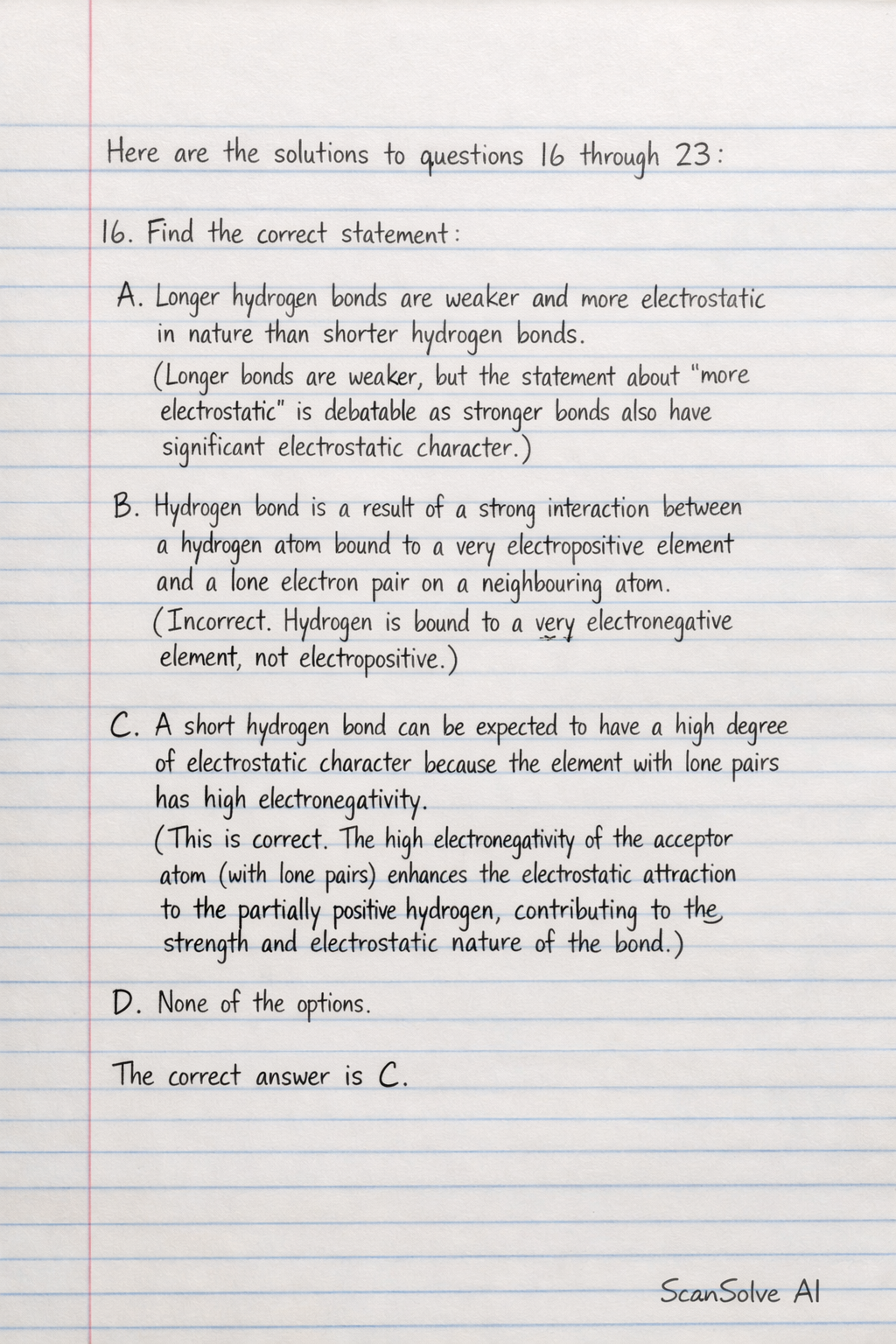
Here are the solutions to questions 16 through 23:
-
Find the correct statement:
- A. Longer hydrogen bonds are weaker and more electrostatic in nature than shorter hydrogen bonds. (Longer bonds are weaker, but the statement about "more electrostatic" is debatable as stronger bonds also have significant electrostatic character.)
- B. Hydrogen bond is a result of a strong interaction between a hydrogen atom bound to a very electropositive element and a lone electron pair on a neighbouring atom. (Incorrect. Hydrogen is bound to a very electronegative element, not electropositive.)
- C. A short hydrogen bond can be expected to have a high degree of electrostatic character because the element with lone pairs has high electronegativity. (This is correct. The high electronegativity of the acceptor atom (with lone pairs) enhances the electrostatic attraction to the partially positive hydrogen, contributing to the strength and electrostatic nature of the bond.)
- D. None of the options.
The correct answer is C.
-
Arrhenius defined an acid as:
- A. a species that can donate a proton. (Bronsted-Lowry definition)
- B. a species that can accept a proton. (Bronsted-Lowry definition of a base)
- C. a source of OH⁻ ions in water. (Arrhenius definition of a base)
- D. a source of H⁺ ions in water. (Arrhenius definition of an acid)
The correct answer is D.
-
In the Bronsted-Lowry system, a base is defined as:
- A. a proton donor. (This is a Bronsted-Lowry acid)
- B. a hydroxide donor. (This is an Arrhenius base)
- C. an electron-pair acceptor. (This is a Lewis acid)
- D. a water-former. (Not a definition of a base)
- E. a proton acceptor. (This is a Bronsted-Lowry base)
The correct answer is E.
-
In the equation:
-
Step 1: Identify proton transfer. HF donates a proton to . accepts a proton from HF.
-
Step 2: Classify reactants and products. HF is an acid (proton donor). is a base (proton acceptor). is the conjugate base of HF. is the conjugate acid of .
-
A. is a base and HF is its conjugate acid. (Incorrect)
-
B. is an acid and HF is the conjugate base. (Incorrect)
-
C. HF is an acid and is its conjugate base. (Correct)
-
D. HF is a base and is its conjugate acid. (Incorrect)
The correct answer is C.
-
-
For the system shown here: Bronsted would classify the base species as:
- Step 1: Identify proton transfer. donates a proton to . accepts a proton from .
- Step 2: Classify reactants and products. is an acid. is a base. is the conjugate acid of . is the conjugate base of .
- Step 3: Identify all base species. The base species are the proton acceptors: (reactant) and (product, which is the conjugate base).
The correct answer is C. and .
-
Which is the strongest acid?
- A. (Perchloric acid)
- B. (Chloric acid)
- C. (Chlorous acid)
- D. HF (Hydrofluoric acid)
For oxoacids with the same central atom, acidity increases with the number of oxygen atoms. Thus, . is one of the strongest known acids. HF is a weak acid. Therefore, is the strongest among the given options.
The correct answer is A. .
-
Which of these species is probably the weakest acid?
- A. (Phosphoric acid, )
- B. (Dihydrogen phosphate ion, )
- C. (Hydrogen phosphate ion, )
- D. (Nitric acid, a strong acid)
Acidity decreases significantly with each successive deprotonation of a polyprotic acid. is a strong acid. Comparing the phosphoric acid species, is stronger than , which is stronger than . Therefore, is the weakest acid among the choices.
The correct answer is C. .
-
Consider the neutralization reactions between the following acid-base pairs in dilute aqueous solutions: (1) This is a reaction between a weak acid (acetic acid) and a strong base (sodium hydroxide). The products are a salt (sodium acetate) and water.
Still stuck on this one?
Ask a follow-up, and the answer starts from this question.
More Chemistry Questions
Handwritten Step-by-Step Solution
Get this as a handwritten image on WhatsApp — like a tutor wrote it for you.
Try on WhatsApp