

This chemistry question involves key chemical concepts and calculations. The detailed solution below walks through each step, from identifying the reaction type to computing the final answer.
ScanSolve AI Answer
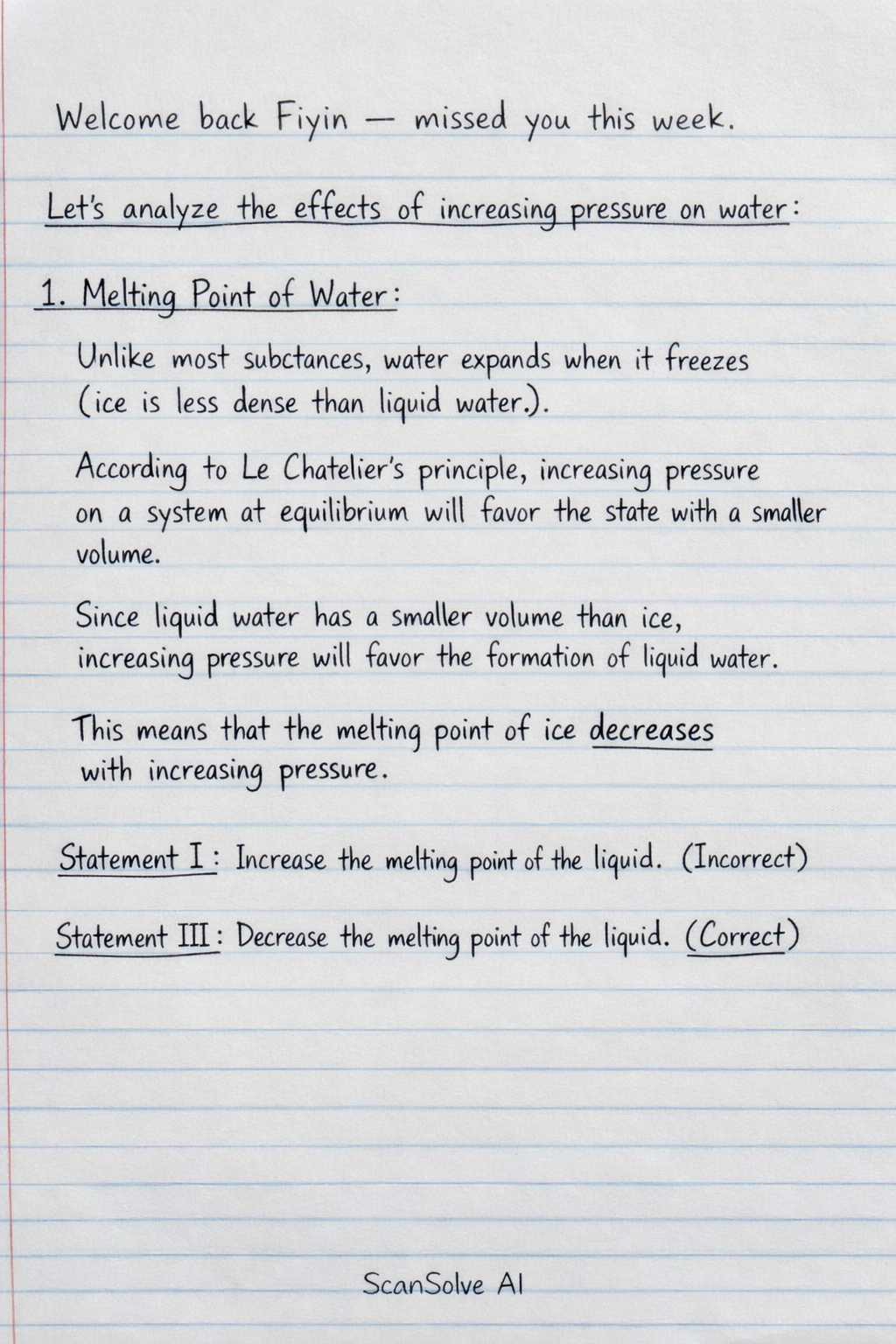
Welcome back fiyin — missed you this week. Let's analyze the effects of increasing pressure on water: 1. Melting Point of Water: Unlike most substances, water expands when it freezes (ice is less dense than liquid water). According to Le Chatelier's principle, increasing pressure on a system at equilibrium will favor the state with a smaller volume. Since liquid water has a smaller volume than ice, increasing pressure will favor the formation of liquid water. This means that the melting point of ice decreases with increasing pressure. Statement I: Increase the melting point of the liquid. (Incorrect) Statement III: Decrease the melting point of the liquid. (Correct*) 2. Boiling Point of Water: For all liquids, boiling occurs when the vapor pressure of the liquid equals the external atmospheric pressure. If the external pressure is increased, the liquid needs to reach a higher temperature to produce enough vapor pressure to overcome that external pressure. Therefore, increasing pressure increases the boiling point of water. Statement II: Increase the boiling point of the liquid. (Correct*) Statement IV: Decrease the boiling point of the liquid. (Incorrect) Based on this, statements II and III are correct. The final answer is A. Drop the next question.