
We read your photo as:
Which of the following statements is NOT true as we move from left to right along the periodic table? a) atomic number of elements increases; b) atomic mass of elements increases; c) electropositive c
ScanSolve AI Answer
Answer
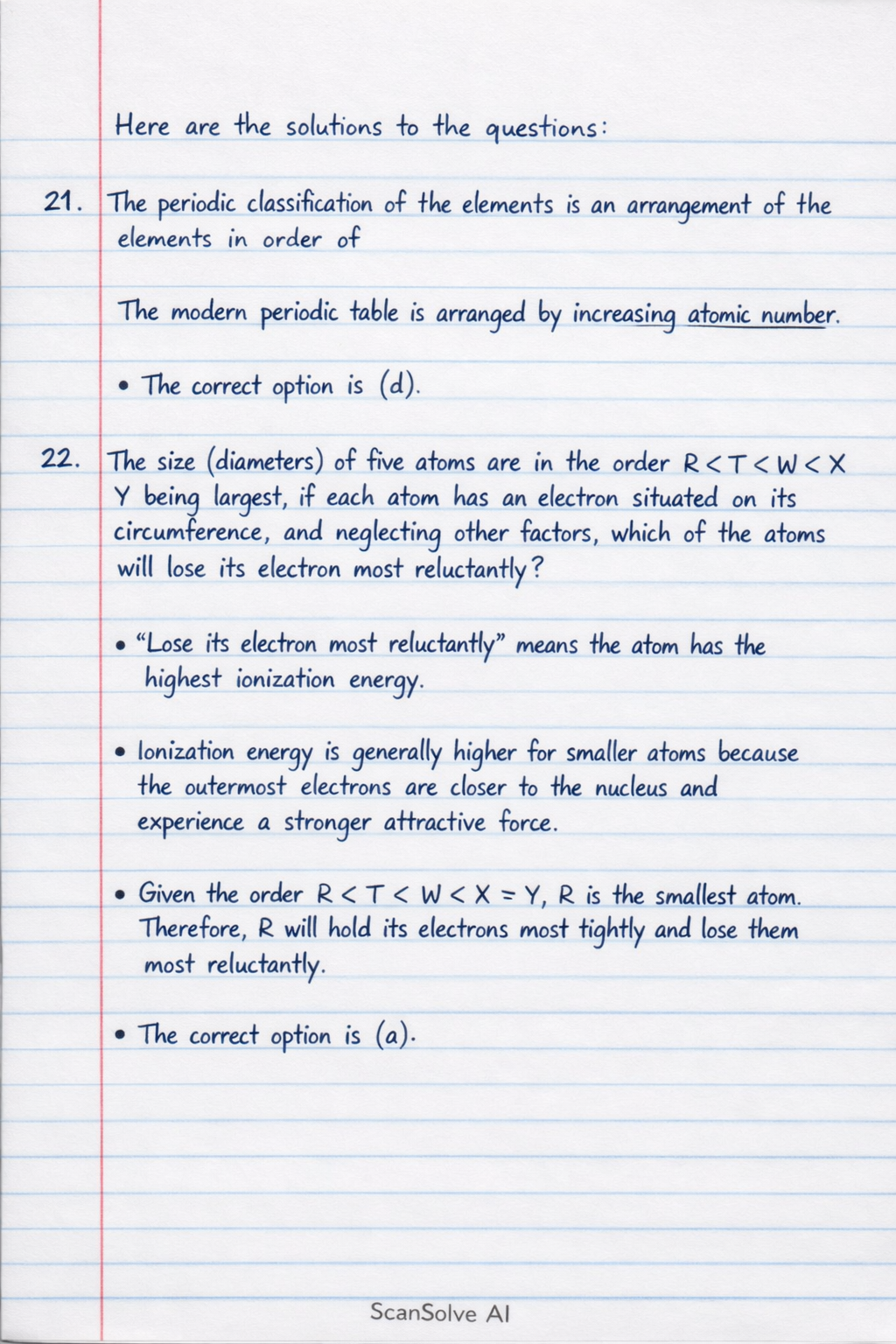
Here are the solutions to the questions:
21. The periodic classification of the elements is an arrangement of the elements in order of
The modern periodic table is arranged by increasing atomic number.
- The correct option is (d).
22. The size (diameters) of five atoms are in the order R < T < W < X < Y being largest, if each atom has an electron situated on its circumference, and neglecting other factors, which of the atoms will lose its electron most reluctantly?
- "Lose its electron most reluctantly" means the atom has the highest ionization energy.
- Ionization energy is generally higher for smaller atoms because the outermost electrons are closer to the nucleus and experience a stronger attractive force.
- Given the order R < T < W < X < Y, R is the smallest atom. Therefore, R will hold its electrons most tightly and lose them most reluctantly.
- The correct option is (a).
23. Indicate which of the following statements is not true as we move from left to right along the periodic table
- a) atomic number of elements increases: This is true. The periodic table is arranged by increasing atomic number.
- b) atomic mass of elements increases: This is generally true.
- c) electropositive character of elements increases: This is false. Electropositive character (tendency to lose electrons, metallic character) decreases from left to right across a period.
- d) electronegative character of elements increases: This is true. Electronegativity (tendency to gain electrons) increases from left to right across a period.
- The statement that is not true is (c).
24. Sodium and potassium belong to the same group of the periodic table. This is because
- Elements in the same group have similar chemical properties due to having the same number of valence electrons. Both sodium (Na) and potassium (K) are alkali metals (Group 1) and have 1 valence electron. They both tend to lose this electron to form +1 cations.
- a) both are metals: True, but not the fundamental reason for being in the same group.
- b) both are soft and lighter than water: True, but a consequence of their metallic nature, not the reason for their group placement.
- c) both form cations by losing electrons: This is a direct consequence of having 1 valence electron and thus a similar outermost electronic configuration, which is the basis for group classification.
- d) both have identical electronic configuration: False. They have similar outermost electronic configurations (e.g., for Na, for K), but not identical overall configurations.
- The best reason is (c).
25. The energy change accompanying the addition of an electron to a gaseous atom is called
- a) first ionization energy: Energy to remove the first electron.
- b) second ionization energy: Energy to remove the second electron.
- c) electron affinity: The energy change that occurs when an electron is added to a neutral gaseous atom to form a negative ion.
- d) electronegativity: A measure of the tendency of an atom to attract a bonding pair of electrons.
- The definition matches (c).
26. Four elements P, Q, R and S have atomic numbers of 4, 10, 12 and 14 respectively. Which of these elements is a noble gas?
- P: Atomic number 4 is Beryllium (Be), an alkaline earth metal.
- Q: Atomic number 10 is Neon (Ne), a noble gas.
- R: Atomic number 12 is Magnesium (Mg), an alkaline earth metal.
- S: Atomic number 14 is Silicon (Si), a metalloid.
- The noble gas is (b).
27. The type of energy involved in the above transformation is
- This equation represents a gaseous atom losing an electron to form a gaseous cation. This process is defined as ionization.
- a) ionization energy: The energy required to remove an electron from a gaseous atom or ion.
- b) sublimation energy: Energy for solid to gas phase change.
- c) lattice energy: Energy released when gaseous ions form an ionic solid.
- d) electron affinity: Energy change when an electron is added to a gaseous atom.
- The correct option is (a).
28. Which of the following is arranged in order of increasing electronegativity?
- Electronegativity generally increases across a period from left to right and decreases down a group.
- The elements given are Sodium (Na), Magnesium (Mg), Aluminum (Al), Phosphorus (P), and Chlorine (Cl). All are in Period 3.
- Their order in Period 3 is Na (Group 1), Mg (Group 2), Al (Group 13), P (Group 15), Cl (Group 17).
- Therefore, the order of increasing electronegativity is Na < Mg < Al < P < Cl.
- Let's check the options:
- (a) chlorine, aluminum, magnesium, phosphorus, sodium: Incorrect (decreasing and mixed order).
- (b) sodium, aluminum, phosphorus, chlorine: This option lists Na, Al, P, Cl. The order Na < Al < P < Cl is correct for these elements. (Mg is omitted, but the sequence of the listed elements is correct).
- (c) chlorine, phosphorus, magnesium, aluminum, sodium: Incorrect (decreasing and mixed order).
- (d) sodium, chlorine, phosphorus, magnesium, aluminum: Incorrect (mixed order).
- The only option that shows an increasing order of electronegativity for the elements listed is (b).
29. Four elements, P, Q, R, and S, have 1, 2, 3, and 7 electrons in their outermost shells respectively. The element which is unlikely to be a metal is
- Elements with 1, 2, or 3 valence electrons (like
Try one yourself
A new problem that tests the same skill.
Still stuck on this one?
Ask a follow-up, and the answer starts from this question.
More Chemistry Questions
Handwritten Step-by-Step Solution
Get this as a handwritten image on WhatsApp — like a tutor wrote it for you.
Try on WhatsApp