
We read your photo as:
On Exam: ? -> complex organic molecule starting from benzene.
ScanSolve AI Answer
Step-by-step solution
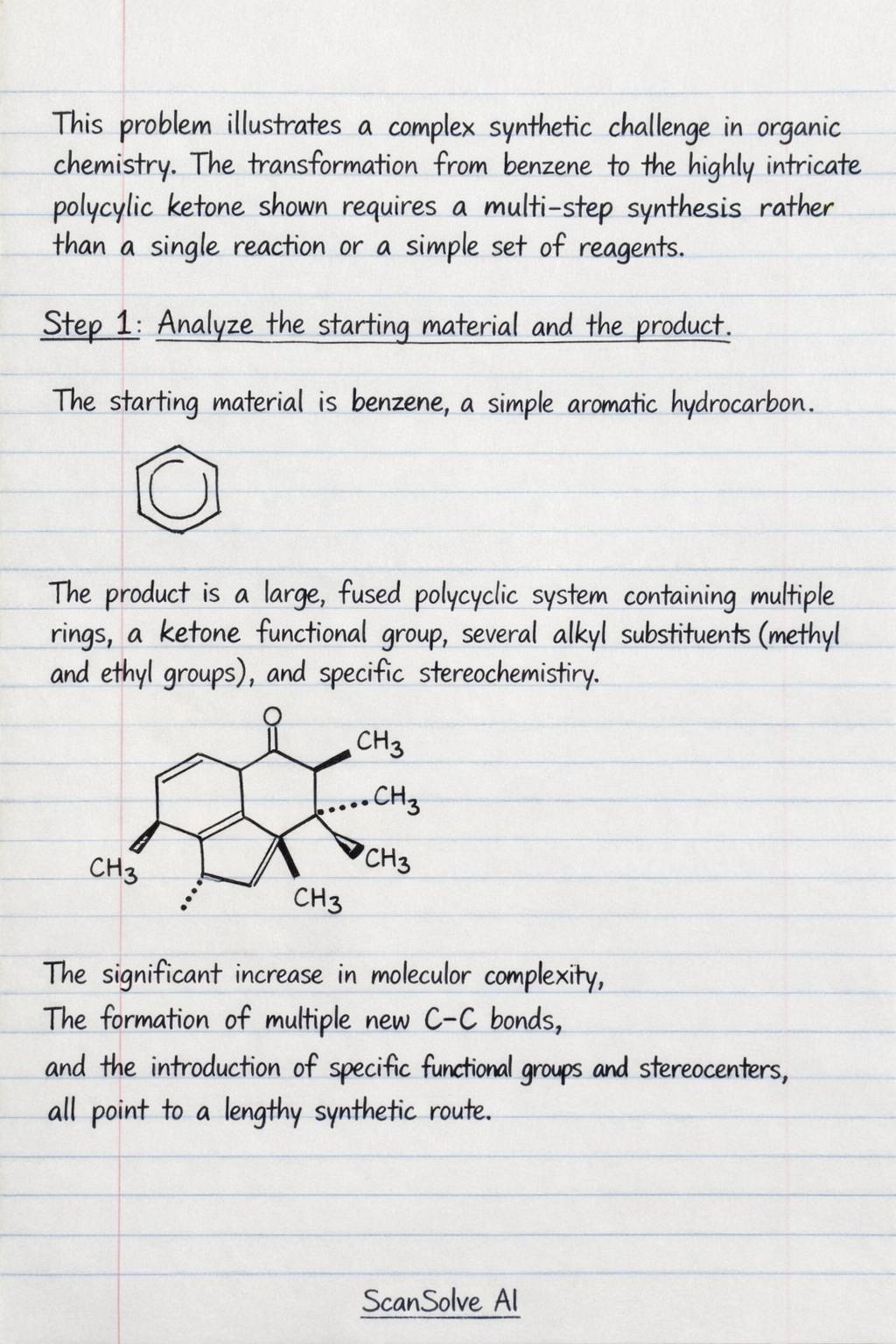
2 stepsThis problem illustrates a complex synthetic challenge in organic chemistry. The transformation from benzene to the highly intricate polycyclic ketone shown requires a multi-step synthesis rather than a single reaction or a simple set of reagents.
Analyze the starting material and the product.
The starting material is benzene, a simple aromatic hydrocarbon. The product is a large, fused polycyclic system containing multiple rings, a ketone functional group, several alkyl substituents (methyl and ethyl groups), and specific stereochemistry (indicated by wedges and dashes). The significant increase in molecular complexity, the formation of multiple new carbon-carbon bonds, and the introduction of specific functional groups and stereocenters all point to a lengthy synthetic route.
Explain the nature of the required synthesis.
To synthesize such a complex molecule from benzene, a series of carefully orchestrated reactions would be necessary. This would involve:
- Building the carbon skeleton: Initial steps would likely involve Friedel-Crafts alkylation and/or acylation to attach carbon chains and introduce carbonyl groups onto the benzene ring.
- Forming the fused rings: Subsequent reactions would involve intramolecular cyclizations to construct the multiple fused rings. These could include further Friedel-Crafts reactions, aldol condensations, Diels-Alder reactions, or other ring-forming methodologies.
- Introducing and modifying functional groups: The ketone group might be introduced directly via acylation or formed through oxidation of an alcohol. Other functional group interconversions would be needed to achieve the desired structure.
- Controlling stereochemistry: Achieving the specific three-dimensional arrangement (stereochemistry) shown in the product would require stereoselective reactions at various stages, potentially involving chiral catalysts or reagents.
Due to the high complexity and the numerous steps involved in forming multiple rings, introducing specific functional groups, and controlling stereochemistry, it is not possible to provide a single set of reagents or a concise reaction sequence for this "On Exam" problem. It represents a challenge that would typically be addressed over many chapters in an advanced organic synthesis course.
Therefore, the question mark indicates that this is a complex, multi-step synthesis, not a single reaction.
Still stuck on this one?
Ask a follow-up, and the answer starts from this question.
More Chemistry Questions
Handwritten Step-by-Step Solution
Get this as a handwritten image on WhatsApp — like a tutor wrote it for you.
Try on WhatsApp