This chemistry question involves key chemical concepts and calculations. The detailed solution below walks through each step, from identifying the reaction type to computing the final answer.
ScanSolve AI Answer
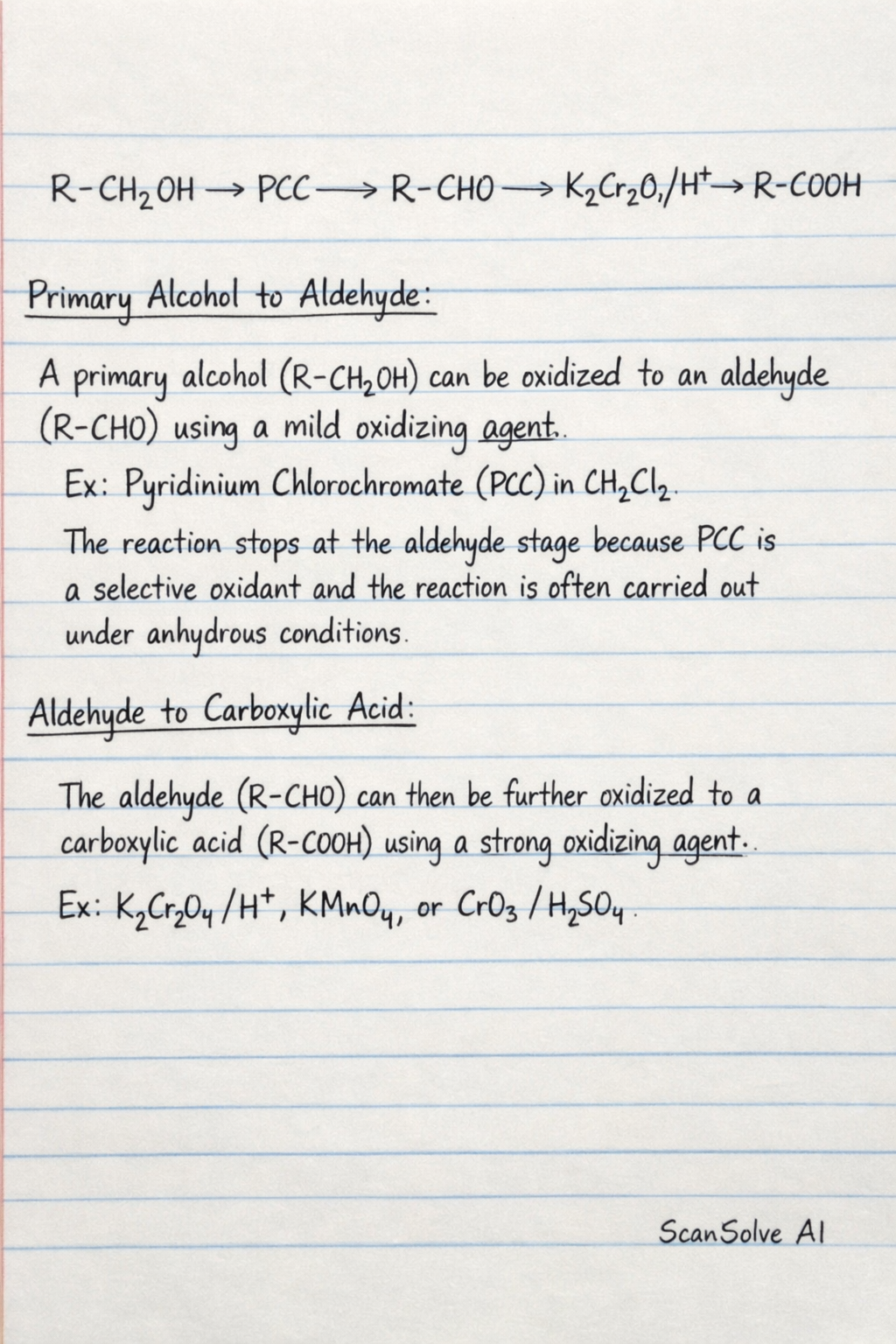
Here is a graphical explanation of the oxidation of a primary alcohol to an aldehyde and then to a carboxylic acid:
$$
\text{R-CH}_2\text{OH} \quad \xrightarrow{\text{Mild oxidizing agent (e.g., PCC)}} \quad \text{R-CHO} \quad \xrightarrow{\text{Strong oxidizing agent (e.g., K}_2\text{Cr}_2\text{O}_7\text{/H}^+)} \quad \text{R-COOH}
$$
Primary Alcohol to Aldehyde: A primary alcohol ($\text{R-CH}_2\text{OH}$) can be oxidized to an aldehyde ($\text{R-CHO}$) using a mild oxidizing agent*. Examples include Pyridinium Chlorochromate (PCC) in dichloromethane. This reaction stops at the aldehyde stage because PCC is a selective oxidant and the reaction is often carried out under anhydrous conditions.
Aldehyde to Carboxylic Acid: The aldehyde ($\text{R-CHO}$) can then be further oxidized to a carboxylic acid ($\text{R-COOH}$) using a strong oxidizing agent*. Examples include potassium dichromate ($\text{K}_2\text{Cr}_2\text{O}_7$) in acidic conditions ($\text{H}^+$), potassium permanganate ($\text{KMnO}_4$), or chromic acid ($\text{CrO}_3/\text{H}_2\text{SO}_4$).
Primary Alcohol to Carboxylic Acid (Direct): A primary alcohol can also be directly oxidized to a carboxylic acid using a strong oxidizing agent, bypassing the isolation of the aldehyde intermediate.
Oxidation reaction of primary alcohol to aldehyde and also carboxylic acid. Send a graphical explanation
|Chemistry
ScanSolve AI Answer
Here is a graphical explanation of the oxidation of a primary alcohol to an aldehyde and then to a carboxylic acid:
Primary Alcohol to Aldehyde: A primary alcohol (R-CH2OH) can be oxidized to an aldehyde (R-CHO) using a mild oxidizing agent. Examples include Pyridinium Chlorochromate (PCC) in dichloromethane. This reaction stops at the aldehyde stage because PCC is a selective oxidant and the reaction is often carried out under anhydrous conditions.
Aldehyde to Carboxylic Acid: The aldehyde (R-CHO) can then be further oxidized to a carboxylic acid (R-COOH) using a strong oxidizing agent. Examples include potassium dichromate (K2Cr2O7) in acidic conditions (H+), potassium permanganate (KMnO4), or chromic acid (CrO3/H2SO4).
Primary Alcohol to Carboxylic Acid (Direct): A primary alcohol can also be directly oxidized to a carboxylic acid using a strong oxidizing agent, bypassing the isolation of the aldehyde intermediate.
Need help with your own homework?
Get instant step-by-step solutions to any question. Free to start.