
We read your photo as:
Explain Pauli's Exclusion Principle and describe the four quantum numbers and their significance.
Chemistry
ScanSolve AI Answer
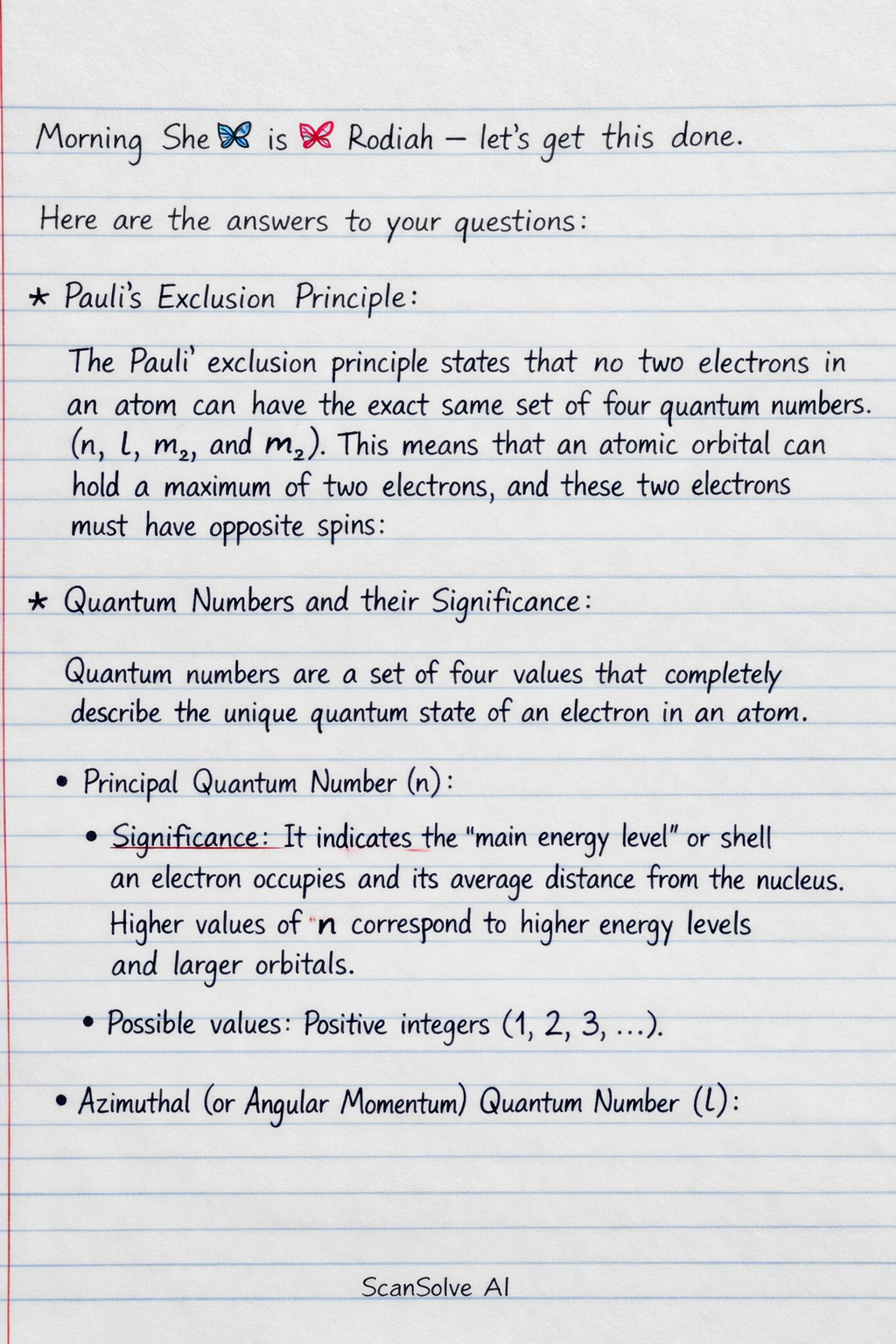
Here are the answers to your questions:
-
Pauli's Exclusion Principle: The Pauli exclusion principle states that no two electrons in an atom can have the exact same set of four quantum numbers (, , , and ). This means that an atomic orbital can hold a maximum of two electrons, and these two electrons must have opposite spins.
-
Quantum Numbers and their Significance: Quantum numbers are a set of four values that completely describe the unique quantum state of an electron in an atom.
- Principal Quantum Number ():
- Significance: It indicates the main energy level or shell an electron occupies and its average distance from the nucleus. Higher values of correspond to higher energy levels and larger orbitals.
- Possible values: Positive integers ().
- Azimuthal (or Angular Momentum) Quantum Number ():
- Significance: It describes the shape of the electron's orbital within a given energy level. It defines subshells (s, p, d, f).
- Possible values: Integers from 0 to .
- corresponds to an s-orbital (spherical).
- corresponds to a p-orbital (dumbbell).
- corresponds to a d-orbital (cloverleaf/complex).
- corresponds to an f-orbital (more complex).
- Magnetic Quantum Number ():
- Significance: It specifies the orientation of the orbital in space around the nucleus. For a given , there are possible values of , corresponding to the number of orbitals of that shape.
- Possible values: Integers from to , including 0.
- Spin Quantum Number ():
- Significance: It describes the intrinsic angular momentum of the electron, often referred to as its spin. Electrons behave as if they are spinning, creating a magnetic field.
- Possible values: .
- Principal Quantum Number ():
Was this helpful?
Still stuck on this one?
Ask a follow-up, and the answer starts from this question.
Got a different question?Ask your own question
More Chemistry Questions
Handwritten Step-by-Step Solution
Get this as a handwritten image on WhatsApp — like a tutor wrote it for you.
Try on WhatsApp