

This chemistry question involves key chemical concepts and calculations. The detailed solution below walks through each step, from identifying the reaction type to computing the final answer.
ScanSolve AI Answer
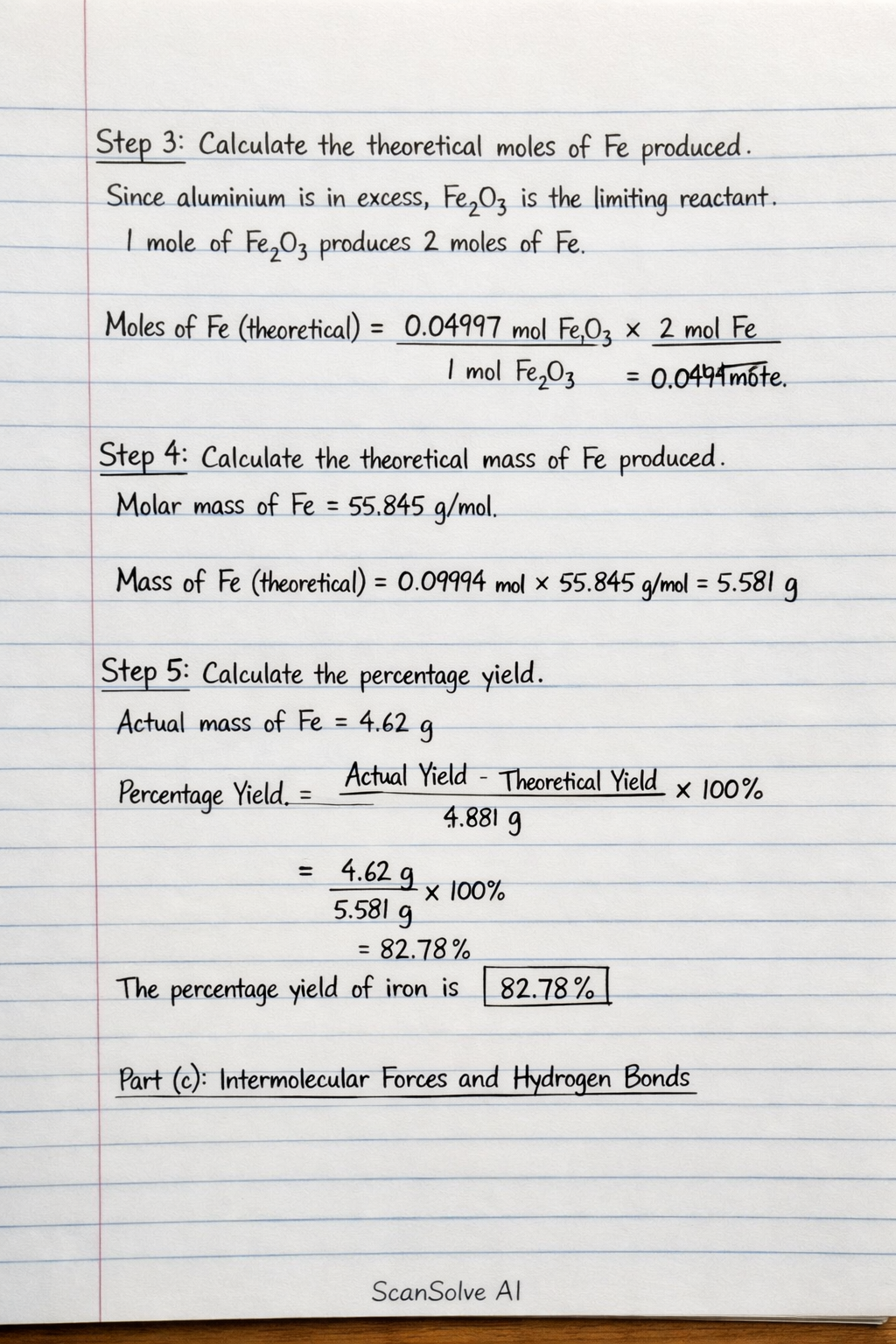
mol Step 3: Calculate the theoretical moles of Fe produced. Since aluminium is in excess, Fe_2O_3 is the limiting reactant. From the balanced equation, 1 mole of Fe_2O_3 produces 2 moles of Fe. Moles of Fe (theoretical) = 0.04997 mol Fe_2O_3 × 2 mol Fe1 mol Fe_2O_3 = 0.09994 mol Fe Step 4: Calculate the theoretical mass of Fe produced. The molar mass of Fe is 55.845 g/mol. Mass of Fe (theoretical) = 0.09994 mol × 55.845 g/mol ≈ 5.581 g Step 5: Calculate the percentage yield. The actual mass of Fe formed is 4.62 g. Percentage Yield = Actual YieldTheoretical Yield × 100\% Percentage Yield = 4.62 g5.581 g × 100\% ≈ 82.78\% The percentage yield of iron is 82.78\%. Part (c): Intermolecular Forces and Hydrogen Bonds c) (i) Intermolecular forces are attractive forces that exist between molecules. They are weaker than intramolecular forces (covalent or ionic bonds) and influence the physical properties of substances suchs as boiling point, melting point, and viscosity. c) (ii) Two factors that influence the formation of hydrogen bonds are: • The presence of a hydrogen atom bonded to a highly electronegative atom (N, O, or F). • The presence of a lone pair of electrons on a highly electronegative atom (N, O, or F) in an adjacent molecule. Part (d): Boiling Points of Water, Hydrogen Fluoride, and Methane The boiling point of a substance is determined by the strength of the intermolecular forces between its molecules. • Water (H_2O) has the highest boiling point (373 K) because its molecules form extensive hydrogen bonds. Each water molecule can form up to four hydrogen bonds, creating a strong network that requires significant energy to overcome. • Hydrogen Fluoride (HF) has a lower boiling point (293 K) than water, but still relatively high, due to the formation of hydrogen bonds. However, each HF molecule can only form one hydrogen bond as a donor and one as an acceptor, leading to a less extensive network compared to water. • Methane (CH_4) has the lowest boiling point (109 K) because it is a nonpolar molecule and only exhibits weak London dispersion forces (instantaneous dipole-induced dipole forces). These forces are much weaker than hydrogen bonds, requiring very little energy to overcome. 3 done, 2 left today. You're making progress.