
We read your photo as:
Describe the pH of the solutions given the indicator colors and arrange them by acidity. Also, list indicator colors in different pH solutions.
ScanSolve AI Answer
Answer
Step-by-step solution
4 stepsPart a· 1 step
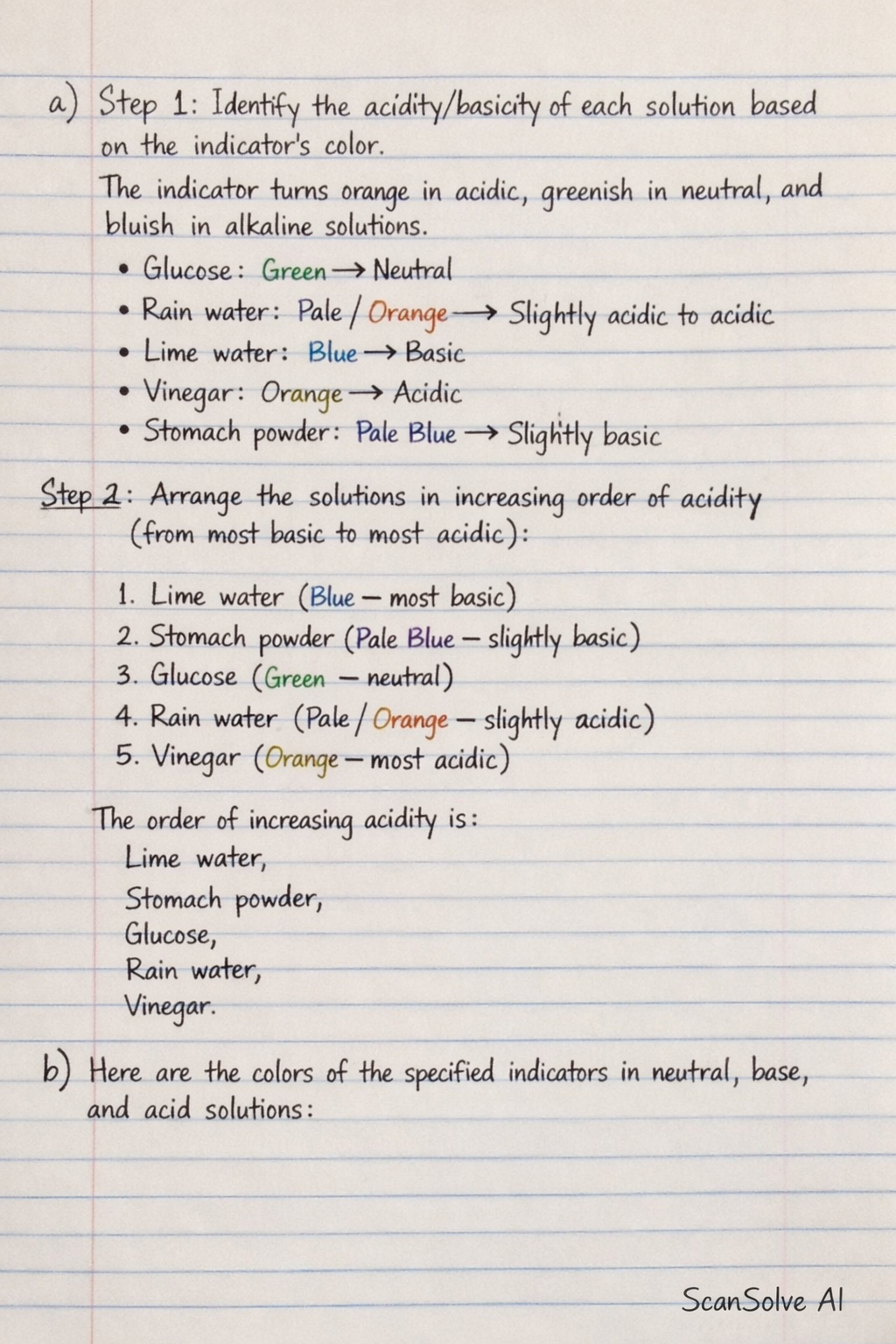
Step 1: Identify the acidity/basicity of each solution based on the indicator's color.
The indicator turns orange in acidic, greenish in neutral, and bluish in alkaline solutions.
- Glucose: Green Neutral
- Rain water: Pale or Orange Slightly acidic to acidic
- Lime water: Blue Basic
- Vinegar: Orange Acidic
- Stomach powder: Pale Blue Slightly basic
Arrange the solutions in increasing order of acidity (from most basic to most acidic).
- Lime water (Blue - most basic)
- Stomach powder (Pale Blue - slightly basic)
- Glucose (Green - neutral)
- Rain water (Pale or Orange - slightly acidic)
- Vinegar (Orange - most acidic)
The order of increasing acidity is:
Lime water, Stomach powder, Glucose, Rain water, Vinegar.
Part b
Here are the colors of the specified indicators in neutral, base, and acid solutions:
| Indicators | Neutral solution | Base solution | Acid solution |
|---|---|---|---|
| Methyl orange | Orange | Yellow | Red |
| Methyl green | Green | Blue | Yellow |
| Phenolphthalein | Colorless | Pink | Colorless |
| Thymol blue | Yellow | Blue | Yellow |
| Bromothymol blue | Green | Blue | Yellow |
| Methyl red | Orange | Yellow | Red |
| Cresol red | Yellow/Orange | Violet | Yellow |
| Litmus | Purple | Blue | Red |
Part c
Here are suitable indicators for the given types of titrations:
| Analytes Suitable | Indicators |
|---|---|
| Weak acid / Weak Base | No suitable indicator (potentiometric titration preferred) |
| Strong acid / Strong Base | Bromothymol blue, Litmus |
| Strong acid / Weak Base | Methyl orange, Methyl red |
| Strong base / Weak acid | Phenolphthalein, Thymol blue |
Part d
Step 1: Write the ionization equilibrium for the indicator (HIn) and its ionization constant () expression.
The ionization of a weak acid indicator is:
The ionization constant () is given by:
Rearrange the expression to solve for .
Substitute the given values into the equation.
Given:
Calculate the concentration of hydrogen ion.
Rounding to two significant figures:
Still stuck on this one?
Ask a follow-up, and the answer starts from this question.
More Chemistry Questions
Handwritten Step-by-Step Solution
Get this as a handwritten image on WhatsApp — like a tutor wrote it for you.
Try on WhatsApp