

This chemistry question involves key chemical concepts and calculations. The detailed solution below walks through each step, from identifying the reaction type to computing the final answer.
ScanSolve AI Answer
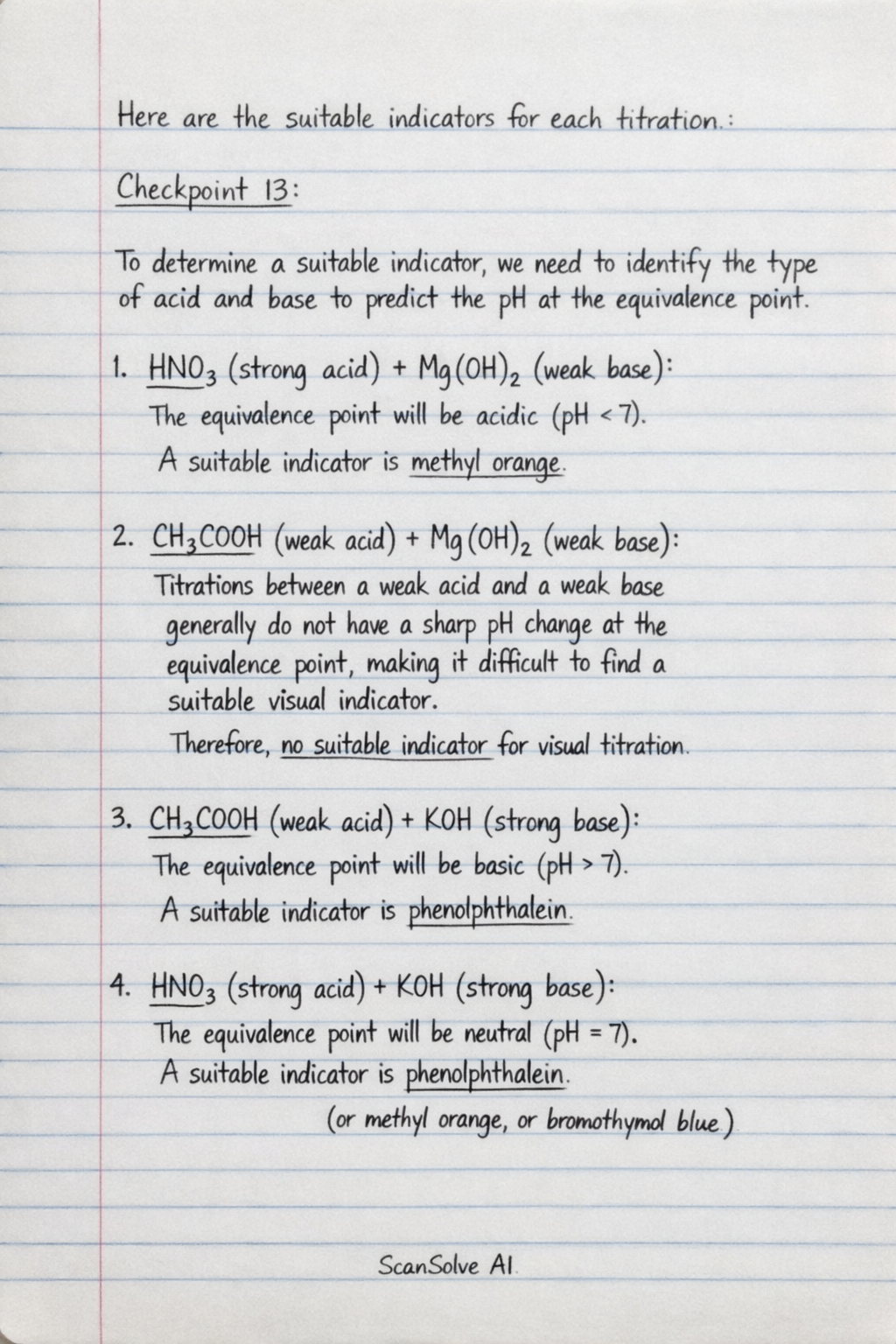
Here are the suitable indicators for each titration: Checkpoint 13: To determine a suitable indicator, we need to identify the type of acid and base (strong or weak) to predict the pH at the equivalence point. 1. HNO_3 (strong acid) and Mg(OH)_2 (weak base): The equivalence point will be acidic (pH < 7). A suitable indicator is methyl orange. 2. CH_3COOH (weak acid) and Mg(OH)_2 (weak base): Titrations between a weak acid and a weak base generally do not have a sharp pH change at the equivalence point, making it difficult to find a suitable visual indicator. Therefore, no suitable indicator for visual titration. 3. CH_3COOH (weak acid) and KOH (strong base): The equivalence point will be basic (pH > 7). A suitable indicator is phenolphthalein. 4. HNO_3 (strong acid) and KOH (strong base): The equivalence point will be neutral (pH = 7). A suitable indicator is phenolphthalein (or methyl orange, or bromothymol blue). Exercise 8.7: 1. HNO_3 (strong acid) and NaOH (strong base): The equivalence point will be neutral (pH = 7). A suitable indicator is phenolphthalein. 2. CH_3COOH (weak acid) and Ca(OH)_2 (strong base): The equivalence point will be basic (pH > 7). A suitable indicator is phenolphthalein. 3. H_2SO_4 (strong acid) and MgCO_3 (weak base): The equivalence point will be acidic (pH < 7). A suitable indicator is methyl orange. 4. H_2CO_3 (weak acid) and KOH (strong base): The equivalence point will be basic (pH > 7). A suitable indicator is phenolphthalein.