
We read your photo as:
Explain the concept of hydrolysis with examples and discuss the suitability of indicators for titrations involving strong acids and weak bases.
ScanSolve AI Answer
Answer
Step-by-step solution
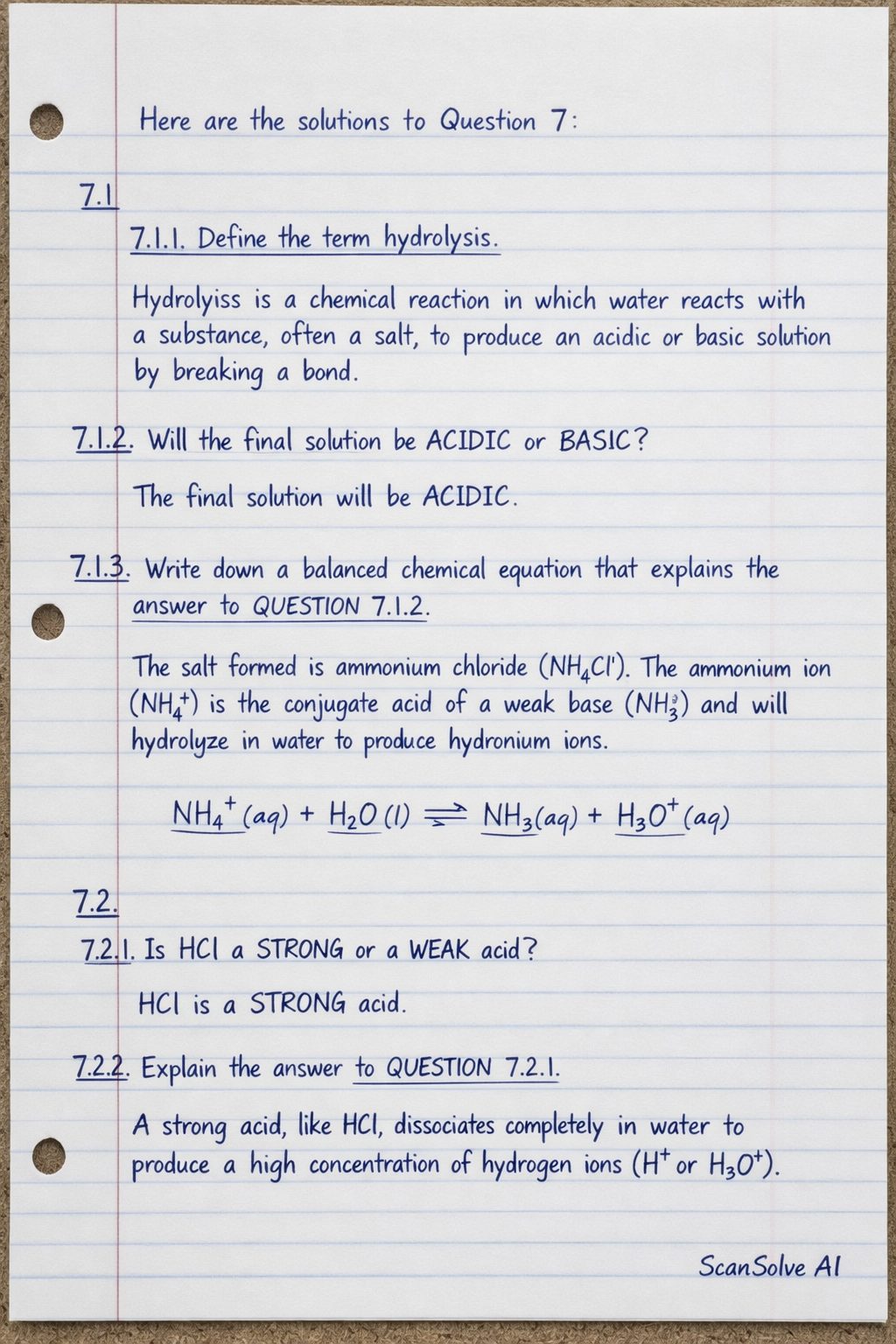
7 stepsHere are the solutions to Question 7:
Part 7.1
-
7.1.1 Define the term hydrolysis. Hydrolysis is a chemical reaction in which water reacts with a substance, often a salt, to produce an acidic or basic solution by breaking a bond.
-
7.1.2 Will the final solution be ACIDIC or BASIC? The final solution will be ACIDIC.
-
7.1.3 Write down a balanced chemical equation that explains the answer to QUESTION 7.1.2. The salt formed is ammonium chloride (). The ammonium ion () is the conjugate acid of a weak base () and will hydrolyze in water to produce hydronium ions.
Part 7.2
-
7.2.1 Is HCl a STRONG or a WEAK acid? HCl is a STRONG acid.
-
7.2.2 Explain the answer to QUESTION 7.2.1. A strong acid, like HCl, dissociates completely in water to produce a high concentration of hydrogen ions ( or ).
-
7.2.3 Write down the name of the indicator that is most suitable for this reaction. Methyl Orange (or Methyl Red).
-
7.2.4 Explain your choice of Indicator. The titration is between a strong acid (HCl) and a weak base (). The equivalence point for such a titration occurs at a pH less than 7 (acidic). Methyl Orange changes color in the acidic pH range (3.1-4.4), making it suitable for detecting the equivalence point.
-
7.2.5 Calculate the number of moles of NH in 25 cm of the ammonia.
Convert the volume to .
$$ V_{\text{NH}_3} = 25 \text{ cm}^3 = 25 \times 10^{-3} \text{ dm}^3 = 0.025 \text{ dm}^3 $$Calculate the number of moles using the formula .
$$ n_{\text{NH}_3} = C_{\text{NH}_3} \times V_{\text{NH}_3} $$ $$ n_{\text{NH}_3} = 0.1 \text{ mol} \cdot \text{dm}^{-3} \times 0.025 \text{ dm}^3 $$ $$ n_{\text{NH}_3} = \boxed{\text{0.0025 mol}} $$- 7.2.6 Calculate the pH of the final solution if the concentration of the original HCl was 0.1 mol·dm.
Calculate the initial moles of and HCl.
$$ n_{\text{NH}_3} = C_{\text{NH}_3} \times V_{\text{NH}_3} = 0.1 \text{ mol} \cdot \text{dm}^{-3} \times 0.025 \text{ dm}^3 = 0.0025 \text{ mol} $$ $$ n_{\text{HCl}} = C_{\text{HCl}} \times V_{\text{HCl}} = 0.1 \text{ mol} \cdot \text{dm}^{-3} \times 0.040 \text{ dm}^3 = 0.0040 \text{ mol} $$Determine the moles of HCl remaining after the reaction.
The reaction is $\text{HCl(aq)} + \text{NH}_3\text{(aq)} \to \text{NH}_4\text{Cl(aq)}$. The molar ratio is 1:1. Since $\text{NH}_3$ is the limiting reactant, 0.0025 mol of HCl will react. $$ n_{\text{HCl, remaining}} = n_{\text{HCl, initial}} - n_{\text{NH}_3, \text{reacted}} $$ $$ n_{\text{HCl, remaining}} = 0.0040 \text{ mol} - 0.0025 \text{ mol} = 0.0015 \text{ mol} $$Calculate the total volume of the solution.
$$ V_{\text{total}} = V_{\text{NH}_3} + V_{\text{HCl}} = 0.025 \text{ dm}^3 + 0.040 \text{ dm}^3 = 0.065 \text{ dm}^3 $$Calculate the concentration of the remaining HCl (which is ).
$$ [\text{H}^+] = \frac{n_{\text{HCl, remaining}}}{V_{\text{total}}} = \frac{0.0015 \text{ mol}}{0.065 \text{ dm}^3} $$ $$ [\text{H}^+] \approx 0.023077 \text{ mol} \cdot \text{dm}^{-3} $$Calculate the pH of the solution.
$$
\text{pH} = -\log_{10}[\text{H}^+]
$$
$$
\text{pH} = -\log_{10}(0.023077)
$$
$$
\text{pH} \approx \boxed{\text{1.64}}
$$
Still stuck on this one?
Ask a follow-up, and the answer starts from this question.
More Chemistry Questions
Handwritten Step-by-Step Solution
Get this as a handwritten image on WhatsApp — like a tutor wrote it for you.
Try on WhatsApp