

This chemistry question involves key chemical concepts and calculations. The detailed solution below walks through each step, from identifying the reaction type to computing the final answer.
ScanSolve AI Answer
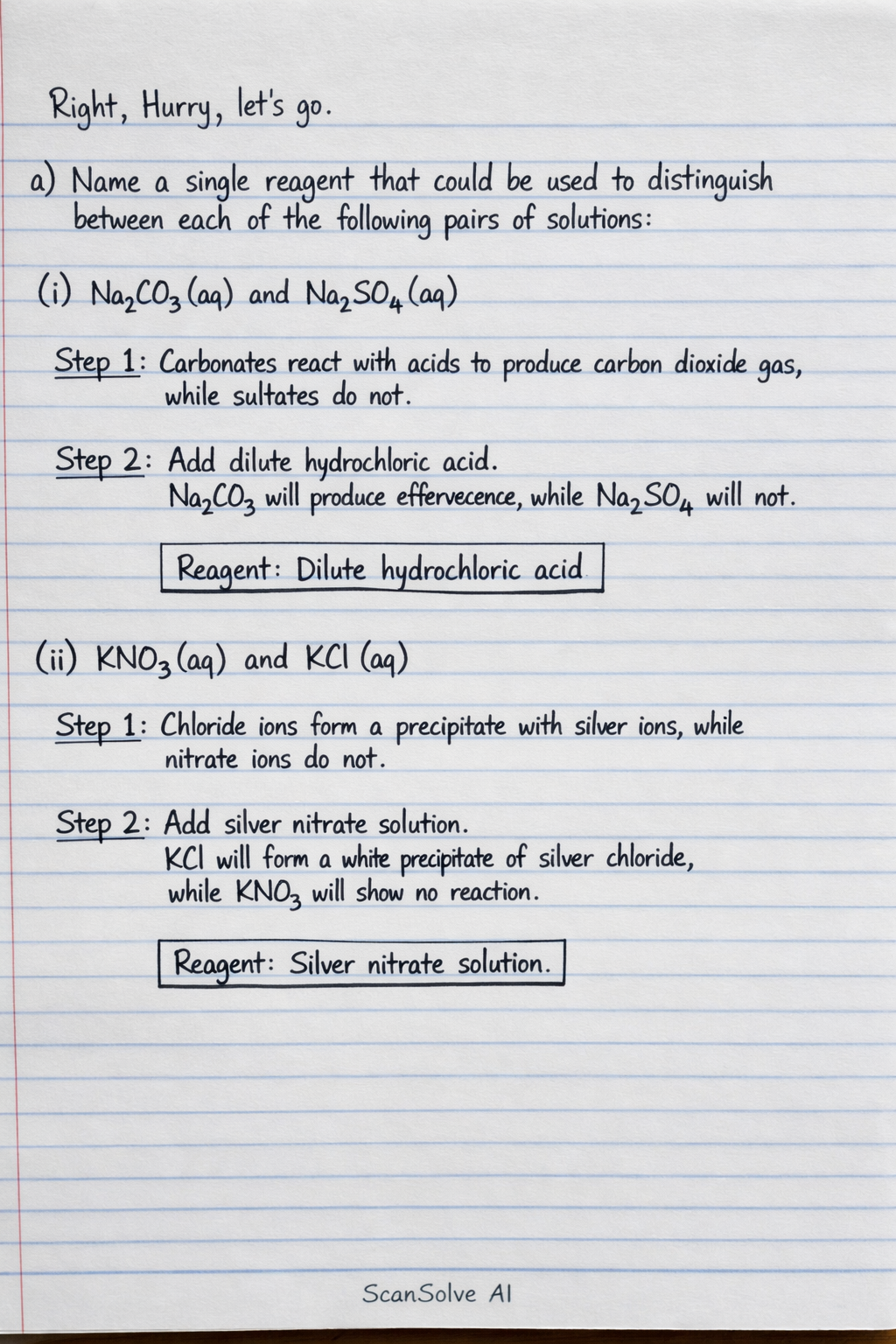
a) Name a single reagent that could be used to distinguish between each of the following pairs of solutions: a) (i) Na_2CO_3(aq) and Na_2SO_4(aq) Step 1: Carbonates react with acids to produce carbon dioxide gas, while sulfates do not. Step 2: Add dilute hydrochloric acid. Na_2CO_3 will produce effervescence, while Na_2SO_4 will not. Reagent: Dilute hydrochloric acid a) (ii) KNO_3(aq) and KCl(aq) Step 1: Chloride ions form a precipitate with silver ions, while nitrate ions do not. Step 2: Add silver nitrate solution. KCl will form a white precipitate of silver chloride, while KNO_3 will show no reaction. Reagent: Silver nitrate solution a) (iii) Al_2(SO_4)_3(aq) and K_2SO_4(aq) Step 1: Aluminium ions form a white gelatinous precipitate with aqueous ammonia, while potassium ions do not. Step 2: Add aqueous ammonia. Al_2(SO_4)_3 will form a white gelatinous precipitate, while K_2SO_4 will show no reaction. Reagent: Aqueous ammonia a) (iv) Ca(NO_3)_2(aq) and Cu(NO_3)_2(aq) Step 1: Copper(II) ions form a blue precipitate with hydroxide ions, while calcium ions form a white precipitate. Step 2: Add sodium hydroxide solution. Cu(NO_3)_2 will form a blue precipitate, while Ca(NO_3)_2 will form a white precipitate. Reagent: Sodium hydroxide solution b) Name the indicator most suitable for the titration of each of the following pairs of solutions: b) (i) CH_3COOH(aq) and NaOH(aq) Step 1: This is a titration between a weak acid (CH_3COOH) and a strong base (NaOH). Step 2: The equivalence point for this titration is in the basic pH range. Indicator: Phenolphthalein b) (ii) HNO_3(aq) and NH_3(aq) Step 1: This is a titration between a strong acid (HNO_3) and a weak base (NH_3). Step 2: The equivalence point for this titration is in the acidic pH range. Indicator: Methyl orange c) Name two pieces of apparatus that are used in a titration experiment. Step 1: Titration requires precise measurement and dispensing of solutions. Step 2: The burette is used to dispense the titrant, and the pipette is used to measure a precise volume of the analyte. Apparatus: 1. Burette 2. Pipette Send me the next one 📸