
We read your photo as:
Define indicator and neutralization, state two differences between acids and bases, and explain why a pipette is rinsed before use and potential errors in titration.
ScanSolve AI Answer
Here are the answers for Question 3.
Question 3: Theory Related to Practical Work
(a) Define the following terms:
- (i) Indicator: An indicator is a substance that changes color in response to a chemical change, typically a change in pH, to signal the endpoint of a reaction.
- (ii) Neutralization: Neutralization is a chemical reaction in which an acid and a base react quantitatively with each other to form a salt and water, resulting in a solution with a pH closer to 7.
(b) State two differences between acids and bases.
- Acids turn blue litmus paper red, while bases turn red litmus paper blue.
- Acids have a pH value less than 7, while bases have a pH value greater than 7.
(c) State two reasons why the pipette is rinsed with the solution it is going to measure before use.
- To remove any residual water or other solutions that would dilute the solution being measured, thus changing its concentration.
- To ensure the inner surface of the pipette is coated with the solution, preventing contamination and ensuring accurate volume delivery.
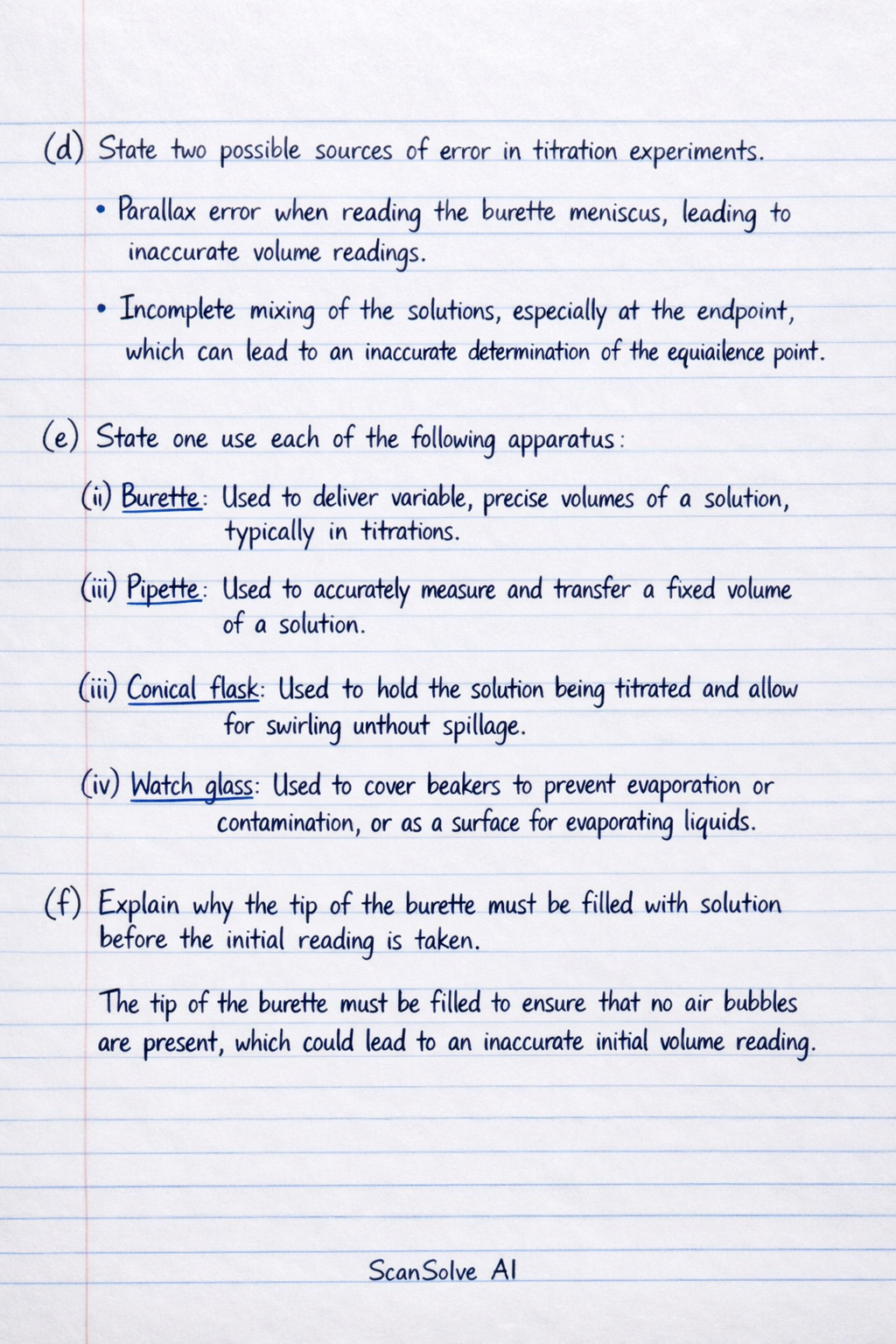
(d) State two possible sources of error in titration experiments.
- Parallax error when reading the burette meniscus, leading to inaccurate volume readings.
- Incomplete mixing of the solutions, especially at the endpoint, which can lead to an inaccurate determination of the equivalence point.
(e) State one use each of the following apparatus:
- (i) Burette: Used to deliver variable, precise volumes of a solution, typically in titrations.
- (ii) Pipette: Used to accurately measure and transfer a fixed volume of a solution.
- (iii) Conical flask: Used to hold the solution being titrated and allow for swirling without spillage.
- (iv) Watch glass: Used to cover beakers to prevent evaporation or contamination, or as a surface for evaporating liquids.
(f) Explain why the tip of the burette must be filled with solution before the initial reading is taken.
The tip of the burette must be filled with solution to remove any air bubbles. If air bubbles are present, they will eventually be dispensed with the solution, leading to an artificially high volume reading and an inaccurate titration result.
Still stuck on this one?
Ask a follow-up, and the answer starts from this question.
More Chemistry Questions
Handwritten Step-by-Step Solution
Get this as a handwritten image on WhatsApp — like a tutor wrote it for you.
Try on WhatsApp