
We read your photo as:
Prepare and collect dry samples of chlorine and ammonia gas. Also, identify a thermometer and calculate the temperature change from the provided readings.
Chemistry
ScanSolve AI Answer
Step-by-step solution
3 stepsHere are the solutions for the questions:
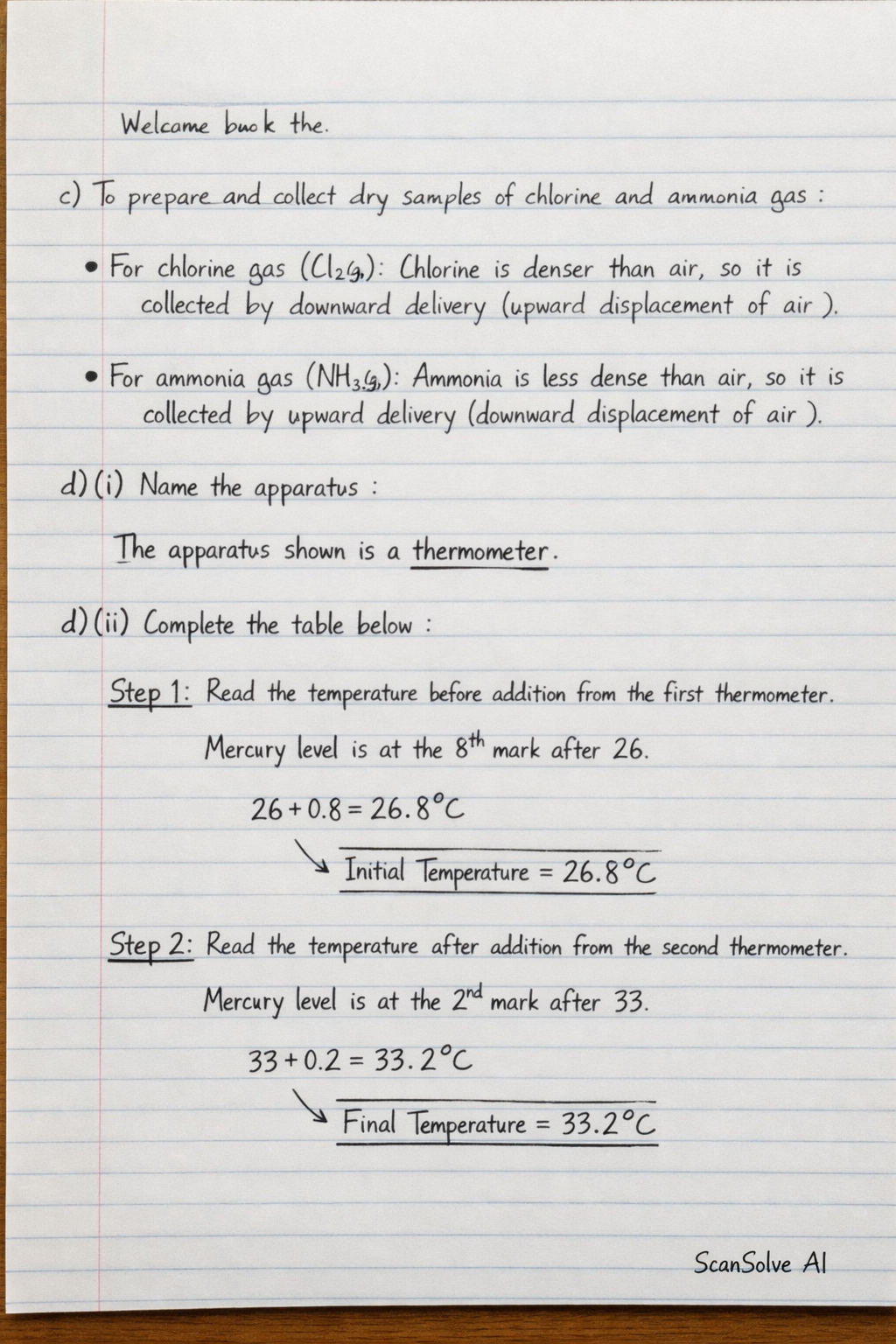
c) To prepare and collect dry samples of chlorine and ammonia gas:
- For chlorine gas (): Chlorine is denser than air, so it is collected by downward delivery (upward displacement of air).
- For ammonia gas (): Ammonia is less dense than air, so it is collected by upward delivery (downward displacement of air).
d) (i) Name the apparatus:
The apparatus shown is a thermometer.
d) (ii) Complete the table below:
Read the temperature before addition from the first thermometer.
The thermometer shows the mercury level at the 8th mark after 26, which is .
Read the temperature after addition from the second thermometer.
The thermometer shows the mercury level at the 2nd mark after 33, which is .
Calculate the temperature change.
Temperature change = Temperature after addition - Temperature before addition
The completed table is:
Temperature after addition Temperature before addition Temperature change
Was this helpful?
Still stuck on this one?
Ask a follow-up, and the answer starts from this question.
Got a different question?Ask your own question
More Chemistry Questions
QConsider the diagram to show how a dry sample of the gas can be collected. (i) Describe how the dry…QIdentify the gas prepared and explain its preparation with a balanced chemical equation…QWrite the equations for the preparation of chlorine and its reaction with NaOH. Explain the action…QAnalyze the provided experimental setups and flowcharts to identify substances, describe collection…QComplete the table for different gases, their reagents, drying agents, and methods of gas…
Handwritten Step-by-Step Solution
Get this as a handwritten image on WhatsApp — like a tutor wrote it for you.
Try on WhatsApp