
We read your photo as:
Consider the diagram to show how a dry sample of the gas can be collected. (i) Describe how the dry chlorine gas was reacted with aluminum as shown in Figure 1. (ii) Give the formula of another reagent that can be reacted with concentrated hydrochloric acid to produce chlorine gas (1 mark).
ScanSolve AI Answer
Step-by-step solution
6 stepshere are the answers to your questions:
3.
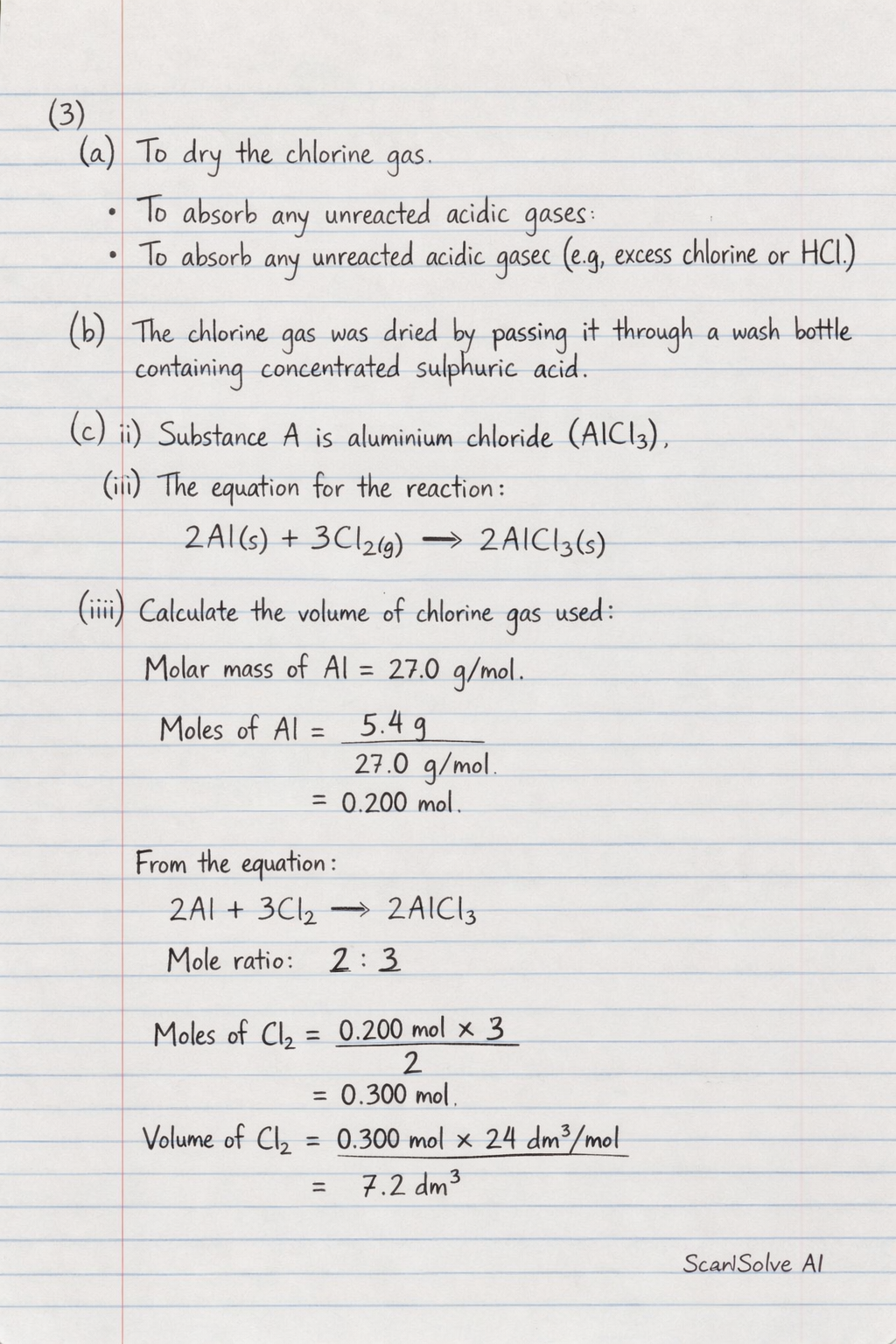
a) Two reasons why calcium oxide is used in the set up:
- To dry the chlorine gas.
- To absorb any unreacted acidic gases (like excess chlorine or hydrogen chloride).
b) The chlorine gas was dried by passing it through a wash bottle containing concentrated sulphuric acid.
c)
i) Substance A is aluminium chloride ().
ii) The equation for the reaction that took place in the combustion tube is:
iii) Calculate the volume of chlorine gas used:
Molar mass of Al =
Molar gas volume =
Calculate the moles of aluminium.
Determine the moles of chlorine gas required from the stoichiometry.
From the balanced equation, 2 moles of Al react with 3 moles of .
Calculate the volume of chlorine gas.
6.
a) Write an equation for the following:
i) Chlorine gas reacting with iron:
ii) Chlorine gas reacting with hot concentrated sodium hydroxide solution:
b) Determine the empirical formula of the oxide:
Mass of oxide =
Mass of oxygen (O) =
Mass of chlorine (Cl) =
Molar mass of O =
Molar mass of Cl =Calculate the moles of each element.
Find the simplest mole ratio by dividing by the smallest number of moles.
For Cl:
For O:Multiply by a factor to get whole numbers.
Multiply by 2:
Cl:
O:
The empirical formula is .c) Other than the manufacture of weed killers, two other uses of chlorine are:
- Water treatment (disinfection).
- Manufacture of plastics (e.g., PVC).
7.
a)
i) The formula of another reagent that can be reacted with concentrated hydrochloric acid to produce chlorine gas is (manganese(IV) oxide).
ii) The chlorine gas would be dried in the laboratory by passing it through a wash bottle containing concentrated sulphuric acid.
8.
a) The conditions under which sodium hydroxide reacts with chlorine gas to form sodium hypochlorite are cold and dilute sodium hydroxide solution.
b) The uses of sodium hypochlorite include:
- As a bleaching agent (e.g., in household bleach).
- As a disinfectant or antiseptic.
Still stuck on this one?
Ask a follow-up, and the answer starts from this question.
More Chemistry Questions
Handwritten Step-by-Step Solution
Get this as a handwritten image on WhatsApp — like a tutor wrote it for you.
Try on WhatsApp