
We read your photo as:
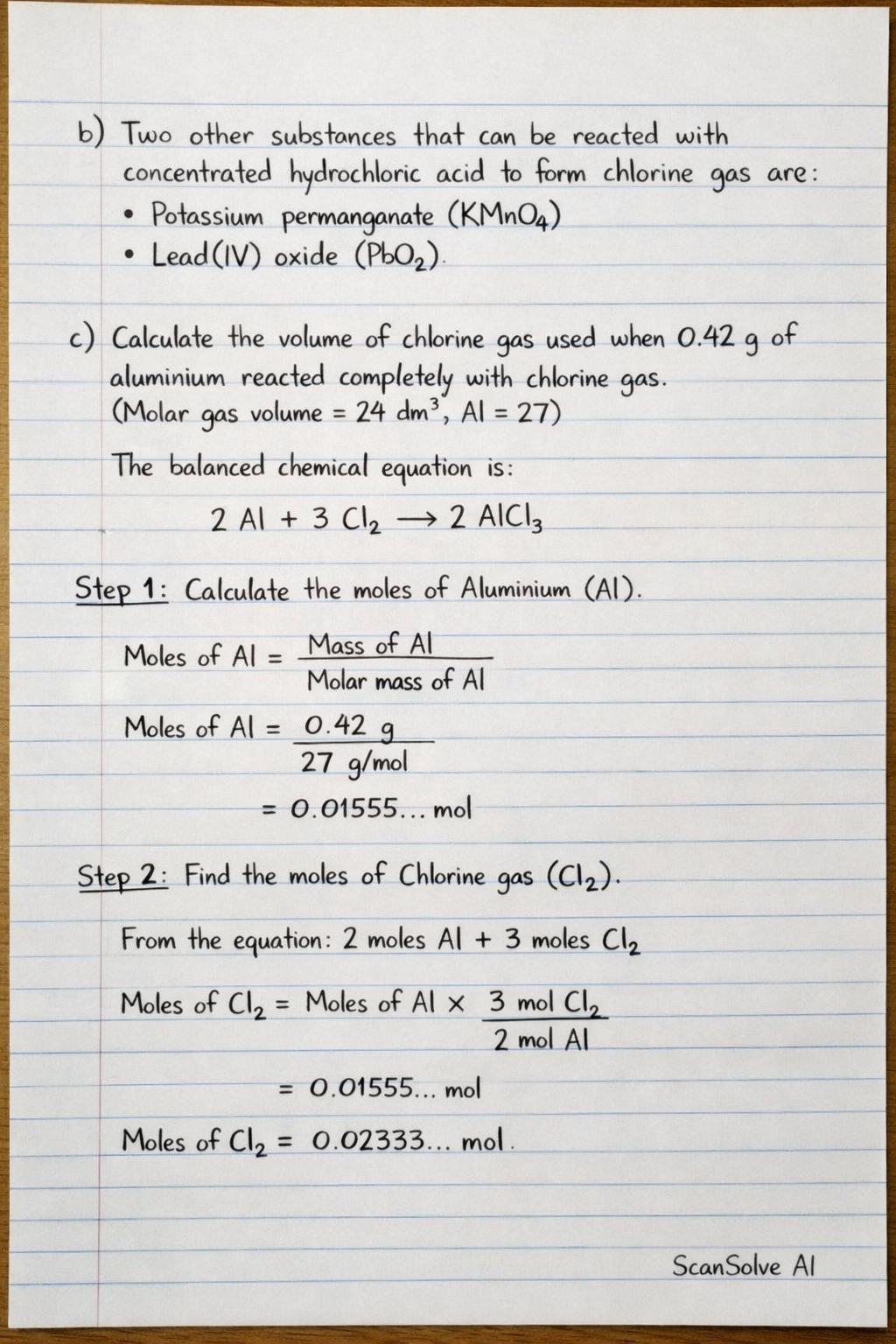
b) Two other substances that can be reacted with concentrated hydrochloric acid to form chlorine gas in the laboratory are:
ScanSolve AI Answer
Answer
Step-by-step solution
3 stepsPart b
Two other substances that can be reacted with concentrated hydrochloric acid to form chlorine gas in the laboratory are
- Potassium permanganate ()
- Lead(IV) oxide ()
Part c
Calculate the volume of chlorine gas used when 0.42g of aluminium reacted completely with chlorine gas. (molar gas volume is 24 , Al=27)
The balanced chemical equation is:
Calculate the moles of Aluminium ().
Use the mole ratio from the balanced equation to find the moles of Chlorine gas ().
From the equation, 2 moles of react with 3 moles of .
Calculate the volume of Chlorine gas ().
The volume of chlorine gas used is .
Part d(i)
Which metallic element shown on the table has the highest electrical conductance? Explain.
Explain how chlorine gas bleaches a red litmus paper.
Chlorine gas reacts with water (present in moist litmus paper) to form hydrochloric acid () and hypochlorous acid (). The makes the paper acidic (red), but the hypochlorous acid is a strong oxidizing agent that oxidizes the dye in the litmus paper, causing it to lose its color and appear bleached.
2. a) Distinguish between an element and a molecule.
An element is a pure substance consisting of only one type of atom and cannot be broken down into simpler substances by chemical means. A molecule is formed when two or more atoms are chemically bonded together, which can be atoms of the same element (e.g., ) or different elements (e.g., ).
2. b) The diagram below represents part of the periodic table.
Element D has the highest electrical conductance. Electrical conductivity in metals is due to the presence of mobile delocalized electrons. As you move down a group, the atomic size increases, and the outermost electrons are further from the nucleus and experience less attraction, making them more mobile. D is a Group 1 metal and is below C, so its valence electron is less tightly held. Group 1 metals generally have higher conductivity than Group 2 metals in the same period.
Part d(ii)
Write the equation for the reaction between E and G.
Element E is in Group 2, Period 3, so it forms a ion (). Element G is in Group 5, Period 2, so it forms a ion ().
To balance the charges, 3 ions of E will combine with 2 ions of G.
Part d(iii)
How do the first ionization energies of elements C and D compare?
The first ionization energy of D is lower than that of C. Both C and D are in Group 1. As you move down a group, the atomic radius increases, and there are more electron shells, leading to increased shielding of the valence electron from the nucleus. This reduces the effective nuclear charge experienced by the outermost electron, making it easier to remove and thus lowering the ionization energy.
Try one yourself
A new problem that tests the same skill.
Still stuck on this one?
Ask a follow-up, and the answer starts from this question.
More Chemistry Questions
Handwritten Step-by-Step Solution
Get this as a handwritten image on WhatsApp — like a tutor wrote it for you.
Try on WhatsApp