
We read your photo as:
Describe the process of soap preparation using cocoa pod ash and palm oil, including the scientific principle and relevant chemical substances.
ScanSolve AI Answer
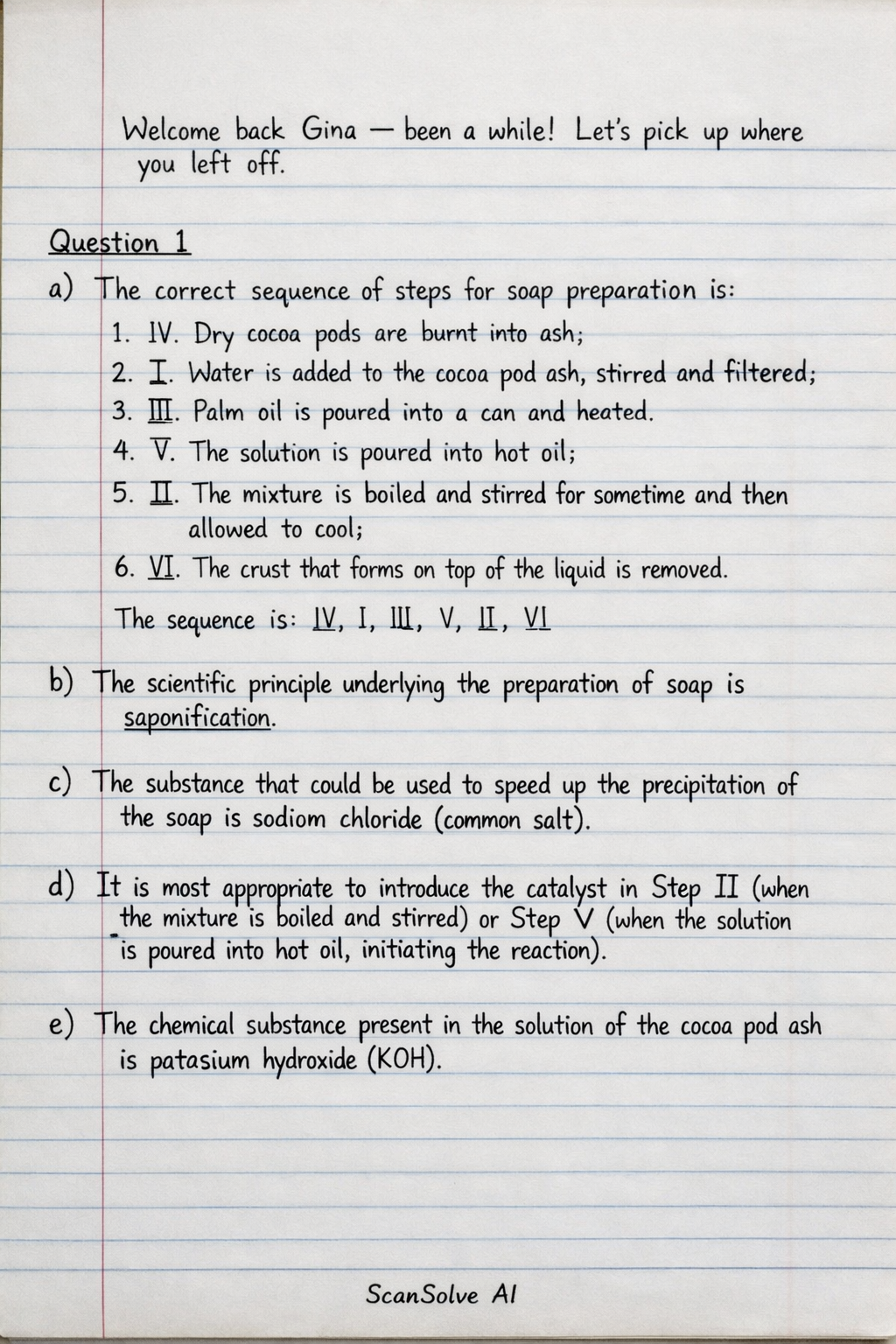
Question 1
a) The correct sequence of steps for soap preparation is:
- IV. Dry cocoa pods are burnt into ash;
- I. Water is added to the cocoa pod ash, stirred and filtered;
- III. Palm oil is poured into a can and heated;
- V. The solution is poured into hot oil;
- II. The mixture is boiled and stirred for sometime and then allowed to cool;
- VI. The crust that forms on top of the liquid is removed.
The sequence is: IV, I, III, V, II, VI
b) The scientific principle underlying the preparation of soap is saponification.
c) The substance that could be used to speed up the precipitation of the soap is sodium chloride (common salt).
d) It is most appropriate to introduce the catalyst in Step II (when the mixture is boiled and stirred) or Step V (when the solution is poured into hot oil, initiating the reaction).
e) The chemical substance present in the solution of the cocoa pod ash is potassium hydroxide ().
f) Two effects of impurities in the soap produced are:
- It reduces the lathering ability of the soap.
- It makes the soap harsh on the skin.
g) To confirm that the product is soap, perform the lathering test:
Add a small piece of the product to water and shake vigorously. If it produces a stable lather, it confirms the presence of soap.
Question 2
a) Identification of the organisms:
A. Caterpillar
B. Bird
C. Nematode (or Roundworm)
D. Tick
b) Organisms classified as:
- (i) pests: A, B, C, D
- (ii) parasite: C, D
c) One crop or animal attacked by:
B. (Bird): Maize (or any grain crop like rice, millet)
D. (Tick): Cattle (or any mammal like sheep, goats, dogs)
d) Kind of damage caused to hosts:
A. (Caterpillar): Eats leaves, stems, or fruits of plants, leading to defoliation and reduced yield.
B. (Bird): Eats seeds, fruits, or grains from crops, causing crop loss and reduced yield.
C. (Nematode): Feeds on plant roots (causing stunted growth, wilting) or lives in animal intestines (causing nutrient deficiency, disease).
e) One adaptive feature of organism B (bird) which enables it to cause the damage stated in (d) is its strong, conical beak for cracking and eating seeds.
f) Two methods of controlling organism D (tick):
- Dipping or spraying animals with acaricides.
- Rotational grazing to break the tick life cycle.
Still stuck on this one?
Ask a follow-up, and the answer starts from this question.
More Chemistry Questions
Handwritten Step-by-Step Solution
Get this as a handwritten image on WhatsApp — like a tutor wrote it for you.
Try on WhatsApp