
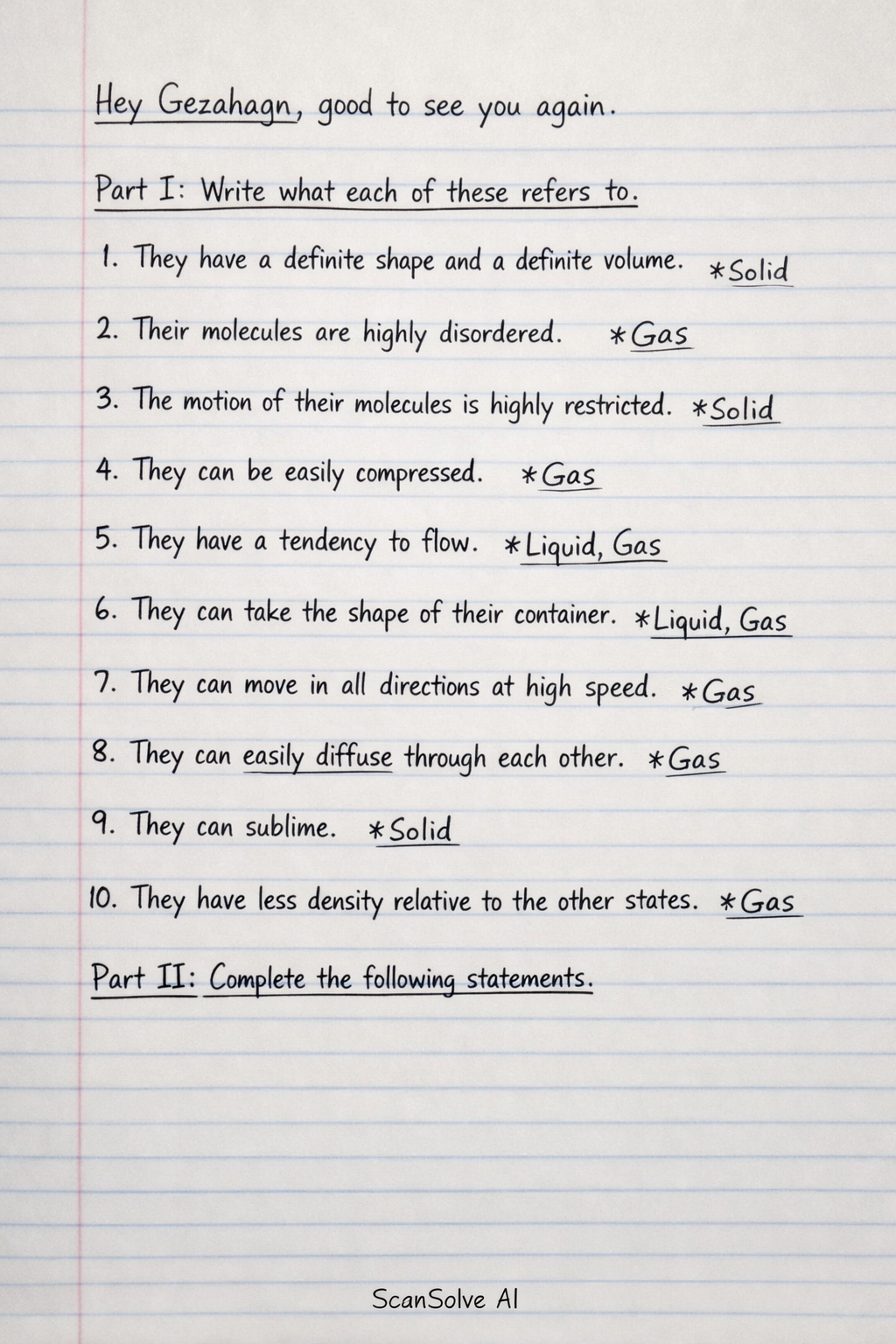
We read your photo as:
Describe the properties of solids, liquids, and gases. Include definitions for states of matter and related concepts like sublimation, absolute zero, and Avogadro's Law.
ScanSolve AI Answer
Answer
Gas
Step-by-step solution
10 stepsPart i
Write what each of these refers to.
- They have a definite shape and a definite volume. Solid
- Their molecules are highly disordered. Gas
- The motion of their molecules is highly restricted. Solid
- They can be easily compressed. Gas
- They have a tendency to flow. Liquid, Gas
- They can take the shape of their container. Liquid, Gas
- They can move in all direction at high speed. Gas
- They can easily diffuse through each other. Gas
- They can sublime. Solid
- They have less density relative to the other states. Gas
Part ii
Complete the following statements.
- Liquids and gases have no definite shape.
- The freezing point of a liquid is the same as the melting point of its solid.
- The temperature at which a crystalline solid is directly converted to a gas is called the sublimation point.
- The lowest attainable temperature is absolute zero.
- "At the fixed temperature and pressure, equal volumes of different gases have equal numbers of molecules." This statement is postulated by Avogadro's Law.
Part iii· 10 steps
Multiple Choice Questions.
-
Which of the following would take up the entire shape of the container it is enclosed within? The correct answer is a. Gas. Gases expand to fill the entire volume and shape of their container.
-
If a gas expands at constant temperature, it indicates that: The correct answer is d. Kinetic energy of molecules remains the same. Temperature is a measure of the average kinetic energy of gas molecules. If the temperature is constant, the average kinetic energy of the molecules remains the same.
-
A sample of oxygen occupies 47.2 L under a pressure of 1240 torr at 25 °C. What volume would it occupy at 25 °C if the pressure were decreased to 730 torr?
Identify the given values and the law to use.
Since the temperature is constant, we use Boyle's Law: .
Given:
Rearrange the formula to solve for .
Substitute the values and calculate .
Compare with the given options.
The closest option is d. 80.2 L.
The final answer is- A sample of nitrogen occupies 5.50 liters under a pressure of 900.0 torr at 25.0 °C. At what temperature will it occupy 10.0 liters at the same pressure?
Identify the given values and the law to use.
Since the pressure is constant, we use Charles's Law: .
Temperatures must be in Kelvin.
Given:
Rearrange the formula to solve for .
Substitute the values and calculate .
Convert back to Celsius.
Compare with the given options.
The closest option is b. 269 °C.
The final answer is- A quantity of gas has a volume of 25 L at 17 °C and 3 atm of pressure. To what volume must the gas be increased for a gas to be under STP conditions?
Identify the given values and the law to use.
This is a Combined Gas Law problem: .
Temperatures must be in Kelvin. STP conditions are and .
Given:
(STP)
$T_2 = 0 °C = 273.15 \text{
Try one yourself
A new problem that tests the same skill.
Still stuck on this one?
Ask a follow-up, and the answer starts from this question.
More Chemistry Questions
Handwritten Step-by-Step Solution
Get this as a handwritten image on WhatsApp — like a tutor wrote it for you.
Try on WhatsApp