
We read your photo as:
Describe the three common states of matter, explaining their properties and giving examples.
Physics
ScanSolve AI Answer
Step-by-step solution
2 stepsState the three states of matter.
The three common states of matter are solids, liquids, and gases.
Explain and provide examples for each state.
- Solids have a definite shape and a definite volume. Their particles are tightly packed and vibrate in fixed positions. Example: Ice.
- Liquids have a definite volume but no definite shape; they take the shape of their container. Their particles are close together but can move past each other. Example: Water.
- Gases have no definite shape and no definite volume; they expand to fill their container. Their particles are far apart and move randomly and rapidly. Example: Steam.
Was this helpful?
Still stuck on this one?
Ask a follow-up, and the answer starts from this question.
Got a different question?Ask your own question
More Physics Questions
QWhat are the three states of matter and their properties?QDefine matter, list three states of matter, and provide one example of each.QMention the three states by which matter exists.QState two properties shared by a solid, a liquid, and a gas, and draw particle diagrams for each…QClassify the given items into the three states of matter: Solid, Liquid, and Gas.
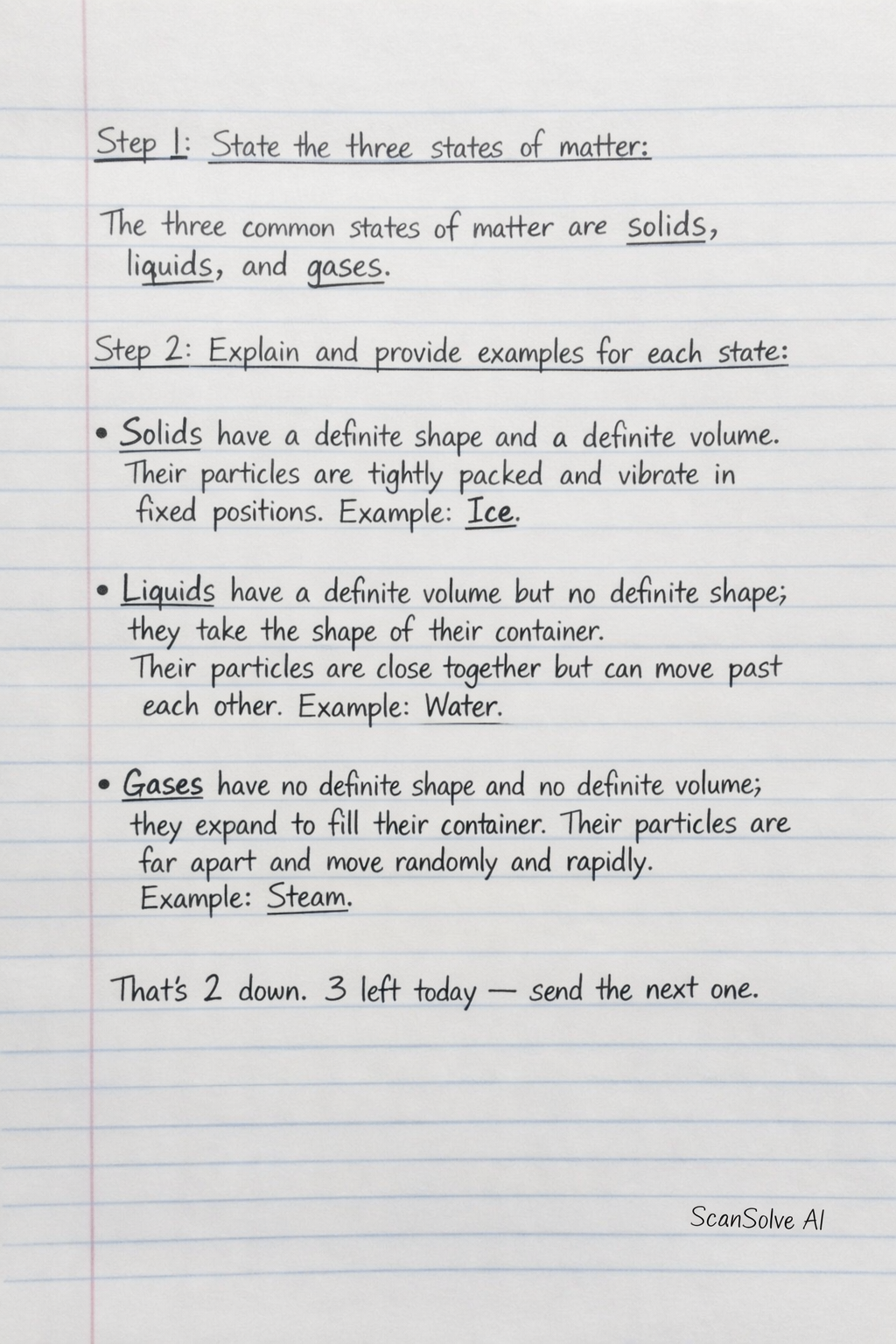
Handwritten Step-by-Step Solution
Get this as a handwritten image on WhatsApp — like a tutor wrote it for you.
Try on WhatsApp