
We read your photo as:
Provide four differences between NaCl and C6H12O6, list four fundamental units of measurement and their symbols, define a derived unit, and list two examples of worms that infest cattle and two precau
ScanSolve AI Answer
Step-by-step solution
4 stepsHere are the solutions to all the questions:
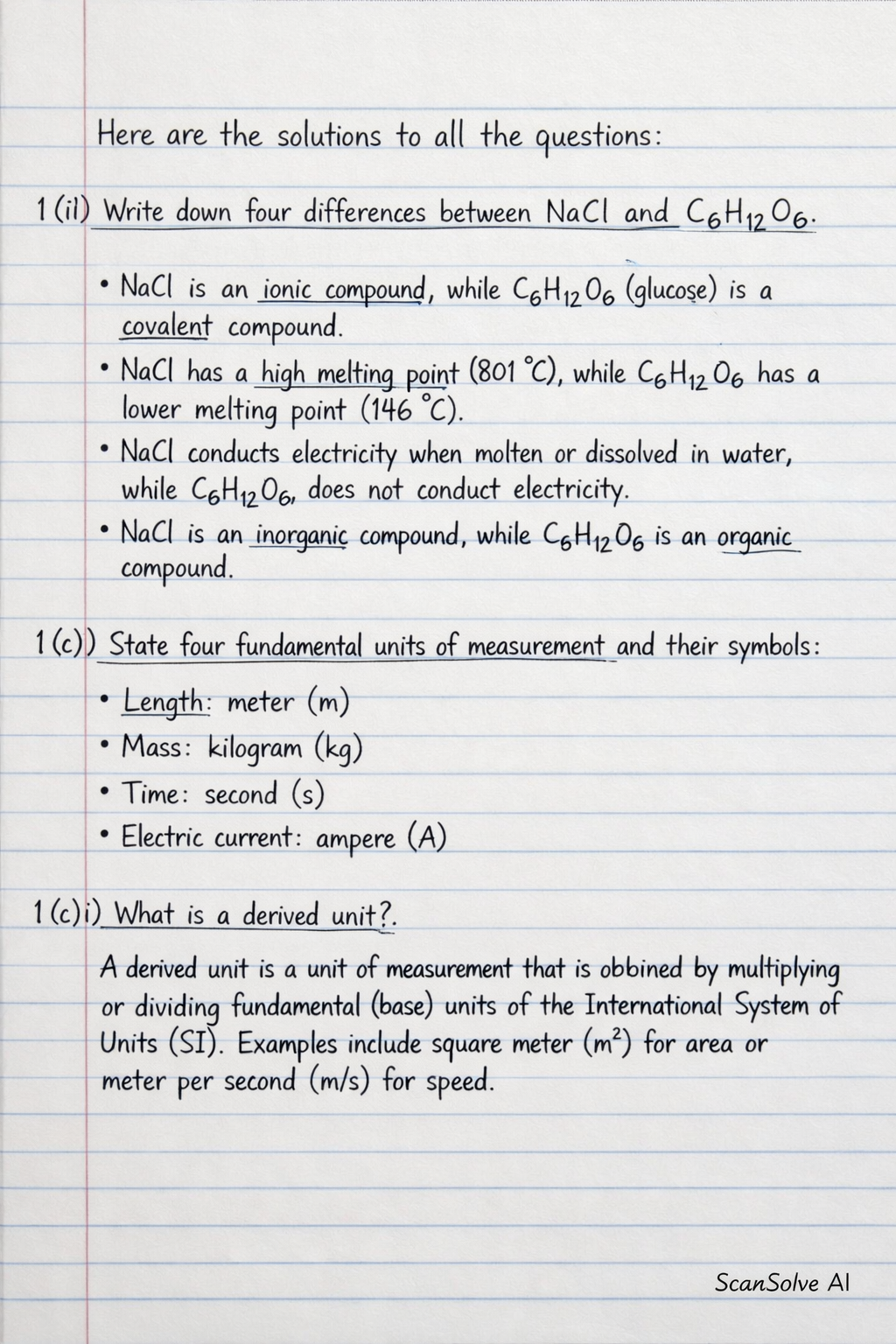
1 (ii) Write down four differences between NaCl and CHO.
- NaCl is an ionic compound, while CHO (glucose) is a covalent compound.
- NaCl has a high melting point (801 °C), while CHO has a lower melting point (146 °C).
- NaCl conducts electricity when molten or dissolved in water, while CHO does not conduct electricity.
- NaCl is an inorganic compound, while CHO is an organic compound.
1 (c) (i) State four fundamental units of measurement and their symbols.
- Length: meter (m)
- Mass: kilogram (kg)
- Time: second (s)
- Electric current: ampere (A)
1 (c) (ii) What is a derived unit?
A derived unit is a unit of measurement that is obtained by multiplying or dividing fundamental (base) units of the International System of Units (SI). Examples include square meter (m) for area or meter per second (m/s) for speed.
1 (d) (i) List two examples of worms that infest cattle.
- Tapeworms
- Roundworms (e.g., Ascaris, hookworms)
1 (d) (ii) State two precautions that could be taken to reduce worm infestation in cattle.
- Regularly deworming cattle with appropriate anthelmintics.
- Practicing rotational grazing to break the life cycle of worms and reduce pasture contamination.
1 (d) (iii) State four ways in which these worms can harm their host.
- They compete for nutrients with the host, leading to malnutrition.
- They can cause damage to host tissues and organs, such as the intestines or liver.
- Some worms cause blood loss, leading to anemia.
- They can reduce growth rates and overall productivity (e.g., milk yield) in cattle.
2 (a) (i) State four ways in which excessive alcohol consumption is harmful to humans.
- Causes liver damage, such as fatty liver, alcoholic hepatitis, and cirrhosis.
- Leads to brain damage and cognitive impairment.
- Increases the risk of developing certain cancers, including those of the mouth, throat, esophagus, and liver.
- Can result in addiction and dependence, leading to social and psychological problems.
2 (a) (ii) List two effects of cigarette smoke on humans.
- Causes lung cancer and other respiratory diseases like emphysema and chronic bronchitis.
- Increases the risk of heart disease, stroke, and other cardiovascular problems.
2 (b) (i) Give the functional groups present in
- (α) Alcohol: Hydroxyl group (-OH)
- (β) Ethylene: Carbon-carbon double bond (C=C)
- (γ) Carboxylic acid: Carboxyl group (-COOH)
- (δ) Esters: Ester group (-COO-)
2 (b) (ii) Write down four differences between neutralization and esterification.
- Reactants: Neutralization involves an acid and a base, while esterification involves a carboxylic acid and an alcohol.
- Products: Neutralization produces a salt and water, while esterification produces an ester and water.
- Reaction type: Neutralization is typically an ionic reaction, while esterification is a covalent reaction.
- Catalyst: Neutralization usually does not require a catalyst, while esterification typically requires an acid catalyst (e.g., concentrated HSO).
2 (c) Define the following terms as applied to a simple machine, stating the effect of friction on each of them
- (i) Mechanical advantage: The ratio of the load (resistance force) to the effort (applied force). Friction reduces the mechanical advantage of a machine because more effort is needed to overcome friction.
- (ii) Velocity ratio: The ratio of the distance moved by the effort to the distance moved by the load. Friction does not affect the velocity ratio, as it is a theoretical value determined by the machine's design.
- (iii) Efficiency: The ratio of the useful work output to the total work input, often expressed as a percentage. Friction reduces the efficiency of a machine because some of the input energy is converted into heat due to friction, thus reducing the useful work output.
2 (d) (i) Name two tools used in the preparation of a nursery bed.
- Spade
- Rake
2 (d) (ii) State four factors you would consider in selecting a site for a nursery.
- Soil type and fertility: Needs well-drained, fertile soil.
- Water availability: Easy access to a reliable water source for irrigation.
- Sunlight exposure: Adequate sunlight for seedling growth.
- Protection: Shelter from strong winds, excessive rain, and pests.
2 (d) (iii) Mention two reasons for nursing seeds at the nursery.
- It allows for better control over environmental conditions (e.g., watering, pest control) during the critical early stages of plant growth.
- It helps to protect young seedlings from harsh weather conditions, pests, and diseases, leading to higher survival rates.
3 (a) (i) State four beneficial effects of microorganisms to humans.
- Food production: Used in making bread, cheese, yogurt, and fermented foods.
- Digestion: Gut bacteria aid in the digestion of food and synthesis of vitamins.
- Decomposition: Break down organic waste and dead organisms, recycling nutrients in the environment.
- Medicine production: Used to produce antibiotics and vaccines.
3 (a) (ii) State two reasons why organisms communicate with one another.
- To attract mates for reproduction.
- To warn others of danger or predators.
3 (b) (i) (α) What is a hydrocarbon?
A hydrocarbon is an organic compound that consists entirely of hydrogen and carbon atoms.
3 (b) (i) (β) Name three sources of hydrocarbons?
- Crude oil
- Natural gas
- Coal
3 (b) (ii) Determine how much water should be added to 30cm of 0.2 mol/dm NaCl solution to obtain 0.02 mol/dm.
Identify the given values for initial concentration (), initial volume (), and desired final concentration ().
Use the dilution formula to find the final volume () of the solution.
Solve for .
Calculate the amount of water that needs to be added by subtracting the initial volume from the final volume.
Still stuck on this one?
Ask a follow-up, and the answer starts from this question.
More Chemistry Questions
Handwritten Step-by-Step Solution
Get this as a handwritten image on WhatsApp — like a tutor wrote it for you.
Try on WhatsApp